
The Customer Experience Picture
Learning Perspective: Exam-Pressed Students
Why This Group Uses Flashka AI
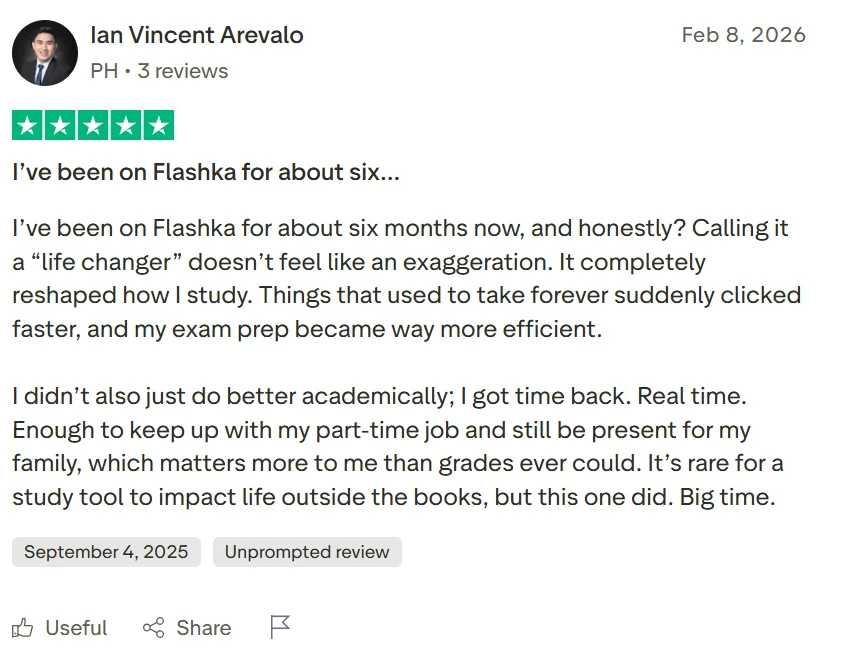
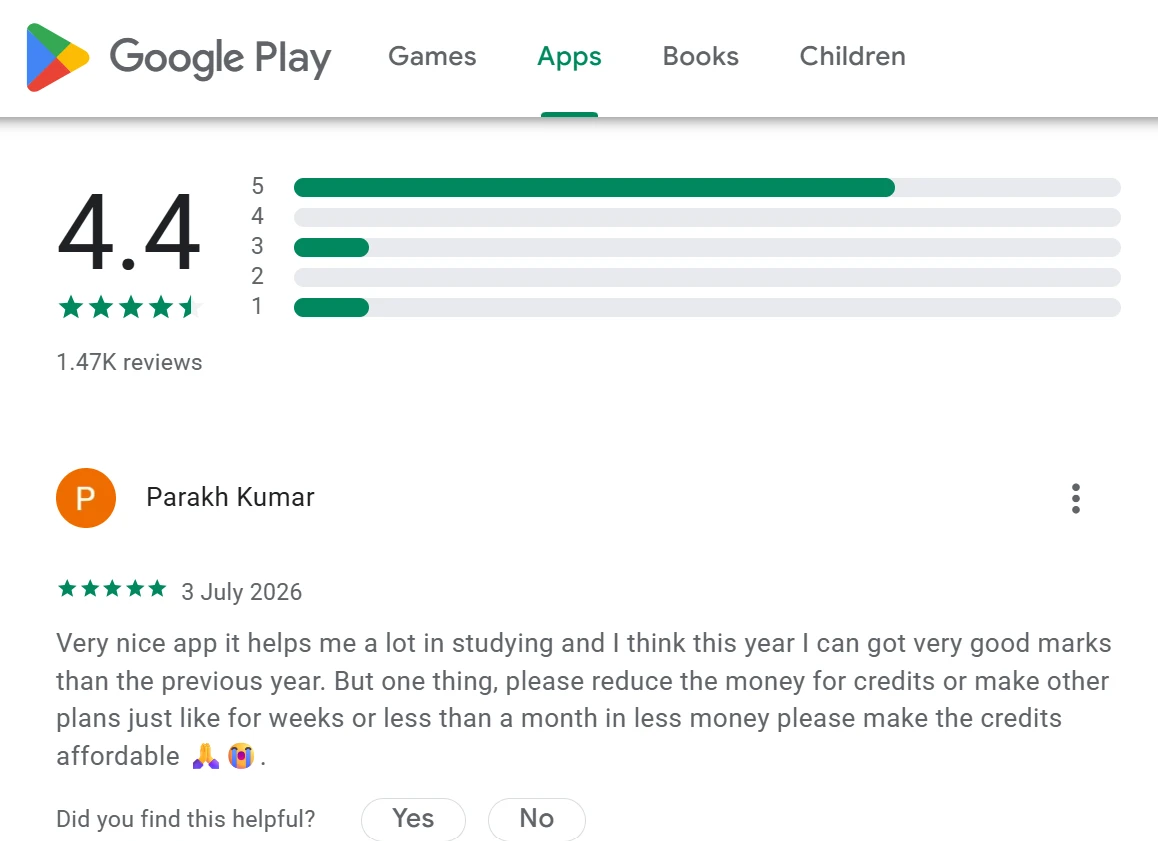
This group appears across Trustpilot, Google Play, and Reddit. Their main goal is not to explore every feature. They want to convert notes into revision material quickly, test themselves, and feel more prepared before an exam. Trustpilot reviews repeatedly connect Flashka with saved study time, faster exam preparation, spaced repetition, quizzes, and the ability to study in short windows. Google Play reviews show similar grade-focused language, including students saying the app helped them study and asking for cheaper credit options. Reddit adds the sharper exam-week version of this pattern, where learners mention same-day exam pressure, credit use, and quiz recovery problems.
What I Notice In These Discussions
In these screenshots, I can see students talking about Flashka in the language of exam pressure rather than software features. One review focuses on getting time back, another describes moving from manual flashcard creation to actual memorization, and the Google Play comment brings money and credits into the same study context. The Reddit comment has a different tone because the user is dealing with quiz progress and lost credits. Read together, the visible comments show how exam-focused learners judge the app during real pressure moments, when speed, saved time, and not wasting credits all become part of the same experience.
Connecting This With My Testing
This matches the Reviewner testing theme around whether Flashka can support a complete study session from source material to recall practice. In my hands-on testing, the strongest fit was also the fast conversion of notes into study material. The community evidence supports that strength, but it also questions the reliability and credit experience when learners are close to an exam. This group should care because small workflow failures feel larger when the study session is time-sensitive.
Learning Perspective: High-School and Grade-Focused Learners
Why This Group Uses Flashka AI
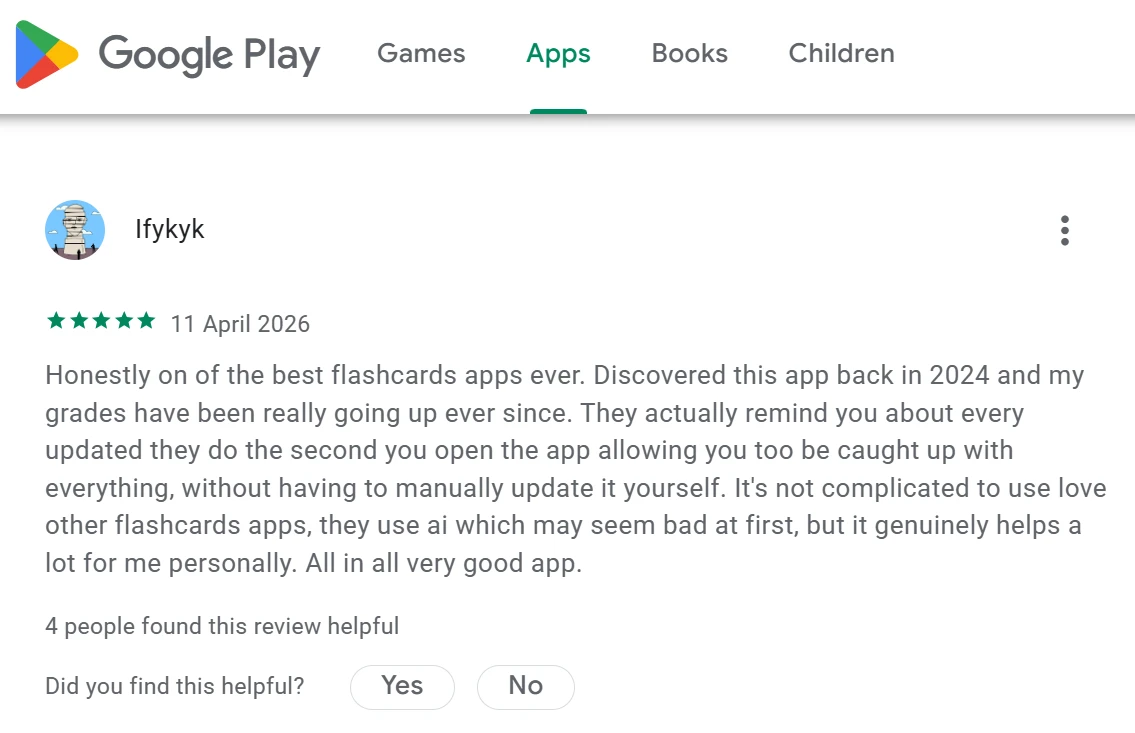
High-school and grade-focused learners appear most clearly on Google Play and Reddit. Their language is simpler and more outcome-focused than the medical or language-learning discussions. They talk about grades, studying more easily, keeping the app affordable, and not wanting useful features locked too aggressively behind payment. One Google Play reviewer says their grades have been improving since discovering the app, while another asks for cheaper credit plans. On Reddit, a high-school user directly asks the team to keep Flashka free or ad-supported because they rely on it for studying.
What I Notice In These Discussions
What stands out in these screenshots is how direct the language is. The Google Play reviews do not read like technical product feedback. They are about marks, studying, AI helping, and whether the price structure fits a student budget. The Reddit post is even more personal because the learner is asking the platform not to become unreachable behind a paywall. I would not treat these as detailed feature evaluations. They show how younger or school-focused learners often measure Flashka by access, simplicity, and whether it helps them feel more ready for class or exams.
Connecting This With My Testing
This supports the Reviewner scorecard area around ease of use and study usefulness, especially for learners who want quick flashcards without building everything manually. My testing also showed that Flashka works best when the learner brings clear notes or PDFs and wants structured recall material. At the same time, this group questions the value side of the scorecard because credits and pricing appear repeatedly in student comments. For school learners, affordability is not separate from usability. It decides how often they can actually study.
Learning Perspective: Language and Multilingual Learners
Why This Group Uses Flashka AI
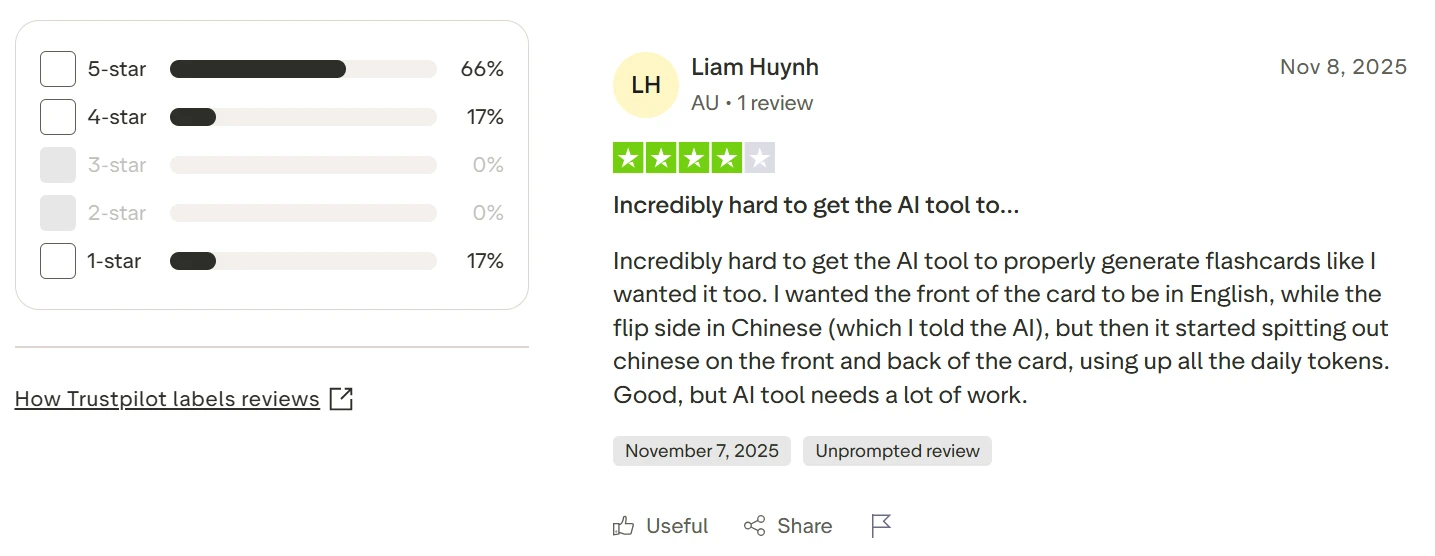
Language learners appear on Trustpilot, Reddit, App Store reviews, and broader study discussions. Their goal is different from that of exam-only learners because card structure matters more. A Trustpilot reviewer tried to make English-front and Chinese-back cards but said the AI mixed up the language layout and used daily tokens. A Reddit user uploaded translation notes and said Flashka focused on the content instead of recognizing the intended translation exercise. App Store feedback also mentions an unwanted Spanish output and asks for smoother interface control. In r/GetStudying, language learning is described as a natural flashcard use case because small facts and translations fit the format well.
What I Notice In These Discussions
These screenshots show learners paying attention to the direction of the card, not only the amount of content generated. I can see one user trying to control which language appears on the front and back, while another wants Flashka to recognize that the exercise should be a translation drill. The App Store comment adds a visible example of unwanted language output during card generation. I would read these screenshots slowly with the audience because they show a very specific learning need. For language learners, a small formatting mistake can change the whole exercise.
Connecting This With My Testing
This questions the Reviewner scorecard area around AI generation accuracy and customization. In my testing, Flashka was strongest when the source material had a clear structure and the expected card format was straightforward. Language learners often need stricter control over front/back logic, translation direction, and answer format. That matters because a bilingual deck is not just another deck. If the AI reverses or mixes languages, the learner spends credits and time fixing the study material before they can begin memorizing.
Learning Perspective: Mobile and On-the-Go Learners
Why This Group Uses Flashka AI
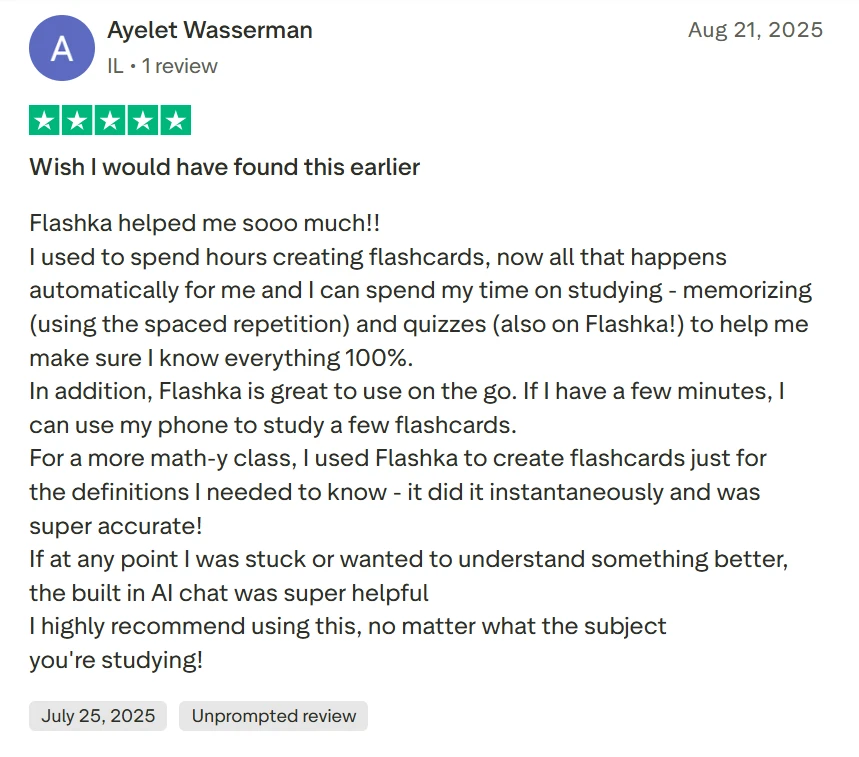
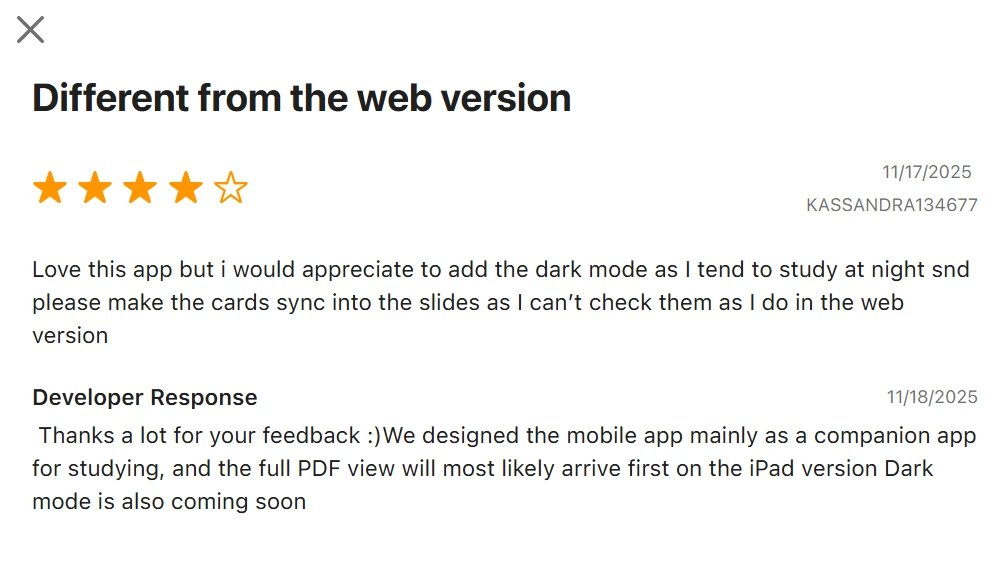
Mobile learners appear on Trustpilot, Google Play, App Store, and Reddit. They use Flashka in short study pockets, across devices, or as a companion to the web version. One Trustpilot reviewer says they use the phone to study a few flashcards when they have a few minutes. Google Play includes a request to bring study groups to the phone. App Store reviews mention web decks not appearing in the app, dark mode for night study, and wanting cards to sync with slides as they do on web. Reddit discussions also show Android availability, sync, deleted decks, loading issues, and Flashka’s own updates around a new sync engine.
What I Notice In These Discussions
The mobile screenshots show two different versions of the same expectation. On one side, I can see a learner using spare minutes on the phone to review flashcards. On the other side, I can see users asking why the app does not behave exactly like the web version. The App Store comments are especially useful because they name concrete mobile study moments: night studying, deck visibility, and checking cards against slides. The Google Play comment adds study groups to the same pattern. These screenshots make the mobile experience feel like a workflow issue, not just an app issue.
Connecting This With My Testing
This supports the Reviewner claim that Flashka can continue beyond desktop study, but it also questions reliability and feature parity. My hands-on testing showed that mobile review is valuable after the deck is already built, especially for quick recall sessions. The community evidence adds an important condition: mobile learners need sync, study groups, source access, and app stability to feel consistent. This group should care because Flashka’s promise is not only card creation. It is whether the study session can continue when the learner leaves the main browser workspace.
One Study Tool, Different Learning Experiences
The most satisfied learners seemed to be those whose main problem was time. Exam-pressed students, grade-focused learners, and people trying to move quickly from notes to memorization often described Flashka in practical terms: it helped them create cards faster, review more often, and use quizzes or AI explanations without building everything manually. Their praise was not abstract. It usually came from a real study bottleneck, such as preparing for exams, saving time, or studying from a phone between other responsibilities.
The concerns that appeared across groups were different from normal app-store complaints. Credits mattered because they affected how much a learner could experiment. Reliability mattered because lost quizzes, sync problems, or loading issues could interrupt revision. AI control mattered because students did not always want “more cards”; they wanted the right kind of cards. That was especially visible among language learners, healthcare students, and users asking for better quiz customization.
The biggest difference was not between positive and negative users. It was between study goals. Flashka looked strongest for learners dealing with memory-heavy material, repeated review, and exam preparation. It looked more complicated for learners who needed bilingual precision, medical-level detail, audio support, diagram clarity, or application-heavy practice. Reddit’s broader study discussion also reminds me that flashcards are not equally suited to every subject or every learner, even when the technology is good.
Researching these perspectives helped me understand Flashka AI beyond my own hands-on testing. I did not come away with one single reputation story. I saw a tool that different learners judge through different pressures: speed, price, card accuracy, study depth, mobile continuity, and trust in AI output. That makes the reputation picture more useful than a star average because it shows where Flashka fits into real study behavior and where learners still expect more control.