
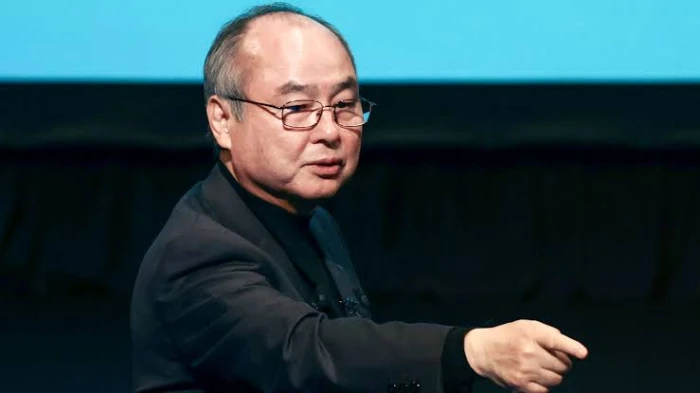
The SoftBank founder used his company's annual conference to mock AI doubters and forecast $5 trillion in yearly spending by 2040. The debt he has taken on to back that conviction is what turns the speech into a wager.
Masayoshi Son has heard the warnings about an AI bubble, and on Tuesday he told a room of executives in Tokyo what he thinks of them. "To ask whether AI is a bubble is a foolish question," the SoftBank Group founder said at the company's annual corporate conference. "AI will transform our lives completely, and do so in a way that generates profits."
He kept going. "Those who refuse to evolve are closing down their world. Those who condemn AI are themselves spitting upward," he said, likening the skeptics to people who once doubted cars and airplanes.
Then came the number. Son estimated that expanding AI worldwide will require close to $5 trillion in investment every year by 2040, spread across data centers and chip factories, plus the power plants needed to run them.
"Every year $5 trillion, or 800 trillion yen, you might think that's a lie, but I am confident that's what it will cost," he said.
The figure lands in the middle of a debate that has unsettled markets for months, and Son delivered it as a rebuke to everyone on the cautious side of that argument.
The math he did not show
Son's forecast leans on a second figure he offered without a formula. By 2040, he said, AI-related industries will make up roughly 20% of global GDP, an economy he calls the world of superintelligence. Set against a number that large, he argued, $5 trillion a year looks trivial. "The business model will be viable because by 2040, if AI revenue makes up 20% of global GDP, spending 800 trillion yen a year is a rounding error," he said.
Reuters, reporting from the event, pointed out that Son never explained how he reached either the $5 trillion price tag or the share of GDP.
The rest of the vision ran further into the future. Son predicted that AI data centers will pull 3 terawatts of power by 2040, close to double what the entire world consumes now. Gas would carry the early load before nuclear fusion took over as the primary source, he said, waving off Elon Musk's pitch for solar power gathered in space. He described a 2040 populated by 100 trillion AI agents that make their own decisions and communicate with one another, closing out what he called the age of humans as the highest life form on earth.
This is the register Son has settled into lately. In June he called bubble talk "blasphemy against AI" and put the present moment at 10 to 50 times the scale of the dot-com boom.
Where the money actually went
The speeches would be easier to wave away if Son had not already spent to match them.
SoftBank's central wager is OpenAI, where its committed investment now runs past $60 billion, more than any other backer has put in. That position, above 10%, makes SoftBank the largest outside shareholder in the ChatGPT maker after Microsoft. To free the cash for it, Son sold SoftBank's entire Nvidia stake, worth about $5.8 billion, along with a large piece of its T-Mobile holding.
He has bought into the physical layer of AI as well. SoftBank anchors Stargate, the $500 billion data-center project unveiled at the White House alongside OpenAI and Oracle, and it acquired data-center operator DigitalBridge for around $4 billion. In Japan, it started a battery business aimed squarely at the power infrastructure that AI demand is expected to strain.
For a stretch, the bet has looked shrewd. SoftBank's profit for the fiscal year through March jumped nearly fivefold to 5 trillion yen, about $32 billion, as the value of its AI holdings climbed.
The case the doubters keep making
The worries Son dismisses have a paper trail of their own.
SoftBank shares fell about 45% from their October 2025 highs into the spring, and Jefferies cut the stock to underperform, branding it a valuation trap for leaning so heavily on one private company. The group's loan-to-value ratio has pushed against its self-imposed 25% ceiling, and analysts have flagged a refinancing wall near $50 billion by the end of 2026. To keep the OpenAI commitment funded, SoftBank issued $3.6 billion in junk bonds this year at an 8.5% coupon, the steepest rate it has ever paid on a dollar bond, then arranged a $40 billion bridge loan on top of that.
Some of the sharpest skepticism came from inside the building. Bloomberg reported that SoftBank insiders were rattled by the size of the OpenAI check, describing a chief who had grown star-struck and warning that the deal could blow up on him.
The target of all that money carries its own questions. OpenAI is burning through cash and is not expected to reach profitability until around 2030, yet it has been valued near $850 billion, a forward-revenue multiple that dwarfs the ones markets assign to established public giants. Critics reach for a comparison closer than cars and planes: WeWork, the SoftBank-backed startup whose 2019 implosion is still the ugliest mark on Son's record.
Son has a rehearsed answer for the crash scenario, and it doubles as a tell. Electronics and automobiles crashed in 1929, he said in June, then climbed for a century. A correction, in his telling, would be the best buying opportunity available rather than a reason to stop.
The IPO that settles the argument
Most of this resolves on a single event. Analysts increasingly treat OpenAI's planned public offering, which could arrive as soon as this year, as the moment that decides whether Son's campaign ends up looking like Alibaba, his legendary early score, or something far more expensive. A strong debut would vindicate the borrowing and the concentrated stake. A weak one, or a delay, would leave SoftBank sitting on an illiquid position financed with debt that was priced for exactly this kind of risk.
Son has removed his own exit from the equation. He scrapped earlier talk of retiring in his sixties and said he plans to run SoftBank for another 10 to 15 years to see the AI build-out through, a commitment he made at age 68.
That leaves the $5 trillion figure doing two jobs at once. It is a forecast about the shape of the world in 2040, and it is a measure of how much conviction one man has staked on being proved right before the bill for the borrowing comes due.

Comments 0
Join the discussion and share your perspective.
Sign in to post a comment and reply to other readers.
No comments yet
Be the first to share your perspective on this article.