
You have signed up for plenty of AI tools. Here is what separates the handful you still open from the dozens you forgot about.
You know the pattern, because you have lived it. A new AI tool shows up, the demo looks incredible, and you sign up within minutes. For a few days you cannot stop using it. Then, quietly, it slips out of your routine. Three weeks later the tab is closed and the subscription is one you keep meaning to cancel.
Meanwhile there is a small set of tools you never stopped using. You would notice immediately if they disappeared. That gap, between the tool you try and the tool you keep, is the most important thing to understand about AI products right now, whether you are choosing what to pay for or building something you want people to stay with.
The data backs up what you feel. AI apps are excellent at getting you in the door and unusually bad at keeping you. RevenueCat's 2026 State of Subscription Apps report, drawn from tens of thousands of apps, found that AI apps earn about 41% more revenue per user than non-AI apps, yet they lose paying users roughly 30% faster. The selling is easy. The keeping is hard.
The difference in one line A tool you try wins a moment of attention. A tool you keep earns a place in your routine. The first depends on novelty. The second depends on becoming a habit you would miss. |
First, See the Gap Clearly
If it feels like AI tools do not stick, that is not just you. Look at how many paying users are left after a month and after a year, AI versus everything else.
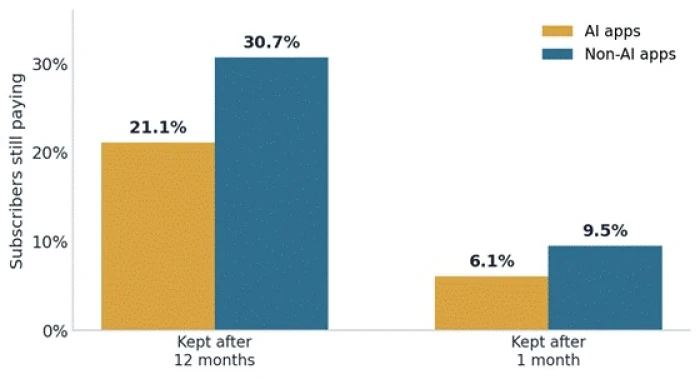
Share of paying subscribers still active over time, AI apps versus non-AI apps. Source: RevenueCat, State of Subscription Apps 2026.
Two numbers are worth sitting with. After twelve months, only about 21% of AI app subscribers are still paying, against roughly 31% for non-AI apps. And AI apps lose close to four out of five annual subscribers before the year is out. People pay eagerly, use briefly, and leave.
It is tempting to blame short attention spans, but the real story shows up earlier than you would think. Most tools do not lose you on day thirty. They lose you in the very first session, before you ever felt the tool do something useful for you.
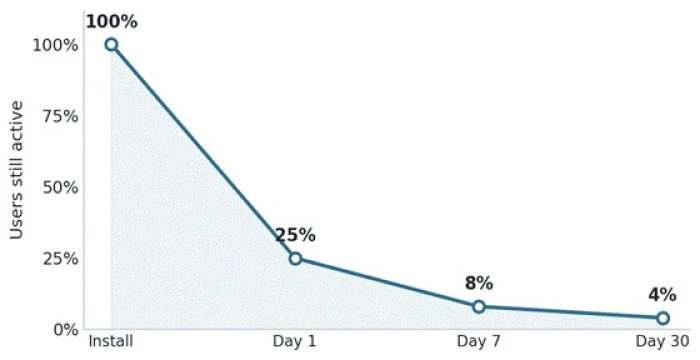
A typical app keeps a small fraction of the people who install it. Source: UXCam and Panto AI mobile retention benchmarks, 2026.
Across app categories, a median product holds about 25% of users after one day, 8% after a week, and 4% after a month. Generative AI apps tend to sit at the lower end of that range. The steep early drop is the whole game. If a tool does not prove itself fast, you are gone before habit ever had a chance to form.
Trying Is a Moment. Keeping Is a Habit.
Here is a useful way to think about your own behavior. Every tool you adopt passes through three gates, and most die at one of them.
Setup. You create an account and get it working. Easy, and no indication yet that you will stay.
Aha. The moment the tool does something genuinely useful for you, not just something impressive in the abstract. This is when you go from curious to convinced.
Habit. You come back without being reminded, because a recurring need pulls you in. Only here are you actually keeping the tool.
The trap is mistaking Setup for success. A slick onboarding and a wow-worthy first output feel like victory, but you have only reached Aha. Plenty of tools give you a brilliant single moment and never become part of your week. Product teams see this constantly: activation looks fine, retention looks terrible, because the habit gate is where people fall away.
Watch your own pattern Think about the last AI tool you dropped. You almost certainly reached Aha with it, that first impressive result is why you remember it at all. What it never gave you was a reason to come back on an ordinary Tuesday. No recurring need, no trigger, no habit. That is the difference, in your own recent history. |
The Real Difference, Side by Side
Strip away the marketing and the two kinds of tools behave differently at every stage. This is the heart of it.
| What you notice | A tool you try | A tool you keep |
| First impression | A striking demo or a viral clip | A task from your real work, handled well |
| What hooks you | Novelty and curiosity | A result you needed anyway |
| Its role in your day | A detour you make time for | A step already inside your workflow |
| When it gets something wrong | You lose trust and drift away | You catch it, because you know its limits |
| Once the novelty fades | Nothing pulls you back | A recurring need pulls you back |
| If it vanished tomorrow | You would barely notice | You would feel the gap immediately |
The pattern that separates a tool you tried from one you kept.
Notice that none of the differences are about how clever the model is. The tools you keep are rarely the ones with the flashiest technology. They are the ones that quietly fit your life. The five sections below unpack what that fit is actually made of, with something you can act on in each.
What Tools People Keep Have in Common
Five things separate the keepers from the rest. Here they are at a glance, then one by one.
| The driver | What it means | How to check for it |
| Fits your workflow | Lives where you already work | Does it save you a copy-paste, or add one? |
| Fast time to value | Useful within the first sitting | Did you get a real result in under 15 minutes? |
| Output you can trust | Reliable enough to not re-check everything | Do you still verify every single output? |
| Serves a recurring need | Tied to something you do often | Is there a natural weekly trigger to return? |
| Worth the switching cost | Holds your context and history | Would leaving mean losing real work? |
The five traits of a tool that sticks, and a quick test for each.
1. It fits into the work you already do
The single biggest predictor of whether you keep a tool is whether it lives inside your existing workflow or sits off to the side. A tool you have to remember to visit is a tool you will forget. A tool that shows up where you already work becomes invisible in the best way.
The effect is not subtle. In a 2026 enterprise study, AI productivity tools that plugged into things people already used, like their calendar and task automation, held about 7.6% of users at day thirty, against a category average near 4.1%. Roughly double the staying power, from fit alone.
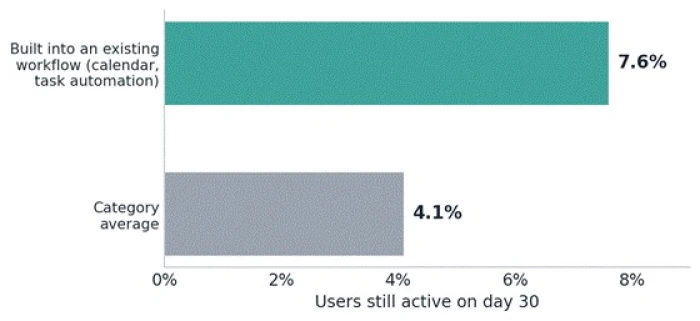
Day 30 retention roughly doubles when an AI tool is built into an existing workflow. Source: Forrester Enterprise Mobility Survey, 2026.
What to do with this: before you commit to a tool, ask whether using it removes a step from your day or adds one. If it makes you leave your normal flow, copy something out, and paste something back, the friction will win eventually. If it meets you where you already are, it has a real chance of sticking.
2. It gets you to a real result fast
You decide whether a tool is worth your time in the first sitting, often in the first few minutes. The tools you keep prove their value before your patience runs out. The ones you drop ask you to configure, learn, and wait before anything useful happens, and by then you are gone.
A common benchmark is that time to first real value should land under fifteen minutes, and that most churn happens in the first week for exactly this reason. It is why personalized onboarding matters so much: when a tool tailors those first minutes to what you actually came for, people reach that first useful result far faster and stay in noticeably higher numbers.
What to do with this: judge a tool by your first genuinely useful output, not by the demo. If you cannot get one real, usable result in a single sitting, that is a strong signal it will not survive in your routine, no matter how good the marketing looked.
3. You can trust what it gives you
Trust is where a lot of AI tools quietly lose you. The first time a tool hands you a confident answer that turns out to be wrong, something shifts. You start double-checking everything, and a tool you have to fully re-verify is often slower than doing the work yourself.
The trust gap is wide and well documented. In one 2026 study, a large majority of people used generative AI for real work while only around four in ten said they trusted the output, and a striking share admitted they had shipped a wrong number they got from it. Use is high, trust is low, and that combination is fragile. Tools that keep users tend to be the ones that are honest about their limits, show their sources, and make the trustworthy path the fast one.
What to do with this: notice how much you still verify a tool's output after a few weeks. If you have relaxed into trusting it for a defined kind of task, it is earning its keep. If you still check every line, the tool has not actually saved you the work, and that is usually a tool on its way out.
4. It serves a need that keeps coming back
Novelty is a one-time hit. A tool that impresses you once but connects to nothing you do regularly has no reason to pull you back. The keepers are attached to a recurring need, a thing you do every week whether you feel like it or not, so there is always a natural trigger to return.
This is exactly why so many AI tools crater between months three and six. The novelty premium wears off, and if there is no repeating need underneath it, the tool has nothing left to stand on. Analysts describe the durable tools as having a workflow moat: value that comes from being woven into a repeated process, not from a clever one-off feature that any competitor can copy.
What to do with this: ask what recurring moment would bring you back to the tool. If you can name a real one, like every Monday when you plan the week, it can become a habit. If the honest answer is whenever I remember it exists, you already know how that ends.
5. Leaving it would cost you something
The tools you keep tend to accumulate something you would lose by leaving: your history, your saved context, your preferences, the way it has learned how you work. That is not a trick to trap you. When a tool holds real context about your work, it gets more useful the longer you use it, and starting over elsewhere means starting from zero.
Model loyalty on its own is fragile. People switch between AI models over price, speed, and reliability all the time, and moving between them has never been easier. What actually holds people is not the raw model, it is everything built up around it: the workflow, the saved work, the context the tool carries. That accumulated fit is the real reason a tool becomes hard to give up.
What to do with this: a healthy switching cost is one where staying is genuinely easier because the tool remembers your work. Be wary of the other kind, where leaving is hard only because your data is locked in and hard to export. The first is a tool earning loyalty. The second is a tool holding you hostage.
A Quick Self-Test Before You Commit
Next time a tool wows you, run it past this before you rearrange your work around it or start paying. The green flags suggest a keeper. The red flags suggest a fun weekend that ends in a cancelled subscription.
| Green flags (likely a keeper) | Red flags (likely a try) |
| It slots into a tool you already use | It lives in yet another separate tab |
| You got a real result in your first sitting | You are still configuring it on day three |
| You have stopped re-checking one kind of task | You verify everything it produces |
| A weekly need naturally pulls you back | You only open it when you remember it exists |
| It remembers your context and gets better | Every session starts from scratch |
| The wow came from your own real work | The wow came from a demo or a viral clip |
Score a new tool honestly. More green than red is a good sign it will last.
If You Are Building One, Not Just Choosing One
If you make AI tools, the same differences flip into a to-do list. The market is crowded, with well over ten thousand new subscription apps launching in a single month in early 2026, so a great demo no longer buys you anything. Being kept does. Here is where to spend your effort.
| Instead of | Do this |
| Chasing a viral first impression | Get people to one real, useful result inside the first session |
| Adding another standalone app | Meet users inside the tools and workflows they already live in |
| Hiding the model's limits | Show sources and confidence so trust survives the first mistake |
| Betting on novelty | Anchor the product to a need that recurs every week |
| Locking users in with data hostage tactics | Earn loyalty by holding their context and getting better over time |
The build-side version of the same five differences.
The Takeaway
The tools you keep are almost never the ones with the most impressive technology. They are the ones that got useful fast, fit into work you were already doing, earned your trust, tied themselves to something you do every week, and quietly became hard to give up.
So the next time a shiny AI tool pulls you in, enjoy the demo, then ask the only question that predicts whether you will still be using it in a month: is this going to become a habit, or is this just a good afternoon? You already know, from all the tabs you have closed, that the honest answer is usually clear early. Trust it.


Comments 0
Join the discussion and share your perspective.
Sign in to post a comment and reply to other readers.
No comments yet
Be the first to share your perspective on this article.