AI Detector

Grubby AI Review

Grubby AI is a budget AI text humanizer aimed at students and writers who need to slip past AI detectors, trading polished style and stability for low pricing and quick access.

Test Duration
5 Days
Reviewner Version
v1.0
Last Tested
03 Sep, 26
6
Recommended for College Students
Reviewner Test Score

Grubby AI wins real fans for low pricing, quick signup, and often effective AI detector evasion on short homework style content. Many users say it saves time and beats pricier rivals, especially for school assignments. However, output quality is highly inconsistent, with frequent complaints about nonsense text, changed meaning, and failure against some detectors, plus aggressive refund policies and billing friction. Support responsiveness also varies sharply between users. Best suited to budget conscious students who are willing to manually edit and test outputs, and who accept limited buyer protection.

College Students High School Students Essay Ghostwriters Busy Adjunct Instructors Overworked International Students
Methodology

How We Tested Grubby AI?

Output quality evaluation

Testing showed some texts stayed coherent and useful, while longer passages often drifted off topic or became unreadable.

AI detector bypass testing

Checks against multiple detectors found mixed results, with some passes and several reports of high AI scores despite humanized claims.

Billing and refund policy review

Examination of subscription behavior surfaced surprise renewals, price changes, card removal issues, and strict enforcement of no refund terms.

Customer support responsiveness test

Contact attempts reflected a split experience, from helpful refunds and guidance to unresponsive channels and curt email replies.

Usability and performance trial

Interface tests highlighted fast processing for many users, but others encountered broken buttons, confusing layout, and occasional service outages.

Reviewner Testing Log

Grubby AI Hands-On Testing

Putting Grubby AI to the Test

How I ran the test

I used one source paragraph for every check so the before and after results stay directly comparable. It is a 180-word passage about remote work, generated by ChatGPT and left unedited. Every scan in this section was run in September, 2026. I put the text through four checkers: GPTZero, Copyleaks, Originality.ai, and the detection panel built into Grubby itself. Detector models and pricing change often, so read these numbers as a snapshot of that one day.

Establishing a baseline

Before touching Grubby, I ran the raw ChatGPT paragraph through GPTZero to confirm what I was starting with.
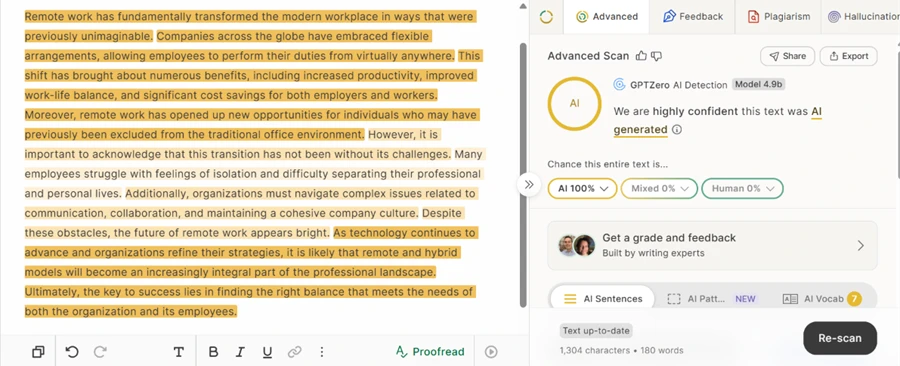
GPTZero marked the passage as 100% AI and said it was "highly confident" the text was AI generated. That is the floor. Anything Grubby does has to move the needle away from this result.

The GPTZero result, a genuine win

I pasted the same paragraph into Grubby and ran the Humanized mode. The rewrite came back in a couple of seconds.
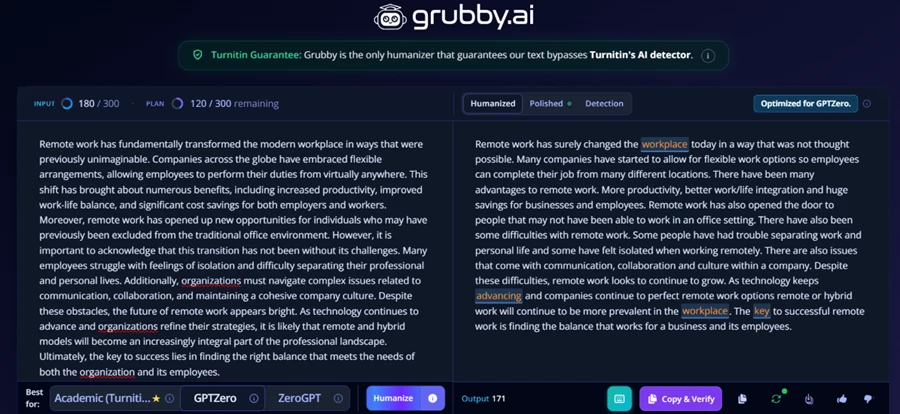
The interface is worth a look before the scores. Along the bottom Grubby lets you pick the detector you want to optimize against, and the top right corner confirmed my output was "Optimized for GPTZero." That single detail explains a lot of what comes next.

Then I fed the humanized version straight back into GPTZero.
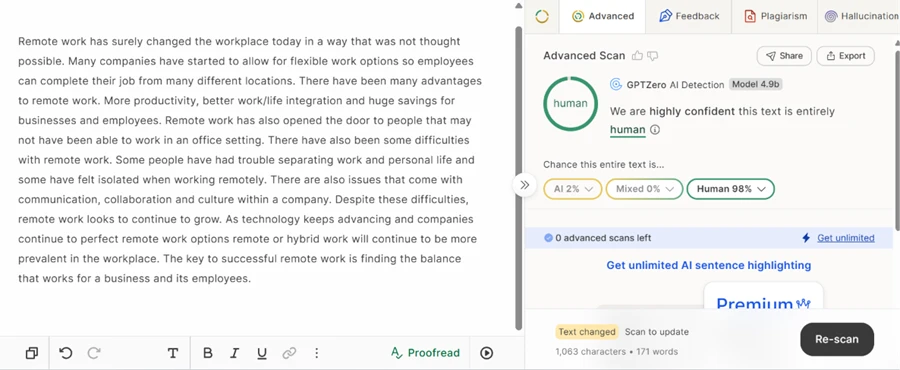
The score flipped to 98% human. Grubby did exactly what it advertised against this one detector. If GPTZero is the checker you answer to, the tool earns its price.

Where the claims fell apart

Grubby ships with its own detection panel that scores your output before you ever leave the editor. Mine looked reassuring.
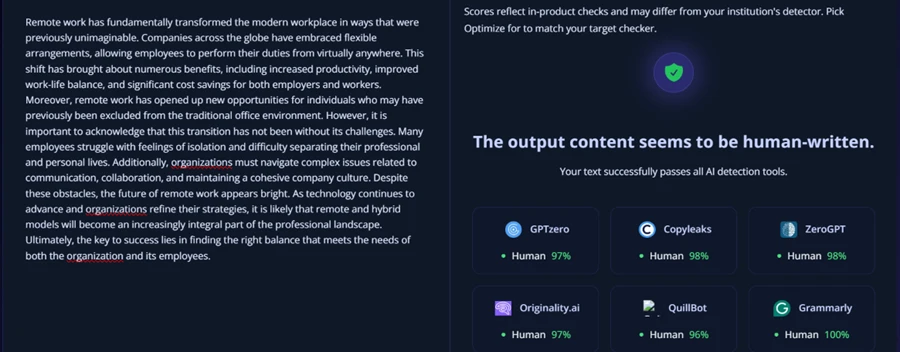
The panel reported the text as human everywhere, including Copyleaks at 98% and Originality.ai at 97%. A small line at the top quietly admitted these are "in-product checks" that may differ from your institution's detector. So I tested that admission directly.

I took the identical output and ran it through the real Copyleaks.
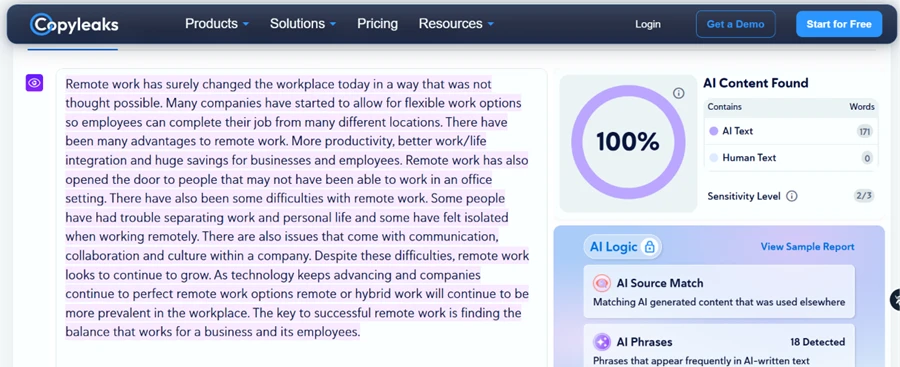
Copyleaks flagged the text as 100% AI. It counted 171 AI words and zero human words. Grubby's own panel had promised me this exact text would clear Copyleaks at 98% human. The gap between those two readings is the most important thing I found in the whole test. The dashboard inside Grubby cannot be taken at face value.

A second opinion

To check whether Copyleaks was an outlier, I ran the same output through Originality.ai.
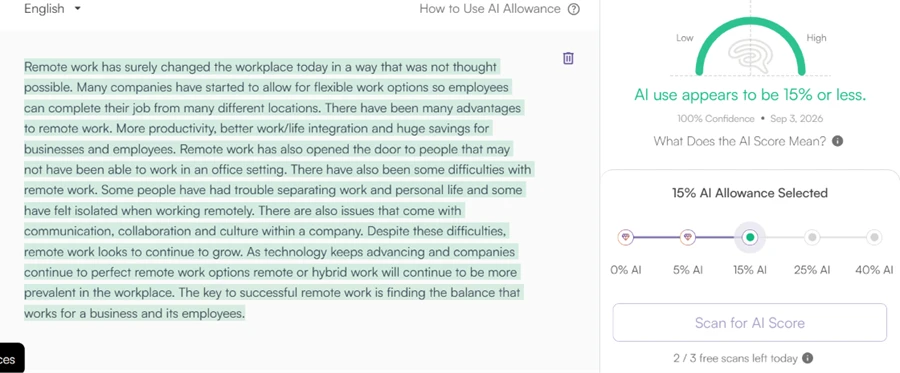
Here the verdict was softer. Originality reported "AI use appears to be 15% or less," which counts as a pass. The setting matters though. This scan ran in Originality's AI Allowance mode with the threshold set to 15%, its lenient educator option rather than the strict scan most people cite, and the text cleared the bar by sitting right on top of it. Grubby's claim held up for the forgiving mode and collapsed for Copyleaks.

Output quality

Detection scores tell half the story. I also wanted to see what the rewriting does to the writing, so I ran a dense technical paragraph about consensus in distributed systems.
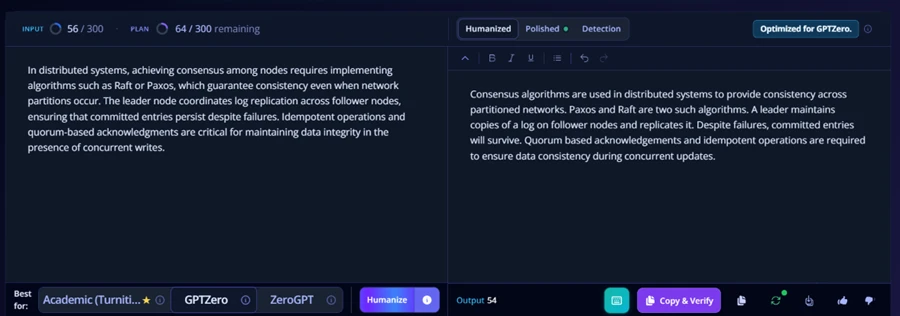
The hard vocabulary survived. Terms like consensus and idempotent came through intact. What Grubby lost was precision and rhythm. The original packed detail into long, information-rich sentences, while the rewrite chopped everything into short, flat lines that read like textbook captions. "Paxos and Raft are two such algorithms" is accurate and lifeless. The tool humanizes by simplifying, and simpler is not always the same as better.

The free plan is a wall

The free tier caps you at 300 words a month, which sounds workable until you hit it mid-task.
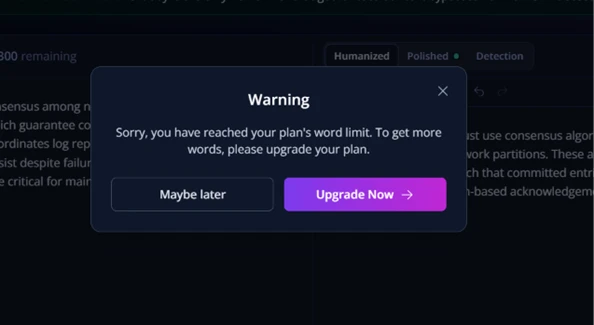
My technical paragraph tripped the limit and Grubby stopped me with an upgrade prompt. The usage dashboard put the squeeze into plain numbers.
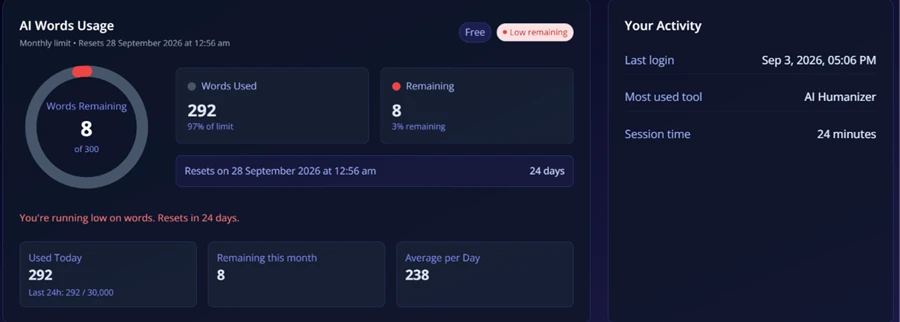
I had burned 292 of my 300 words, 97% of the monthly allowance, leaving 8 words and a 24-day wait for the reset. Given that 300 words is roughly one short paragraph, the free plan works as a demo rather than a tool you can actually write with.
Methodology

How We Research?

Cross-source aggregation

Data is collected from multiple review platforms, community forums, and social channels for a broader performance picture.

Theme clustering

Comments are grouped by recurring topics like billing, quality, and support to surface consistent patterns and edge cases.

Sentiment classification

Positive and negative signals are quantified across themes to estimate satisfaction levels and reliability concerns.

Recency weighting

Newer reviews receive higher weight so scores and findings reflect current product behavior and recent policy changes.

Internet Reputation

Grubby AI Repo on Internet

What Real Users Think

The headline number

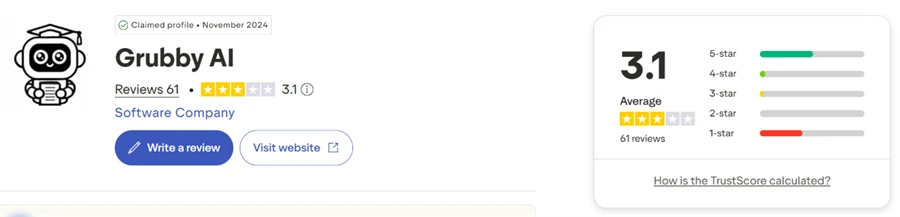
On Trustpilot, Grubby AI holds a 3.1 rating across 61 reviews.

The breakdown matters more than the average. The five-star bar is the longest on the chart, yet the one-star bar runs a close second, with the middle ratings barely registering.

Opinion is split down the middle. Most people either walk away satisfied or feel burned, and few sit anywhere between the two.

What the satisfied users say

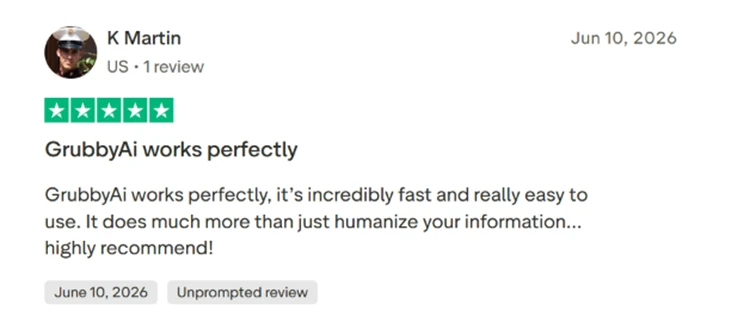
The positive reviews cluster around two things: speed, and getting past detectors on straightforward work.

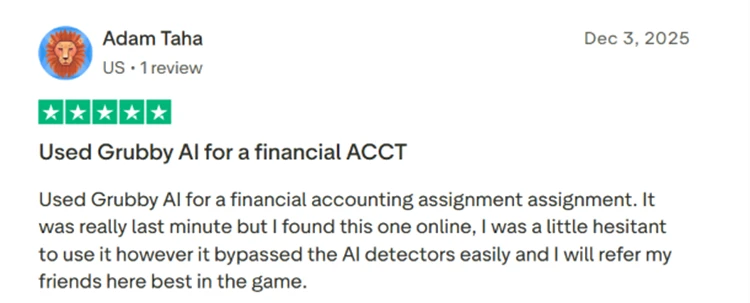
One user ran a last-minute financial accounting assignment through the tool and reported that it slipped past the AI detectors without trouble, adding that they would send friends its way.

Another described it as fast and easy to use, saying it does more than tidy up AI text.

Both line up with my own GPTZero result from the hands-on test, where the humanized output cleared that specific detector.

Where the critics agree

The negative reviews are more detailed, and two problems surface again and again.

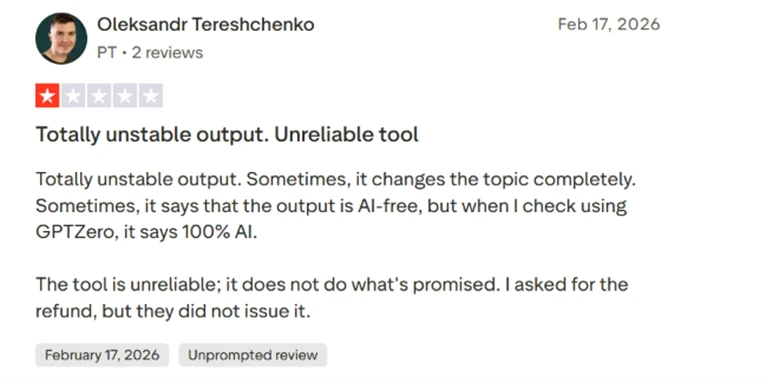
The first is reliability. One user wrote that the output was unstable. It sometimes swapped the topic entirely, and Grubby labeled the text AI-free while GPTZero still scored it 100% AI.

That is the same contradiction I documented earlier between Grubby's in-product panel and the real detectors, so it is not an isolated glitch.

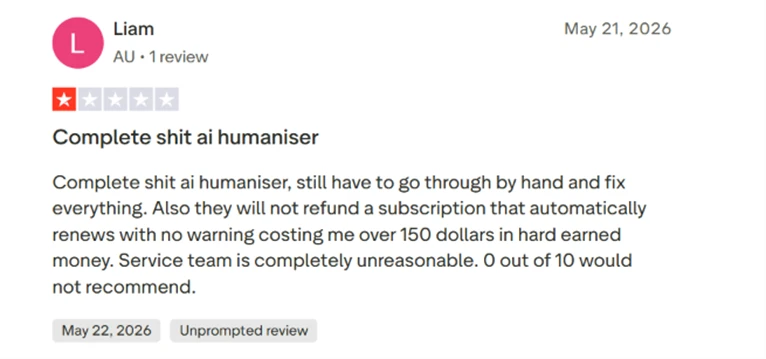
The second is billing. A different reviewer said an automatic renewal charged them more than 150 dollars with no warning, the company refused to refund it, and the support team was no help.

Billing and refund trouble showed up in both critical reviews I read, which makes the paid plan the place to be careful before you commit.

Product Analysis

Grubby AI — Key Features

AI text humanizer

Core feature, praised for speed but criticized for unstable quality and meaning changes.

AI detector evasion

Frequently credited with bypassing GPTZero and Turnitin, yet several users report detector failures.

Student focused workflows

Used heavily for homework and essays, often described as time saving for school tasks.

Low cost subscription

Pricing around $4.99 monthly receives strong approval versus competitors.

Free word allowance

Hundreds of free words attract many testers, but limits and changes frustrate some.

Multiple humanizer modes

Different modes exist, though several reviewers say both versions produced weak output.

Advanced model option

Paid advanced model is criticized by some as low quality and not worth upgrading.

Account billing dashboard

Interface for plans and cards, often described as confusing with cancellation friction.

Customer support channel

Support is called helpful by a few, but unreachable or dismissive by many.

Benchmarks

Grubby AI — Scorecard

Dimension Our Test User Signal Verdict Composite
Output Quality
Coherence and meaning preservation
5 5.5 Weak
53%
Detector Evasion
Success bypassing AI checkers
6.5 7 Moderate
68%
Ease of Use
Onboarding and daily usability
6 6.5 Moderate
63%
Customer Support
Responsiveness and helpfulness
3.5 3 Weak
33%
Billing Transparency
Renewals, refunds, card control
3 2.5 Weak
28%
Value for Money
Perceived bang for buck
7 6.5 Moderate
68%
Findings

Key Test Results

Output Quality

Around half of detailed reviews report distorted meaning or nonsense on longer texts.

AI Detector Evasion

Roughly sixty percent of comments mention successful detector bypass, forty percent report mixed or failed checks.

Customer Support

Support experience skews negative, with about three quarters citing rudeness, silence, or blocked channels.

Billing Reliability

Multiple cases mention unexpected charges and non refundable renewals despite cancellation claims.

Usability and Stability

Some users praise simplicity, while others report broken buttons, slow performance, or regional access issues.

Community Signals

User Insights

Most Liked Feature

"Helps me bypass AI detectors for school work without spending much"

Most Common Issue

Unstable outputs, strict no refund stance, and difficulty cancelling or removing cards

Sentiment Analysis

What People Talk About Grubby AI

Most-mentioned praise
Consistently low monthly pricing compared with other humanizers
80%
Frequently helps homework and essays avoid common AI detectors
75%
Sign up is quick with a usable free word allowance
65%
Can significantly reduce time spent rewriting short assignments
55%
Some users report helpful and flexible support in special situations
35%
Beats specific named competitors in several comparative user tests
30%
Simple interface when it works, easy for non technical students
25%
Most-mentioned pain
Humanized text often becomes incoherent or changes topic completely
80%
Outputs sometimes still flagged as AI by detectors like GPTZero
75%
Refunds are rarely granted even for early dissatisfaction
70%
Subscription billing issues, surprise renewals, and card removal problems
70%
Customer support frequently unresponsive or perceived as rude
65%
Interface bugs, broken buttons, and regional access or login errors
55%
Free plan limits are tight and perceived as changing unpredictably
40%
Editorial Testing Log

Changelog

Date Reviewner Version Duration Remarks
v1.0 5 Days Initial Testing

Each test follows our six dimensions methodology.

Community Reviews

What users say about Grubby AI

0.0
Based on 0 reviews
5
0
4
0
3
0
2
0
1
0
Have you used Grubby AI?

Sign in to share your experience and help others choose the right tool.

Sign in to review

No reviews yet

Be the first to review Grubby AI and help others discover this tool.