
I went to A2E's pricing page expecting a simple answer to a simple question: what does this cost per video? What I found was a grid of credit costs, a daily bonus I had to claim by logging in, top-up packs in two sizes, and a row of premium models carrying their own rates. The dollar figures were sitting right there, and none of them told me what I would actually spend.
So I worked the math out for myself. This article is the result.
I will start with the one idea that makes the rest of the page readable, then show what each plan costs per month once the daily bonus is counted, translate credits into real tasks like a minute of talking-head video, and finish with three worked examples so you can predict your own bill.
I put this piece together alongside our full A2E review, and I will point back to it where the price connects to how the product performs. Everything below comes from A2E's live pricing page, which is the number to trust if what you see differs from what I quote here.
First, what a credit actually is
A2E does not charge you per video or per image. You buy or earn credits, then spend them on whatever you make.
Think of credits as fuel in a tank. Each tool you run draws a set amount from that tank. Your plan refills it on a schedule, and top-ups add fuel that stays put until you burn it.
Once that clicks, the pricing page stops looking like a spreadsheet and starts looking like a menu: every feature has a price in credits, and your only real job is to work out how fast you empty the tank.
That is the lens for everything that follows. I will put it to work in the next section by comparing the three plans.
The three plans and what they cost
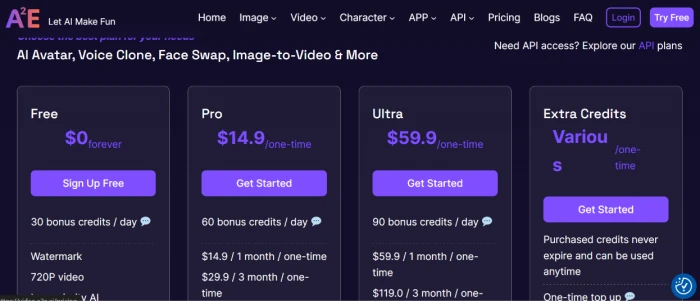
A2E sells three tiers: Free, Pro, and Ultra. Each tier changes two things up front: your credit allowance and the maximum quality you can export. Higher tiers also skip the queue when the servers are under load.
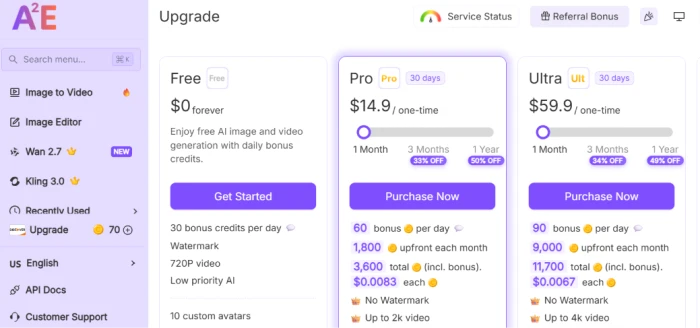
The Free plan stays free forever. It hands you 30 bonus credits a day for logging in, caps exports at 720p, stamps a watermark on your output, and drops you into the slow lane at busy times. You also get room for 10 custom avatars and a single voice clone slot. It is built for trying things, not shipping them.
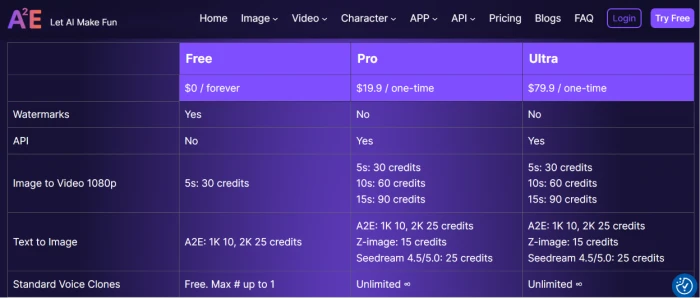
Pro is where most paying users land. A2E sells it as a one-time payment that scales with how long you want access. It removes the watermark, lifts quality to 2K, raises the daily bonus to 60 credits, opens up API access, widens your avatar library to 50, and lifts the cap on voice clone slots entirely.
Ultra aims at heavy users and the people who want new models first. It pushes exports to 4K, raises the daily bonus to 90 credits, drops the throttling so jobs run at top priority, and adds early access to new models, with the avatar limit climbing higher again.
The table below shows what each paid tier costs across the three billing lengths.
| Plan | 1 month | 3 months | 1 year |
|---|---|---|---|
| Pro | $14.90 | $29.90 | $89.90 |
| Ultra | $59.90 | $119 | $365 |
One thing to flag before you buy. A2E's own comparison table, lower on the same page, lists Pro and Ultra at different one-time prices ($19.90 and $79.90). That gap means either a promotion is running on the plan cards or one part of the page is stale. Open the live pricing page and treat whatever it shows at checkout as the real number.
The daily bonus that quietly funds your account
I have mentioned the daily bonus twice now. It earns its own section, because on Pro it makes up half of what you get each month.
The mechanic is plain. You open the site and claim the day's bonus, and the credits land in your account. Miss a day and that day's credits are gone, with no way to claim them later.
The bonus scales by tier. Free gives 30 credits a day. Pro doubles that to 60. Ultra goes to 90.
Why does this matter for what you pay? Because those daily credits stack into a real share of your monthly budget. The next section does that math.

What a full month of credits looks like
Here is how the Pro budget actually fills up.
The day your subscription activates, A2E drops 1,800 credits into your account. Over the next 30 days, claiming your 60-credit bonus daily adds another 1,800. That brings you to 3,600 credits for the month.
Read the phrase "up to" carefully, though. You only reach 3,600 if you check in every single day. Skip ten days and you forfeit 600 credits. The first 1,800 is locked in no matter what; everything past that rides on your habit of showing up.
Ultra runs on the same structure: a larger upfront grant, plus 90 credits for each daily claim.
Then comes the catch that trips people up. When your billing cycle resets, your balance resets with it. Anything you did not spend disappears.
That single rule is the whole reason the next kind of credit exists.
The top-up credits that never expire
Top-up credits are the opposite of plan credits. They sit in your account indefinitely and never reset.
Pro and Ultra subscribers can buy them in two sizes: $19.90 for 1,800 credits, or $80 for 16,000. The per-credit math is where the two split apart. The small pack works out to about 90 credits per dollar. The large pack gives you 200 credits per dollar. Buying in bulk more than doubles your value, so if you know you will use them, the $80 pack is the cheaper credit.
This is why I treat the two credit types differently. Plan credits are a monthly allowance, meant to be spent before the cycle ends. Top-ups behave like a savings account you draw from when a bigger project lands. A2E pitches the setup at API developers who want a credit buffer without committing to a recurring bill.
I will cover how you actually pay, and the refund rules, near the end. First, the question this whole article has been circling: what does each tool cost to run?
What each tool costs to run
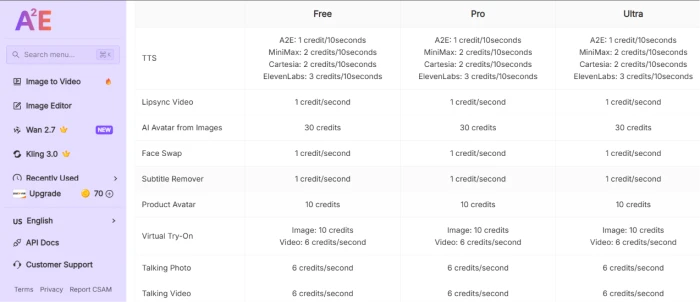
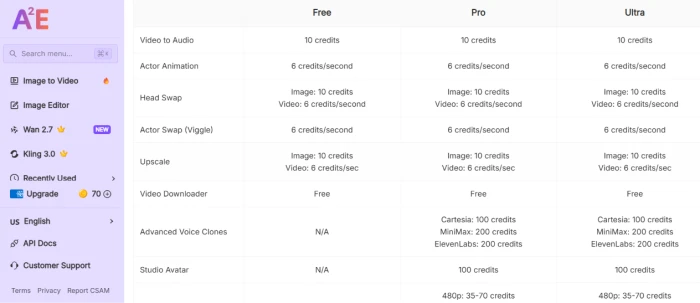
A2E prices most of its tools by the second. Once you know the rate, the running cost is just arithmetic. These rates hold across every plan tier; the tier changes your quality and speed, not the price of a job.
| Feature | Credit cost |
|---|---|
| AI avatar / lip-sync video | 1 credit per second |
| Face swap (video) | 1 credit per second |
| Face swap (image) | 1 credit per image |
| Image to video (1080p, 5s) | 30 credits |
| Talking photo or talking video | 6 credits per second |
| Text to speech (A2E voice) | 1 credit per 10 seconds |
| Voice clone setup | Free |
| Custom avatar from your video | Free |
| Subtitle removal | 1 credit per second |
| Video upscale | 6 credits per second |
The per-second model is gentler than it first sounds. A one-minute talking-head video costs 60 credits, since you pay a credit a second. Cloning a voice or building a custom avatar from your own footage costs nothing to set up; you pay only when you generate with them.
Text to speech is where A2E quietly undercuts the field. Its native voice runs 1 credit per 10 seconds, so a full minute of narration is 6 credits. A premium engine like ElevenLabs costs more, at 3 credits per 10 seconds, plus a one-time 200-credit fee to set up a dedicated clone.
Those are the everyday rates. The premium video models play a different game, and I will show in the next section how fast they empty the tank.
The premium models that drain credits fast
The big-name video models sit in a separate price bracket. A single generation can cost more than a minute of avatar work, sometimes far more. Here are four of them at current rates:
- Veo 3.1: 80 credits on Fast mode, climbing to 320 on Quality.
- Sora 2 Pro: 180 credits for a 5-second clip, up to 720 for 15 seconds at high quality.
- Kling 3.0 Pro: 160 credits for 5 seconds, scaling to 480 for 15 seconds.
- Wan 2.7: 250 to 750 credits per generation at 1080p, depending on length.
Now map that against the Pro budget. Your 3,600 monthly credits buy roughly 11 Quality renders on Veo, or about 20 standard Sora clips, and then you are empty. The same 3,600 credits would instead fund a full hour of avatar video. Your choice of model decides whether the month's credits last four weeks or four days.
This is the part of A2E's pricing that draws the most complaints, and I dug into it in our review. Some creators feel the premium rates run steep once you step outside A2E's own engines. The counterpoint is that you are reaching cutting-edge models on demand, with no separate subscription to each one, and you are paying for the outside engine rather than an A2E markup.
The trade works for occasional premium use. It falls apart if you are reaching for Sora or Veo every day.
Payment and the refund fine print
Paying is the easy part. You can pay with a card (Stripe handles cards and PayPal) or with crypto through NowPayments. No card is required to start, and every new account gets 100 free credits to test things before spending a cent.
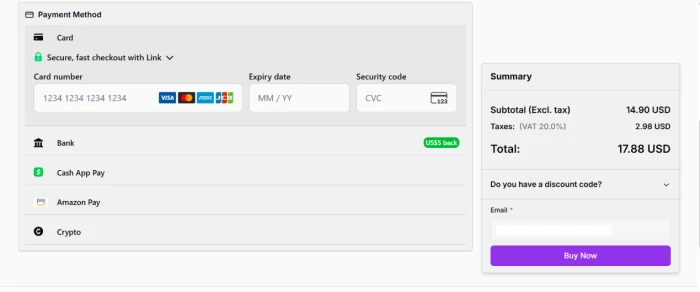
The refund policy needs a closer read. Because A2E gives you a free trial with free avatar cloning and synthesis, purchased credits are not refundable. A double charge can be reversed within 72 hours if you contact support, but a normal purchase is final once the credits land. A2E states there are no hidden fees: you pay for credits at the published rates and nothing else.
You manage your plan from the billing dashboard on your profile. Upgrades take effect immediately and add the new credits on the spot. Downgrades also apply right away and strip the paid privileges at once, so the timing of a downgrade is worth a moment's thought if you want to use up what you are paying for.
What you actually pay: three real scenarios
Numbers in a table stay abstract. Here are three creators and what A2E would cost each of them.
The casual tester. You stay on Free and claim the daily bonus most days, landing around 900 credits a month. That covers about 15 minutes of avatar video, or roughly 30 short image-to-video clips, at 720p with a watermark. Your bill is $0, and the trade is quality and speed.
The steady creator. You post a few talking-head videos and some narration each week. Pro at $14.90 a month fits cleanly: 3,600 credits cover around ten minutes of avatar video plus the voiceover, with credits to spare for image-to-video and the odd face swap. You rarely need a top-up, and you stay under $15 a month.
The studio user leaning on premium models. You run Veo and Sora for client work, so you need 4K and no throttling, which means Ultra. Even Ultra's allowance burns down fast at premium rates: 30 Veo Quality clips alone cost 9,600 credits, more than any monthly plan includes. So you buy the $80 top-up for 16,000 never-expiring credits and treat it as a project budget.
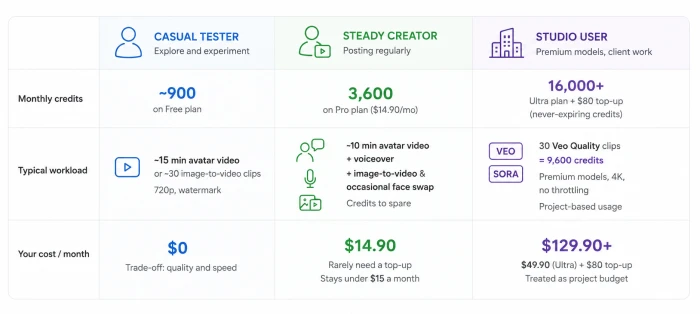
The pattern across all three is the same. Your bill tracks the tools you run and the seconds you generate, far more than the tier sitting on your account. So the useful move before you pay is to estimate the seconds you expect to generate each month for your main tool, multiply by that tool's credit rate, and hold the result against the 3,600 credits a Pro month gives you. That one comparison tells you which tier fits better than any feature list will.
The Bottom Line
A2E's pricing is fair for the work it was built around. If your output is talking-head video and voiceover on A2E's own engines, the per-second rates are cheap, and Pro stretches further than its $14.90 sticker suggests. The math only turns against you when premium models like Veo and Sora become a habit, where a few clips can swallow a month of credits.
My read after running the numbers: most creators should land on Pro and stay there. Free works as a trial rather than a home, since the watermark and 720p cap are built to move you along, and Ultra with a top-up earns its keep only once premium models become routine work.



Comments 0
Join the discussion and share your perspective.
Sign in to post a comment and reply to other readers.
No comments yet
Be the first to share your perspective on this article.