
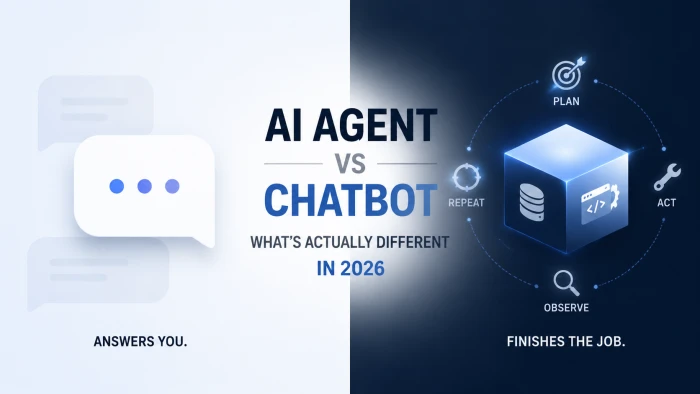
A chatbot answers you. An AI agent finishes the job.
That one distinction explains most of the confusion between the two, and it explains why Gartner had to coin a term for vendors who blur the line. This guide covers what each system does underneath, why seven specific capability gaps decide which one you should buy, how the surrounding vocabulary got so muddled, and how to check whether a product demo is showing you a real agent or a repainted chatbot.
By the end you will be able to sit through any vendor pitch and place the product correctly within about two minutes.
The Ten-Second Answer
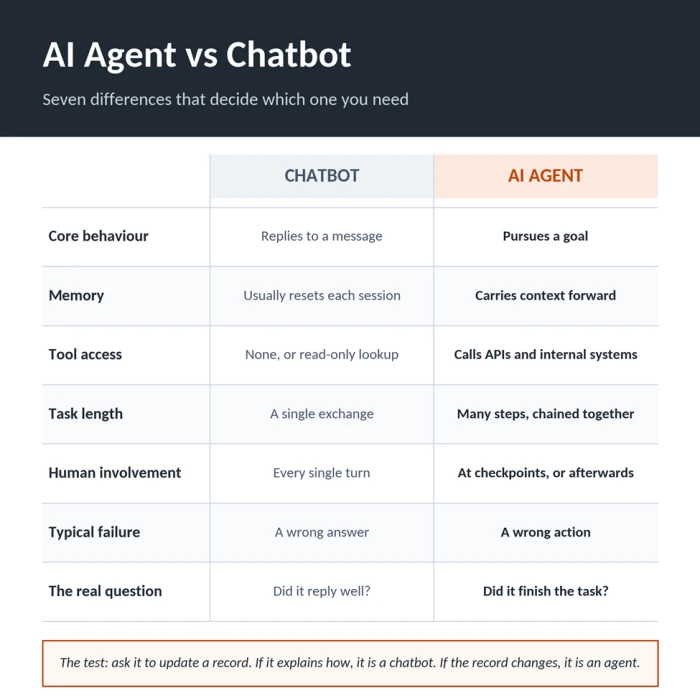
If you read nothing else, read this table.
| Dimension | Chatbot | AI agent |
|---|---|---|
| Core behaviour | Replies to a message | Pursues a goal |
| Memory | Usually resets each session | Carries context forward |
| Tool access | None, or read-only lookup | Calls APIs, databases, browsers and internal software |
| Task length | A single exchange | Many steps, chained together |
| Human involvement | Every single turn | At checkpoints, or after the fact |
| Typical failure | A wrong answer | A wrong action |
| The question you ask of it | Did it reply well? | Did it complete the task correctly? |
That final row is where the commercial difference lives. A bad chatbot reply annoys a customer. A bad agent action issues a refund that should never have been issued. Everything below expands on that gap.
What a Chatbot Actually Is
A chatbot is a conversational interface. It waits for input, works out a response, and returns text. It then forgets almost everything and waits again.
Three generations of technology that share almost nothing architecturally now sit under that one label, which is a large part of why buyers get confused.
| Generation | How it decides what to say | What breaks it |
|---|---|---|
| Rule-based | Keyword matching and decision trees | Any phrasing the script did not anticipate |
| Intent-based NLP | Classifies the message into a predefined intent | A request that spans two intents at once |
| LLM-powered | Generates a reply from a language model | Anything that requires acting outside the chat window |
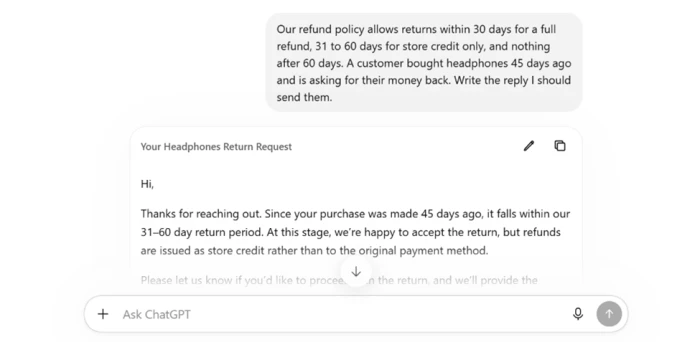
The third generation is where the trouble starts. An LLM-powered chatbot sounds capable. It will explain your refund policy in clean, confident prose. Ask it to issue the refund and the conversation stops, because it has nowhere to send that instruction.
That ceiling is structural, not a tuning problem. A chatbot has no hands.
What an AI Agent Actually Is
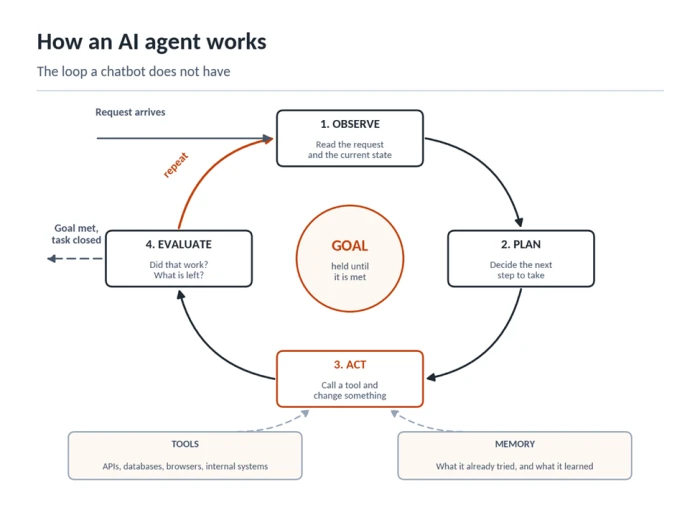
An AI agent takes a goal, works out the steps required to reach it, and carries those steps out using tools it has been granted access to.
Four parts make that possible:
• A reasoning model. Usually an LLM, doing the planning and the decision-making.
• Tools. APIs, databases, browsers, internal software. This is the piece that gives the agent hands.
• Memory. State that survives across steps and often across sessions, so the system knows what it already tried.
• A loop. The agent observes the result of each action, then chooses the next one.
The loop is the part people skip over, and it is the whole difference. A chatbot runs once per message. An agent keeps running until the goal is met or it concludes it cannot get there.
Put plainly: a chatbot is a receptionist who can answer any question about the building. An agent is a colleague who can walk into the building and move things around.
Seven Differences That Decide Which One You Need
The table near the top compressed these into one line each. Here is what each gap looks like in practice.
1. Autonomy: responding versus deciding
A chatbot has no discretion. It maps input to output. An agent chooses what to do next based on what happened last, which means it can take a path nobody scripted in advance. That is the source of both its value and its risk.
2. Memory: a blank slate every time
Most chatbots forget the conversation once the window closes. An agent retains state, so on Thursday it knows what it attempted on Tuesday. Anything that spans more than one sitting needs this.
3. Tool use: describing the action versus performing it
This is the cleanest test in the entire comparison. Ask the system to update a record. If it explains how you would update the record, it is a chatbot. If the record changes, it is an agent.
4. Multi-step reasoning: one turn versus a chain
"Find every enterprise customer whose renewal falls in the next 30 days and who logged a P1 ticket last month, then draft an outreach note for each" is four operations stacked on top of each other. A chatbot handles the first clause and gives up. An agent decomposes the request and works through it.
5. Integration depth: sitting on top versus sitting inside
Chatbots typically sit on a layer above your systems, reading from a knowledge base. Agents sit inside them, with write permissions to your CRM or your ticketing system. That distinction is why agent deployments take months rather than weeks, a point the adoption data later in this article puts a number on.
6. Failure mode: a wrong answer versus a wrong action
A chatbot that hallucinates gives a customer bad information, and a human can correct it on the next message. An agent that hallucinates executes something. It cancels the wrong subscription or emails the wrong list.
Vendor pages rarely spend time here. Your risk team will.
7. Accountability: who signs off
Once software acts on its own, somebody has to own the outcome. Agent deployments need audit logs, scoped permissions, a rollback path and a named owner. That is exactly the governance work that stalls projects. Chatbots need none of that, because they never do anything.
Sorting Out the Rest of the Vocabulary
Four other terms get used as if they were interchangeable with the two above. They are not, and vendors benefit from the fog.
| Term | What it actually refers to | Acts on its own? |
|---|---|---|
| Chatbot | A conversational interface | No |
| LLM | The underlying language model | No, it produces text |
| AI assistant | A helper that works alongside a person | Only when asked |
| AI agent | A system that completes tasks using tools | Yes, within its permissions |
| Agentic AI | The property of behaving like an agent | It is a description, not a product |
AI assistant versus AI agent
An assistant makes a person faster. It drafts the email that the person then sends. An agent removes the person from the loop for that step and sends the email itself. Gartner's own framing puts assistants as the precursor stage to agents, with most enterprise applications expected to carry an embedded assistant by the end of 2025.
Agentic AI versus AI agent
An AI agent is a thing you can deploy. Agentic AI is an adjective describing how a system behaves. When a vendor says their product is "agentic" without naming which agent does what, treat that as marketing rather than specification.
LLM versus AI agent
The LLM is the engine. The agent is the vehicle built around it, including the tool connections, the memory layer, the control logic and the permission model. Swapping in a stronger model makes an agent smarter at planning. It does not give the agent new permissions.
Is ChatGPT an AI agent?
It depends entirely on which mode you are using. Asking it a question in the chat window is chatbot behaviour. Handing it a browsing or code-execution task where it operates over several steps and returns a finished result is agent behaviour. The same product spans both categories, which is one more reason the terms blur in everyday use.
One Support Ticket, Two Systems
Abstract capability lists are easy to nod along to. Here is the same request handled by each.
A customer writes in: "Our nightly data export has been failing since Tuesday."
The chatbot searches the help centre, finds the closest article by keyword match, and returns "Troubleshooting Failed Exports." The customer has already read it. They ask for a human. Handling time goes up rather than down.
The agent looks up the account, sees the customer is on the enterprise plan running export version 3.2, cross-references that version against open engineering issues, finds a defect logged Monday night that matches the symptom, attaches the account to that issue, routes the ticket to the right engineering queue with the diagnostic context already filled in, and drafts a reply telling the customer which release carries the fix.
Identical question. The first produced a document. The second produced a resolution path.
When a Chatbot Is Still the Right Call
Agents are not an upgrade in every situation, and any article that says otherwise is selling something.
• High-volume, low-variance questions. Store hours, order status, password resets, delivery tracking. A scripted flow answers these faster and at a fraction of the cost.
• Regulated wording. Where the reply must be identical every time for compliance reasons, generative variability is a liability.
• No systems worth connecting to. If your data lives in spreadsheets and nobody has an API, an agent has nothing to act on.
• Thin budgets and thin engineering capacity. A chatbot ships in weeks. An agent deployment is an integration project with a governance workstream attached.
Gartner made this point directly when analysing failed projects: many use cases positioned as agentic today do not require an agentic implementation. Which brings us to the numbers.
What the 2026 Numbers Actually Say
Three datasets frame the year, and read together they tell a more useful story than any of them does alone.
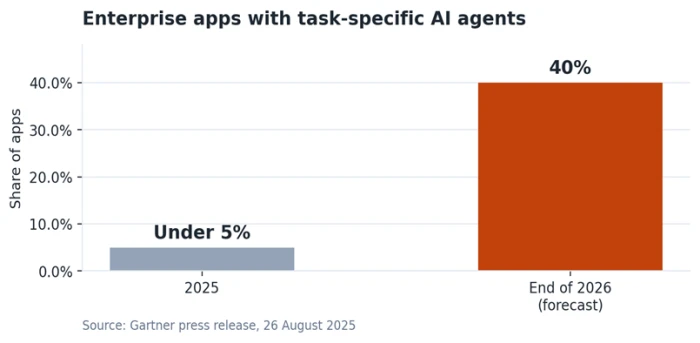
Start with the forecast that made 2026 the year everyone points at. In an August 2025 press release, Gartner predicted that 40 percent of enterprise applications would carry task-specific AI agents by the end of 2026, up from under 5 percent.
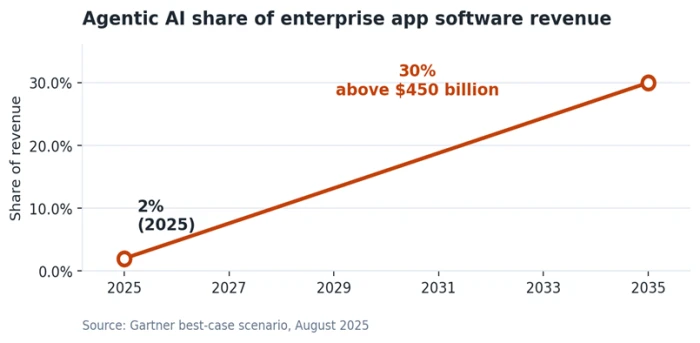
The revenue projection behind that forecast is larger still. Gartner's best-case scenario has agentic AI driving roughly 30 percent of enterprise application software revenue by 2035, above 450 billion dollars, from 2 percent in 2025.
Then comes the correction. Forrester's 2026 research found around three-quarters of enterprise leaders saying they are adopting agentic AI, while only a small minority have anything running in meaningful production beyond what Forrester calls "agentish" chatbots. Practitioner surveys point at the same bottleneck, with 46 percent naming integration with existing systems as their primary obstacle.
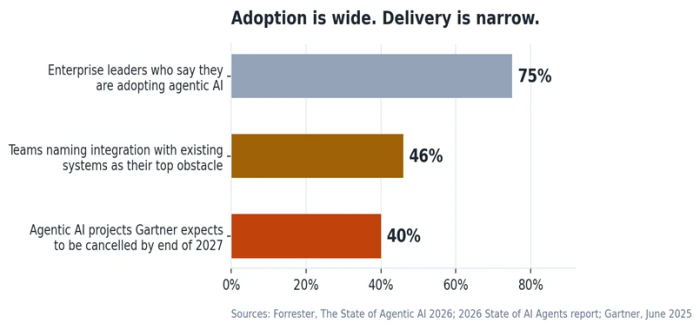
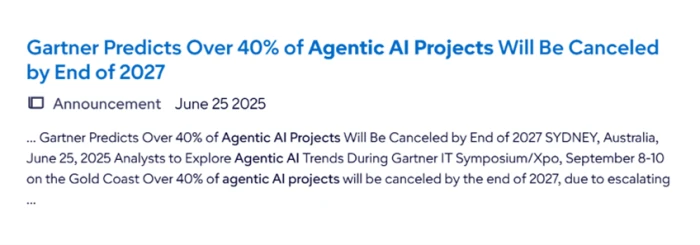
The third figure on that chart deserves a note on provenance, because it is the most misquoted statistic in the category. Gartner's prediction that over 40 percent of agentic AI projects will be cancelled by the end of 2027 was published on 25 June 2025, drawn from a poll of more than 3,400 organisations. A great many articles published this year quote it without a date, which makes a year-old forecast read like fresh 2026 research. The cited causes were escalating costs and business value nobody could pin down. Weak risk controls compounded both.
How to Tell Whether a Vendor Is Selling You a Real Agent
Alongside that cancellation forecast, Gartner named the behaviour driving much of the confusion: agent washing, meaning existing assistants and chatbots repackaged as agentic without the underlying capability. Of the thousands of companies marketing themselves as agentic AI vendors, Gartner estimated only around 130 were building the real thing.
Treat that 130 as directional rather than exact, since no public methodology accompanied the denominator. The pattern it describes is easy to verify yourself with five questions in a demo.
• Can it call an external tool? Ask them to show a write operation against a live system, not a slide.
• Does it hold state between sessions? Close the window, reopen it, and see whether the task resumes.
• Can it complete a task with nobody watching? If every step needs a human click, you are buying an assistant.
• Is there an audit trail? Ask to see the log of a completed run, including the actions taken and the reasoning recorded.
• What happens when it gets something wrong? A vendor with a real agent has a rollback story. A vendor with a chatbot changes the subject.
Question four separates serious products from demos more reliably than any of the others. Logging is expensive to build and nobody bothers unless the system genuinely acts.
Choosing Between Them
Work backwards from the outcome rather than forwards from the technology.
| If your goal is... | Build this | Because |
|---|---|---|
| Deflect repetitive questions at scale | Chatbot | Predictable, and it ships in weeks |
| Cut average handling time on complex tickets | Agent | Needs system access and multi-step reasoning |
| Give your team faster drafts and summaries | Assistant | A human stays in the loop by design |
| Close tasks end to end without a person | Agent | Only a tool-using system can finish the work |
One practical sequence beats the two-way choice. Deploy the chatbot for the top of the funnel where questions repeat, then run an agent behind it for the cases it cannot resolve. The chatbot absorbs volume, the agent handles the work that needs hands, and you learn where your integration gaps sit before committing to the harder build.
Start with a single workflow that already has clean data and a measurable baseline, because that is where the 60 percent of projects that survive tend to begin.
Comments 0
Join the discussion and share your perspective.
Sign in to post a comment and reply to other readers.
No comments yet
Be the first to share your perspective on this article.