
In February 2024, Klarna made an announcement that moved through the business world quickly. Its new AI assistant, built with OpenAI, had handled 2.3 million customer chats in a single month. That was two-thirds of the company's support volume and, by Klarna's estimate, the workload of 700 full-time agents. Resolution times fell from 11 minutes to under two, and the company projected a $40 million profit improvement for the year.
Fifteen months later, the same CEO told Bloomberg the company had gone too far. Quality had dropped, and Klarna started hiring people back.
I keep returning to that story, because it holds the question every team is wrestling with right now.
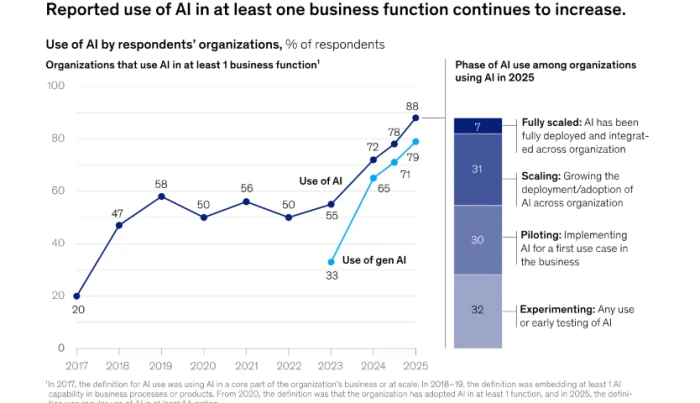
Whether to use AI at work is settled. McKinsey's 2025 State of AI survey, fielded across nearly 2,000 organizations in mid-2025, found 88% already using it in at least one function. The harder question, the one Klarna answered half-right, is which work you hand to the machine and which work you keep in human hands.
This piece is my attempt to answer that with evidence instead of vibes. I will give you a scorecard for sorting tasks, a tour of what AI does well, an honest look at what it should not touch, three companies living this split today, and the mistakes that turn a rollout into a public apology. One idea ties it together: the strongest setups pair human judgment with machine speed rather than betting everything on either side.
Everybody uses AI. Almost nobody has cracked it.
Adoption is the easy part now.
The gap between using AI and getting value from it is where the story gets interesting, and McKinsey's mid-2025 survey put hard numbers on it. 88% of organizations use AI somewhere. 72% use generative AI, more than double the 33% they reported in 2024. Yet only about 6% qualify as high performers, tracing more than 5% of profit to their AI work, and nearly two-thirds have not begun scaling it across the business at all.
Near-universal adoption. Rare payoff.
The reason is unglamorous. Most companies bolt AI onto processes they already run and hope for a return. The ones seeing money redesign the work around it. In the same research, high performers were 2.8 times more likely to have rebuilt a workflow from the ground up, and far more likely to keep a person checking the output, 65% against 23%. That last figure previews everything below: the companies winning with AI are the ones deciding, on purpose, where a human stays in the loop.
So the skill worth building is not prompt-writing. It is judgment about allocation, what to give the machine and what to protect. Here is how I make that call.
A five-minute test for what to automate
Run any task through a handful of questions before you automate it. I turned the usual checklist into something you can score, because "is this a good fit?" is too vague to act on.
Rate the task 1 to 5 on each line. A high total points to automation. A low total says keep it human.
| Factor | Score 1: keep human | Score 5: automate |
|---|---|---|
| How repetitive is it? | One-off, always different | The same steps every time |
| How rule-based is it? | Needs human judgment | Clear, fixed rules |
| Cost of a wrong answer? | Severe or hard to undo | Minor and easy to catch |
| How much empathy is needed? | Deep human connection | None |
| Legal or ethical accountability? | High | None |
| Is the data good? | Little or messy | Plenty and clean |
Add up the six scores. My rough cutoffs, from using this with teams: 24 and above, automate with a light review pass. 15 to 23, build it as a human-plus-AI workflow where the machine drafts and a person signs off. Below 15, keep a human in charge and let AI assist only.
Two things make this sharper than a yes-or-no list. It forces you to price the cost of a wrong answer, which is where Klarna slipped. And it exposes the wide middle zone, the tasks that are neither fully automatable nor fully manual, where most real work sits. Hold the scorecard in mind as we walk the categories below.
What AI should take off your plate
Some work is close to begging to be handed over. These four buckets score high on the test above, and the evidence that AI helps is strong.
Back-office and administrative work
Scheduling, data entry, invoice matching, expense processing, document sorting. Repetitive, rule-heavy, cheap to get wrong, easy to check. This is the least glamorous and most dependable win. It clears the busywork that quietly eats hours and hands people back time for the parts of the job that need a brain.
Front-line customer questions
A large share of support tickets are variations on a few simple asks: where is my order, how do I get a refund, reset my password, update an address. AI answers those in seconds, at any hour, across dozens of languages. Klarna's assistant still handles two-thirds of chats and cut repeat contacts by 25%. The trick, as its later stumble showed, is a clean handoff to a person the second a question turns complex or emotional. More on that shortly.
Data crunching and pattern-spotting
Here machines outclass us outright. Mastercard's fraud model reviews roughly 125 billion transactions a year and scores each in under 50 milliseconds, lifting detection by about 20% on average while cutting false alarms by more than 85%. No human team could match that volume or speed. Reporting, forecasting, anomaly detection, trend analysis: hand it over.
First drafts and routine writing
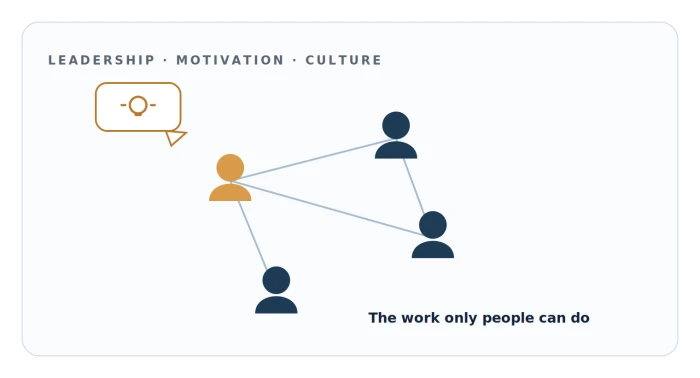
Meeting summaries, email drafts, translations, boilerplate copy. In a controlled study of more than 5,000 support agents published in the Quarterly Journal of Economics in 2025, AI assistance raised output by 15% overall and 34% for the least experienced workers. A separate 2023 experiment with 758 BCG consultants found a 40% quality jump on tasks that fell within the tool's strengths. The catch sits in the word draft. A person still edits for accuracy and tone, which matters more than it sounds, for reasons I cover in the risks section.
Notice the pattern. In every case the machine takes volume and speed, and a human keeps the final call on anything that carries consequences. That principle gets sharper when we look at what should never leave human hands.
What should stay human
This is the longer list, and it is the heart of the title. These tasks score low on the scorecard for a reason. They turn on judgment, relationships, and responsibility, the things a model does not have.
Strategy and judgment calls
Where to place a bet. When to hold or fold. AI can lay out options and stress-test assumptions, but it cannot own the decision, because it cannot be accountable for getting it wrong. Strategy needs a person who reads the context the data misses and will answer for the result.
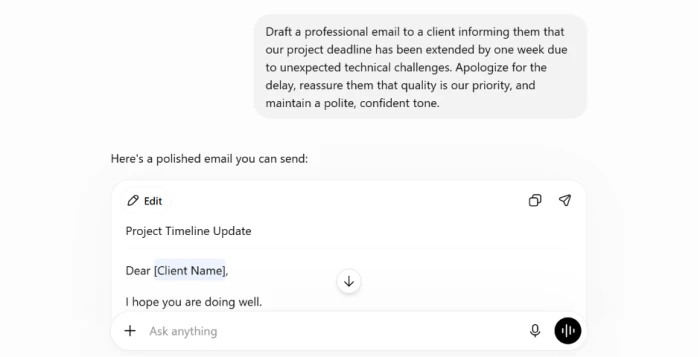
Leadership, motivation, and culture
Coaching someone who is struggling. Reading a room before it boils over. A model can offer talking points; it cannot make a person feel seen. The World Economic Forum's 2025 Future of Jobs report ranks leadership and social influence among the fastest-rising skills through 2030, precisely because automation makes them scarcer.
Original creative work
AI recombines what already exists. The jump to something new, a brand's voice, a product nobody has asked for yet, a campaign that reframes a whole category, still starts with a person. Creative thinking sits in the top five growing skills in that same report. Use AI to spin up variations and cut weak ideas faster. Do not outsource the original one.
Empathy and high-trust relationships
Hard conversations, negotiations, mentoring, steadying a customer in real distress. The numbers here are blunt. In a 2025 Five9 survey, 86% of customers said empathy and human connection matter more than a fast reply. Klarna learned that the expensive way. Speed is not care, and people can tell the difference.
Ethical and high-stakes decisions
Hiring, firing, promotions, medical and legal calls, anything hard to reverse or where fairness is at stake. Models absorb bias from their training data and can deliver a wrong answer with complete confidence. Where accountability matters, a person decides and signs their name. Regulators increasingly say the same, which I return to under rollout.
If those two sections read like two clean piles, real work is messier. Most tasks are a blend. The table below is how I keep the split straight.
The split at a glance
The best results rarely come from AI alone or a person alone. They come from the handoff. The right-hand column is the point.
| AI handles | A person owns | Strongest together |
|---|---|---|
| Data entry and scheduling | Strategy and direction | AI drafts a plan; a leader decides and owns it |
| Tier-1 support | Complex or emotional cases | AI resolves the routine and routes the rest to people |
| Forecasting and detection | Final judgment calls | AI flags the risks; an analyst investigates |
| Drafting and summarizing | Brand voice and original ideas | AI writes version one; a human edits it to ship |
| Document processing | Hiring and ethics decisions | AI screens; a person chooses and is accountable |
Those pairings are the next three companies, running in the wild.
Three places this already works
Enough theory. Here is the human-plus-AI split in production, with results attached.
Healthcare: giving doctors their evenings back
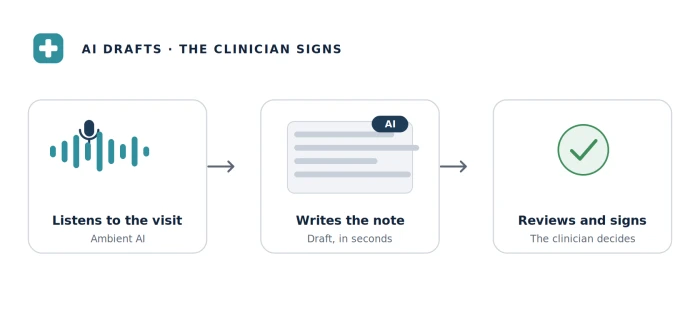
Physician burnout is driven in part by hours of after-visit paperwork. Ambient AI scribes listen to the appointment and draft the clinical note. In a 2025 study in JAMA Network Open covering 263 physicians across six health systems, burnout fell from 51.9% to 38.8% in 30 days. A randomized trial at UW Health, running from late 2024 into 2025, saved clinicians about 30 minutes a day. The division of labor is exact: the AI writes the draft, and the doctor reviews and signs it, correcting whatever is off. The machine handles the transcription. The human keeps the medical judgment and the liability.
Finance: catching fraud at machine speed
You saw Mastercard's numbers earlier. Here is the collaboration behind them. The model scans 125 billion transactions a year and flags the suspect ones in milliseconds, work no analyst could do by hand. People set the risk rules and work the hard cases, including the customer whose legitimate card just got declined. AI does detection at scale. Humans own policy and the judgment calls.
Customer service: the cautionary tale that course-corrected
Back to Klarna, because the full arc is the lesson. The 2024 launch was real: two-thirds of chats automated and resolution times under two minutes. Then quality on complex tickets slipped, and in May 2025 the CEO conceded the cost focus had gone too far, admitting that "what you end up having is lower quality." Klarna did not abandon AI. By late 2025 the assistant was doing the work of 853 agents while the company rebuilt its human team for the hard conversations and guaranteed that customers could always reach a person. The setup that works is hybrid, which is exactly what the first version lacked.
Three industries, one shape: machines for volume and speed, humans for judgment and trust. Push past that line and things break, which is the next stop.
Where over-automation bites back
Handing the wrong work to AI, or handing it over with no one watching, carries real costs. Four show up again and again.
Confident wrong answers. Models produce fluent text whether or not it is true. McKinsey's 2025 survey names inaccurate output the single most common problem organizations hit with AI. In anything client-facing, a polished mistake can cost more than no answer.
The clean-up tax. There is now a name for AI output that looks finished but is not: workslop. Research from BetterUp Labs and Stanford's Social Media Lab, published in Harvard Business Review in 2025, found that 40% of US desk workers received such output in a single month and spent about two hours fixing each incident. Scaled out, that is roughly $186 per employee per month, and near $9 million a year for a company of 10,000. Automation that generates rework saves no one time.
Eroded trust. This is the Klarna wound. Lean too hard on bots for sensitive moments and customers feel it. Two-thirds of consumers report a bad chatbot experience, according to Verint. Trust is slow to build and quick to lose.
Compliance exposure. In regulated work, an automated decision you cannot explain is a liability, not an efficiency. Which leads straight to how to do this without stepping on a rake.
How to roll this out without the backlash
The distance between AI that helps and AI that hurts comes down to execution. A few practices, drawn from what McKinsey's high performers do, carry most of the weight.
- Start where errors are cheap. Pick low-risk, high-volume tasks first, the top of your scorecard, prove the value, then expand. Do not lead with your most sensitive workflow.
- Keep a person in the loop where it counts. Recall the standout number from earlier: high performers were far more likely to have human validation built in, 65% against 23%. Design that checkpoint on purpose.
- Train your people, then train them again. In a late-2025 Zapier survey, 94% of trained workers said AI lifted their productivity, against 69% of untrained ones, and only 1% of trained workers saw a dip. The tool barely matters if nobody knows how to use it well.
- Name an owner and watch the right metrics. Track resolution quality, error rates, escalation rates, and customer sentiment, not deflection or volume alone. Klarna's dashboards looked great right up until they did not.
- Mind the rules, because they are moving. The EU AI Act has been in force since 2024, and its obligations for high-risk uses like recruitment and credit scoring were pushed to late 2027 under a 2026 simplification package, while transparency duties, telling people when they are dealing with AI, still land in 2026. (Status as of mid-2026, and shifting, so check before you build.)
Do these and AI becomes a quiet advantage instead of a headline. The last question is where all of this is heading.
What the next few years look like
The frontier has already moved from chatbots to agents, software that can plan and carry out multi-step tasks with limited supervision. This is underway, not a forecast. In McKinsey's 2025 survey, 23% of organizations were already scaling agentic AI and another 39% were experimenting. The near future looks like small teams of people supervising fleets of these agents, handling the exceptions and setting direction, rather than doing every step by hand.
Jobs will shift more than they vanish.
The World Economic Forum projects 170 million new roles and 92 million displaced by 2030, a net gain of 78 million, alongside a 22% churn in what the work involves. Old tasks fall away and new ones appear.
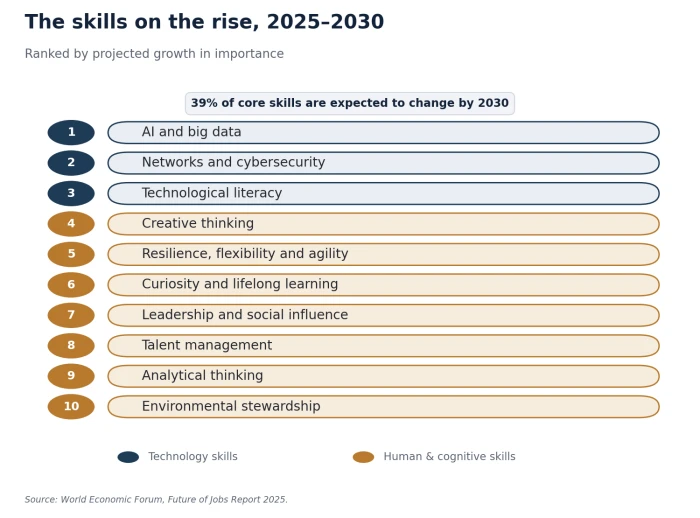
The skills on the rise tell the real story. That same report puts AI and big data at the top of the fastest-growing skills, and right beside them sit analytical thinking (still the skill most employers name, chosen by seven in ten), creative thinking, resilience, and leadership. The people who do well over the next five years will pair fluency with the machine and the human strengths it cannot fake.
Klarna's whole detour reduces to that balance. Speed was never the problem; treating speed as a substitute for judgment was. Score the work, and keep your name on the calls that carry weight.
The Bottom Line
Strip away the case studies and the numbers, and the answer holds. AI is a tool for augmentation, and the teams getting real value from it treat it that way. The ones pulling ahead are not automating the most, nor holding out the longest. They are drawing the line on purpose, one task at a time.
Here is my verdict. Give the machine the repetitive, rule-bound work and the pattern-spotting no person can match at scale. Keep judgment, trust, creativity, and anything with lasting consequences in human hands. Then build the handoff between them with care, because that seam is where the payoff lives and where most rollouts fail.
When you cannot tell which side a task belongs on, do not guess. Score it, and start small. Keep a person on anything where the stakes are real. Get that one discipline right, and AI stops being a risk to manage and becomes the edge your competitors have not built yet.

Comments 0
Join the discussion and share your perspective.
Sign in to post a comment and reply to other readers.
No comments yet
Be the first to share your perspective on this article.