
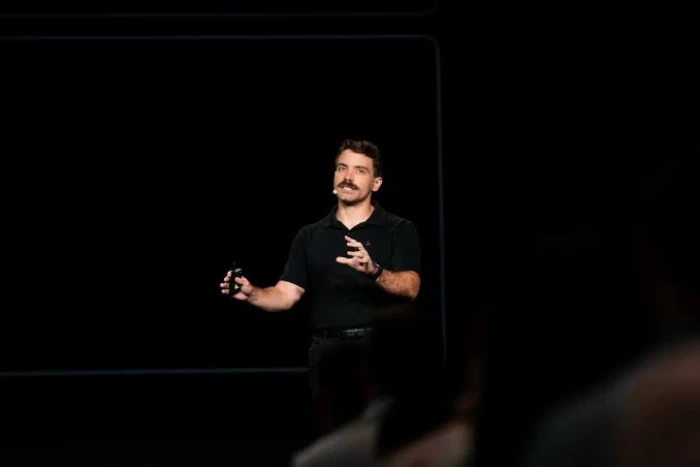
Guillermo Rauch says production teams have stopped betting everything on a single lab. His company's pitch, and its claim to becoming "the AWS of this generation," rides on models turning into interchangeable parts.
Guillermo Rauch has taken a public side in an argument that will decide how software gets built for the next decade.
Speaking after Vercel's ShipNYC conference last week, the chief executive told TechCrunch that the AI industry is now settling one structural question. Does the model stay welded to the agent that runs on it, sold as a single closed product? Or do the two break into separate parts that a developer can swap the way they swap a database or a caching layer?
Rauch wants them apart, and his reasoning traces straight back to Vercel's own position in the market.
His company spent a decade convincing developers to ship code without touching a server. That business has quietly turned into one of the load-bearing pillars of AI software. Vercel now processes 6 million deployments a day, and roughly half of those are set off by coding agents rather than people typing commands. More than a trillion tokens move through the company's AI gateway every 24 hours.
Those figures are the reason the coupling debate is not academic for him. If one lab ends up owning the model, the harness, the data layer, and the hosting inside a single walled garden, the independent infrastructure that Vercel sells gets squeezed out of the loop. If instead every layer stays modular, Vercel sits in the middle of the flow, routing tokens and hosting whatever the agents produce.
From prototype season to production reality
Rauch frames 2025 as the year of the prototype. The pitch back then was expansive. Turn the agents loose, let anyone build, see what sticks.
Vercel ran that experiment on itself, spinning up hundreds of internally built agents. Then came the harder part, which was operating those agents once they touched real data and real customers. Auditing what an agent did, keeping a trail of every tool call it made, and controlling which systems it could reach turned out to be where the difficulty lived.
Out of that came a sharper read on where agents actually earn their keep. Rauch names two applications that pay off reliably. The first is the coding agent, which he credits for a large share of global token consumption. Produce that much software and it has to live somewhere, which is the opening Vercel is built to fill.
The second is quieter and, in his telling, underrated: the internal agent that helps run the company itself.
He offers a concrete example from Vercel's own sales floor. A rep whose job is growing existing accounts kept hitting the same wall. Her constraint was never intelligence or the ability to build relationships. It was access to data. She wanted to know which accounts had added the most seats in the past fortnight so she could prioritize her outreach, and for years she could not ask that question without waiting on a quarterly dashboard project to ship.
Rauch is blunt about his own record here. He says he had never opened Salesforce before starting the company, and that Vercel's sales and revenue plumbing lagged years behind the pace of its engineering org. The fix he is describing is the same technology pointed inward: the agents that talk to customers can also unstick the people running the business, because underneath they are the same APIs.
That framing carries a warning for a large category of software vendors. Rauch argues that many of the industry's biggest names built their businesses on trapping a customer's data inside their own walls, and that the instinct is incompatible with a world where agents need open access to get work done.
Eve and the Sandbox: putting the agent in a cage
Two products carry Vercel's answer to the internal-agent problem.
The first, a framework called Eve, lets a team write out an agent's instructions and skills in plain language rather than code. The second, Vercel Sandbox, drops the agent into a confined environment where administrators set policy on which data it can reach and which data is allowed to leave.
Rauch's favorite argument for the sandbox is about controlling where proprietary data ends up. He describes a conversation with the president of Airbus. Picture decades of specialized C++ written for aerospace engineering. One engineer installs the wrong coding tool in the wrong configuration, and that entire codebase can be shipped off to a cloud service and folded into someone else's training run.
He points a finger at coding environments like Devin and Cursor, warning that in the wrong settings they can train on a customer's codebase. The sandbox exists so the agent keeps its freedom to act while the source of value stays put.
That warning does double duty. It names a genuine risk that any regulated engineering shop already worries about, and it doubles as a pitch for the product Vercel happens to sell. Both things are true at the same time, which is worth keeping in view every time a platform CEO describes a danger his company is positioned to solve.
The end of the single-lab bet
The sharpest shift Rauch describes is in how buyers treat the labs.
A year ago, plenty of companies planted a flag with one provider and declared they would build everything on OpenAI or on Anthropic. That posture is fading. Teams now look at the stack as a set of separable pieces, model and harness and data platform and sandbox and gateway, each one swappable for a better option.
Once buyers optimize for production instead of picking a favorite, the calculation turns to price and performance. That is where the conversation gets uncomfortable for the labs, because the brand stamped on the model starts to matter less than the cost of getting a task done.
Rauch says Gemini is picking up serious usage even without dominating the headlines, because its price-to-performance profile is strong. Open-weight models are climbing the same curve. He singles out DeepSeek and GLM-5.2 as taking off in production settings, and the data he is pointing at makes the case.
GLM-5.2, released in June by the Beijing lab Z.ai under a permissive MIT license, runs about $1.40 per million input tokens and $4.40 per million output tokens. On several long-horizon coding benchmarks it edges past OpenAI's GPT-5.5 while costing roughly a sixth as much, according to reporting from VentureBeat. DeepSeek's V4 line pushes the floor lower still, with its Flash tier landing near $0.14 and $0.28 per million tokens and cache-heavy workloads costing a fraction of that again.
Set those against the proprietary flagships. GPT-5.5 runs $5 in and $30 out per million tokens. Claude Opus 4.8 sits at $5 and $25. Gemini 3.1 Pro comes in cheaper at $2 and $12. The gap in raw capability between the best open weights and the best closed models has narrowed to the point where independent analysts describe the old "open tax" at the top of the market as effectively gone.
For a company like Vercel, that compression is the whole thesis playing out in public. When no single model is clearly worth locking into, the valuable real estate moves to the layer sitting between the models, metering cost and enforcing the rules. Production teams that once shopped for a favored model now need something to route each task to the right engine, watch spend and latency, run evaluations, and keep every agent inside auditable boundaries. Selling that layer is Vercel's business.
Competing with the labs it also serves
The modular world Rauch is selling collides with an obvious problem. As the labs bolt on more capability, they start doing the things infrastructure companies already do.
OpenAI made that concrete this spring. Through a Codex feature called Sites, which entered preview in early June for Business and Enterprise workspaces, ChatGPT can generate and host a website or a small app entirely inside OpenAI's own environment, with no separate deployment step required.
That lands directly on Vercel's turf. Rauch's read on it runs against the obvious fear. He treats ChatGPT teaching millions of people to make websites as an on-ramp rather than a threat. Once those users start asking the model where to host what they built, he expects the model to point them toward established infrastructure.
There is a real mechanism behind that optimism. Vercel builds and maintains Next.js, the open-source framework that a large share of the modern web runs on. Language models absorbed enormous amounts of Next.js code during training, which makes them fluent in it and prone to recommend Vercel when a freshly generated app needs a home. Forbes reported earlier this year that Vercel customers using Claude represent a little over 1 percent of its users yet generate close to 15 percent of its deployments, with the majority of agent-driven deploys traced back to Claude Code.
The wrinkle Rauch does not dwell on is that OpenAI lists Vercel among the early partners for Sites. The relationship between platform and lab is competitive and cooperative in the same breath, which is roughly the state of the entire sector right now. Everyone is building on everyone, and everyone is quietly preparing to compete with the layer above and below them.
The bet, and the part the analogy skips
Rauch's ambition sits in a single line he keeps returning to. He wants Vercel to be "the AWS of this generation," fighting for a world of open protocols where intelligence arrives as a building block you assemble rather than a finished product you rent.
The comparison is doing a lot of work, and it quietly steps around the load-bearing question. Amazon's cloud commoditized raw compute because one server is close enough to another that price and reliability decide the sale. A frontier model is a different kind of good. A large portion of an AI product's value still lives inside the model itself, in ways a bare virtual machine never carried. Whether models flatten into a swappable commodity the way compute did is a forecast about the future, not a settled fact of the present.
The direction of travel favors his argument for now. Prices keep falling, open weights keep closing the gap, and production teams increasingly reach for model routing over lab loyalty. Independent observers reading the same interview drew a similar conclusion, casting the moment as the point where shipping AI turns into an infrastructure discipline built on routing and auditable controls rather than a contract with one favored vendor.
None of which resolves the fight. It sets the terms.
Rauch has been telegraphing where he thinks all of this leads for Vercel itself. At an earlier conference this year he described the company as operating in public and offered no firm timeline for a stock listing, while arguing that the addressable market for infrastructure has lost its ceiling now that agents generate more software than any human workforce could. The valuation math has kept pace with the rhetoric. A 2025 round priced Vercel at $9.3 billion, nearly triple its worth a year earlier, and run-rate revenue reached $340 million by the end of February, up 86 percent year over year.
The unbundling he is betting on would make all of those numbers look conservative. The coupling he is fighting would turn them into a ceiling after all.



Comments 0
Join the discussion and share your perspective.
Sign in to post a comment and reply to other readers.
No comments yet
Be the first to share your perspective on this article.