
I bought a $90 pair of “noise-cancelling” earbuds two winters ago because the product page glowed with 4.8 stars and more than 6,000 reviews. The earbuds arrived. They cancelled nothing louder than a whisper.
When I finally read the reviews instead of glancing at the number, the story fell apart in about four minutes. Dozens of five-star reviews had been posted on the same three days. Half of them praised a “crisp sound” without mentioning noise cancellation at all. The one-star reviews, buried where nobody scrolls, described exactly what I later experienced.
That $90 lesson changed how I shop.
I read reviews carefully now, both as a buyer and as someone who has spent years watching how they get manipulated. The rating printed on the front of a product page is often the least useful number on the screen. This guide is the method I run every time I spend money online. I will show you how to separate a genuine review from a planted one, and why the reviews most people scroll past are the ones I read first. By the end, you will look at a five-star badge the way I do now, with curiosity instead of trust.
The Number Everyone Trusts, and Why I Stopped
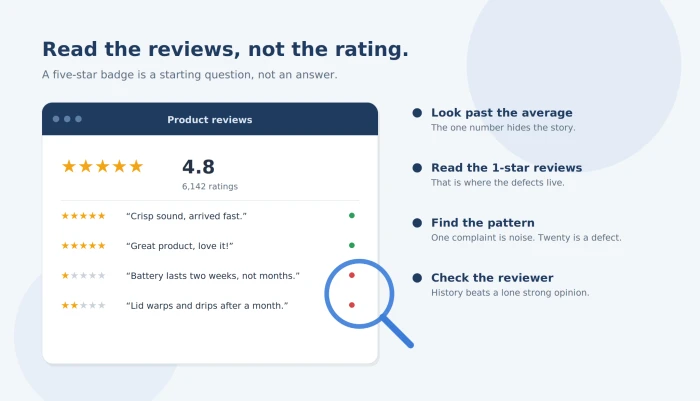
Reviews carry more weight in a purchase than almost any advertisement. Around 97% of people read online reviews before choosing a local business, according to BrightLocal’s annual survey, and shoppers spend close to 14 minutes reading them before they decide to trust a business. That is not a glance. People treat the review section like homework.
There is a catch hiding inside that number. Most shoppers form an opinion after reading only one to six reviews. If those few happen to be the planted ones sitting at the top of the page, the 14 minutes never save you. Reading a lot is not the same as reading the right ones.
Here is the trouble I walked into. The same popularity that makes reviews useful also makes them a target. Where attention goes, manipulation follows.
Independent analysis backs this up. Fakespot has estimated that roughly 43% of Amazon reviews are unreliable. A separate audit of more than 40,000 products by the tool Null Fake found that about one in four had reviews showing signs of manipulation, with cheap electronics accessories (phone cases, chargers, cables, earbuds) among the worst offenders. My earbuds fit that pattern to the letter.
Then there is the newer wrinkle: machines writing the reviews.
The reviews a machine wrote
In 2025, AI detection firm Pangram Labs scanned 30,000 front-page Amazon reviews across 500 best-selling products. About 3% were AI-generated with high confidence. Of those, nearly three-quarters were five-star, and 93% carried the “Verified Purchase” label.
Read that again. The badge I had treated as proof of honesty was sitting on top of text a person never wrote.
Amazon is fighting this at scale. The company says it blocked hundreds of millions of suspected fake reviews in 2025 and helped shut down more than 100 websites that sold them. That is reassuring and unsettling at once: reassuring that someone is filtering, unsettling that the flood is large enough to need it.
Not All Reviews Are Worth the Same Trust
Before I judge a single word, I sort reviews by where they come from. The source tells me how much weight a review has earned before I even read it. Here is the rough hierarchy I keep in my head.
| Where the review comes from | How much I trust it | Why |
|---|---|---|
| Verified purchase | High | Tied to a real, traceable order |
| Independent expert test | High | Measured under controlled conditions |
| Sponsored or gifted review | Medium | The reviewer received something, so bias is built in |
| Ordinary user review | Medium | Real experience, but nothing confirms the purchase |
| Anonymous account | Low | No history and no accountability |
A warning about that top row. The Pangram data I just mentioned showed that a “Verified Purchase” tag can sit on an AI-written review, so I treat it as a helpful signal, never a guarantee. As we will see later, I still check it against the reviewer’s history.
There is now a legal backstop worth knowing about, and it changed how sellers behave.
The rule that made fakes illegal
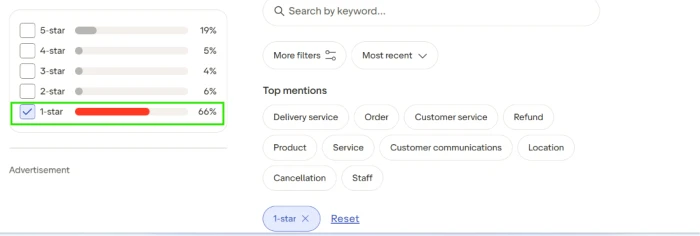
In August 2024 the Federal Trade Commission finalized a rule banning the sale and purchase of fake reviews. It took effect on October 21, 2024. The rule targets several practices:
- Reviews from people who never used the product
- Reviews written by company insiders who hide the connection
- Buying or selling reviews that fake a sentiment
- Threatening or suppressing honest negative reviews
Penalties can reach tens of thousands of dollars per violation. For years this behavior sat in a gray area. In December 2025 the FTC sent its first round of warning letters to companies suspected of breaking the rule, so the risk is now real money. That pressure has pushed the smart manipulators toward subtler tactics, the kind you can only catch by reading.
Why the Star Rating Is the Worst Place to Start
The average rating is a summary of a summary. It squeezes thousands of different experiences into one decimal, and decimals hide things.
Picture two headphones. One shows a perfect 5.0 from 32 reviews. The other shows 4.4 from 9,000 reviews. The 5.0 looks better. It usually is not. A tiny sample inflates easily, and a flawless score across thousands of buyers is odd enough to suggest curation. When I see nothing but praise, I get suspicious, not comforted.
There is data behind that instinct. Around 82% of shoppers deliberately seek out negative reviews to judge credibility, and 76% say they trust a product more when the feedback is mixed rather than uniformly glowing. A wall of five stars reads as staged. A 4.4 with detailed complaints reads as human.
Read the one-star reviews first
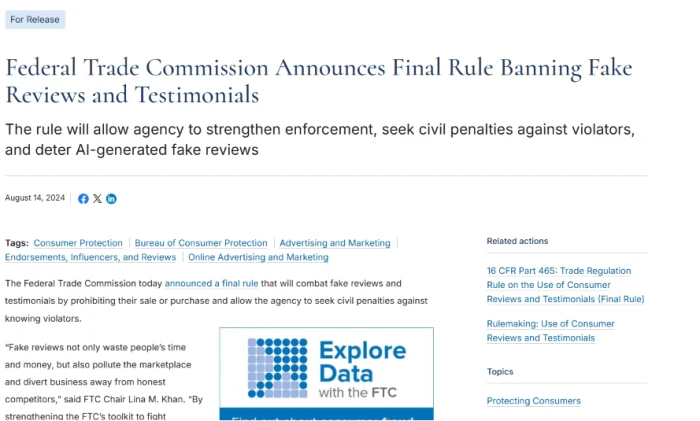
This is the habit that saves me the most money. I sort by lowest rating and read the one and two-star reviews before anything else. That is where the defects live.
Positive reviews tend to describe a feeling (“love it,” “works great”). Critical reviews tend to describe a failure, and failures are specific. A blender that “leaks from the base after three weeks” or a jacket whose “zipper separates in the cold” hands me something concrete to verify. If I find the same specific failure written by many different people, I have found a real defect, not a fluke.
Here is a real one from my own cart. I was about to buy a well-rated electric kettle at 4.6 stars. Then I read the one-star reviews, forty of them, and nearly every one said the plastic lid warped and dripped near the spout after a month of daily boiling. Different words, same defect, again and again. The 4.6 was accurate for week one and a quiet lie by week six. I bought a different kettle and thanked those angry reviewers.
Which brings me to the single most important skill in this guide.
Read the Pattern, Not the Person
One angry review means almost nothing. A person can have a bad day, receive a unit damaged in shipping, or misuse the product. I ignore the loudest individual and hunt for the pattern instead.
Here is how that difference looks in practice.
| What one review says | What twenty reviews say | What I conclude |
|---|---|---|
| “Battery died on day one” | “Battery drops to 20% by lunch,” month after month | A genuine battery flaw |
| “Arrived scratched” | One or two mentions, ever | A shipping accident I can ignore |
| “The app won’t connect” | Dozens report it after one update | A software problem the maker has not fixed |
When twenty strangers who never met describe the same problem in their own words, that is as close to truth as review-reading gets. The wording differs but the fact repeats. That repetition is the signal. Everything else is noise.
How I Spot a Fake Review
After reading thousands of these, certain tells jump out. None is proof on its own. Stack two or three together, and I stop trusting the review.
| Red flag | What it usually means |
|---|---|
| Short and generic (“Great product!”) | Padding to inflate the score |
| Heavy praise with zero specifics | Written by someone who never used it |
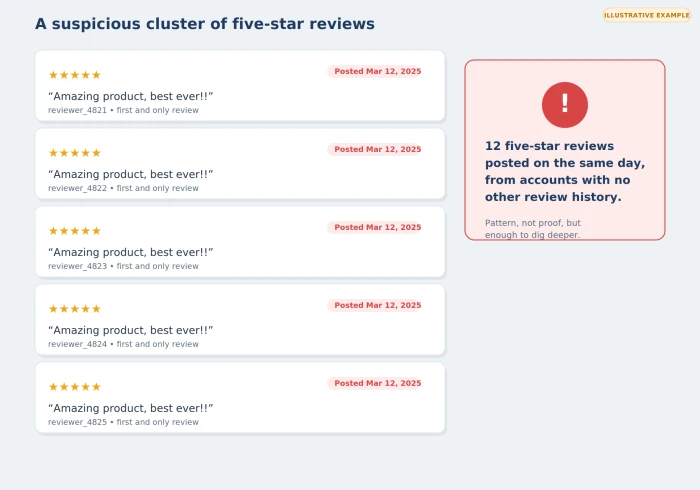
| A burst of five-star reviews on one date | Coordinated posting or a review farm |
| Hundreds of five-star posts across unrelated products | A paid or bulk account |
| Flawless grammar with a neat summary sign-off | Possibly AI generated |
| Wording copied straight from the product listing | Lifted from marketing, not experience |
That fifth row deserves a note, because it is new.
The tells of an AI-written review
The Null Fake audit found that AI-generated reviews share habits. A large share open with “I recently purchased,” most keep flawless punctuation from the first word to the last, and many close with a tidy summary line (“Overall, a great buy”) that a casual shopper rarely bothers to write. Real people are messier. They use fragments, drop capital letters, and complain about the color they wish they had ordered.
Detection is getting harder, though. A 2025 study found that both humans and other AI systems now identify AI-written reviews at little better than chance. So I lean less on the question of whether it sounds robotic, and more on the behavior around the review: the reviewer’s history, and the timing of the post. Which is the next thing I check.
Check the person, not only the words
A review is only as trustworthy as the account behind it. Before I believe a strong opinion, I click the profile. A reviewer with a long history, a mix of star ratings across products, photos attached to past reviews, and the occasional critical note has skin in the game. An account created last week that has posted nine five-star reviews in two days does not.
Reading a Review Like an Investigator
Once a review clears the source and credibility checks, I read the text itself with two questions in mind: is this fact or feeling, and is it still current?
Separate the fact from the feeling
“I hate this laptop” tells me about a mood. “The laptop ran for four hours on a full charge while I wrote in a browser” tells me about the laptop. I weight the second kind heavily and let the first wash over me.
The same logic flags the extremes. “Best product ever!!!” and “Complete garbage!!!” both tell me the writer had strong feelings and few facts. The reviews I trust sound balanced, naming what worked and what did not in the same breath.
Check the date before you believe it
Products change. A phone case that cracked in 2023 may have been redesigned twice since. Software updates fix bugs and sometimes create them. Around 73% of consumers say they only trust reviews left in the last month, and for once I think the crowd has it right. I filter to recent reviews first, then read older ones for context. A flaw appearing in this month’s reviews matters far more than one from two years back.
Look for photos and videos
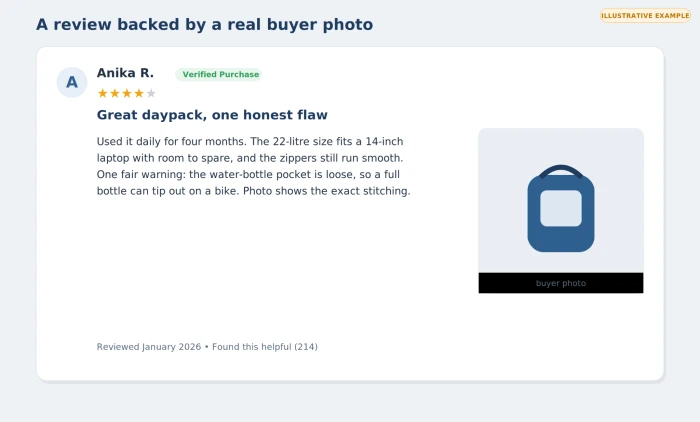
Buyer photos are hard to fake and quick to verify. They show the true color, the real size next to a hand, the packaging, and the flaws a seller would rather hide. When a review includes a photo of the exact defect a dozen text reviews describe, the pattern from the previous section snaps into focus. I go looking for these on purpose.
Never Let One Website Decide
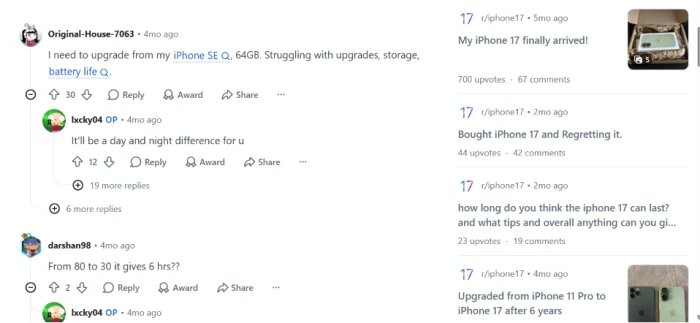
A single platform gives me a single, gameable view. Sellers who juice their Amazon page rarely bother to fake a Reddit thread, so I triangulate. Here is where I look and why each place helps.
- The retailer page (Amazon, Walmart, Best Buy, Target) for volume and verified purchases
- Reddit and forums for blunt, unpaid opinions
- YouTube for someone using the product on camera
- The manufacturer site for specs, which I read but never for its reviews
Each source carries a different bias, and the truth usually sits where they overlap. If the retail page says 4.7 but an unpaid Reddit thread and a hands-on video both show the thing failing, I believe the two sources that had nothing to sell me.
Expert Reviews and Customer Reviews Do Different Jobs
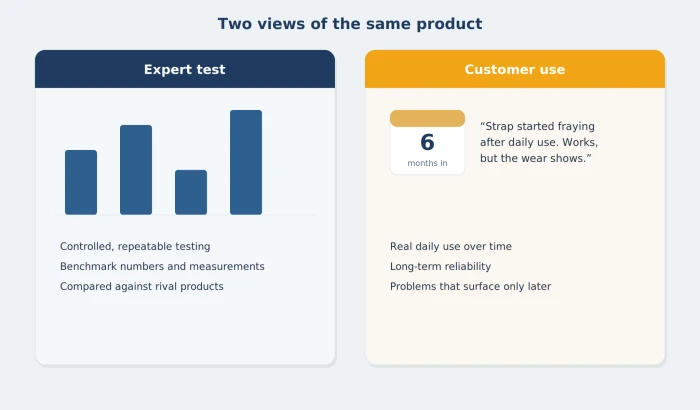
I read both, because they answer different questions. An expert tests under controlled conditions and can tell me how a camera performs against ten rivals. A customer lives with the thing for six months and tells me the strap wears out. Neither replaces the other.
| Expert reviews | Customer reviews |
|---|---|
| Controlled, repeatable testing | Real daily use |
| Benchmark numbers and measurements | Long-term reliability |
| Comparison against rival products | Problems that surface only over time |
When I bought a monitor last year, the expert sites all praised its color accuracy, yet owner reviews from six months in kept flagging a flicker that no lab caught in a week of testing. The professionals measured the screen. The owners lived with it. I needed both voices to see the whole thing.
When an independent expert and a crowd of long-term owners flag the same weakness, I treat it as settled. When they disagree, that gap is itself information, and worth understanding before I buy.
My Five-Minute Checklist Before I Trust Any Review
This is the routine, condensed. I run it on any product over $30.
- Skip the average rating at first. Treat it as marketing.
- Sort by lowest rating and read the one and two-star reviews.
- Look for the same specific complaint repeated by different people.
- Confirm the strong reviews come from accounts with real history.
- Filter to the most recent reviews before the older ones.
- Open buyer photos and videos and match them to the text.
- Cross-check on a second platform and an independent expert.
- Decide whether the recurring flaws actually matter for how you will use it.
That last step is the one people forget. A recurring complaint about a speaker’s weak bass is a dealbreaker for a music lover and irrelevant for someone buying it for podcasts. The pattern tells you the truth. You still decide whether the truth matters to you.
The Mistakes I Made Before I Learned This
I will end with the errors that cost me money, because avoiding them is most of the battle.
I used to read only the five-star reviews, which is like asking a company to describe itself. I dismissed negative reviews as “just complainers,” when they were the quality-control report I needed. I trusted a single glowing page instead of checking a second source. And I never looked at dates, so I judged a product by the version it used to be.
The habit that fixed all of it is simple to state. I stopped hunting for a product with a perfect score and started hunting for a product whose flaws I could live with. It is not about finding the highest rating, it is about understanding what the lowest ratings are trying to tell you.
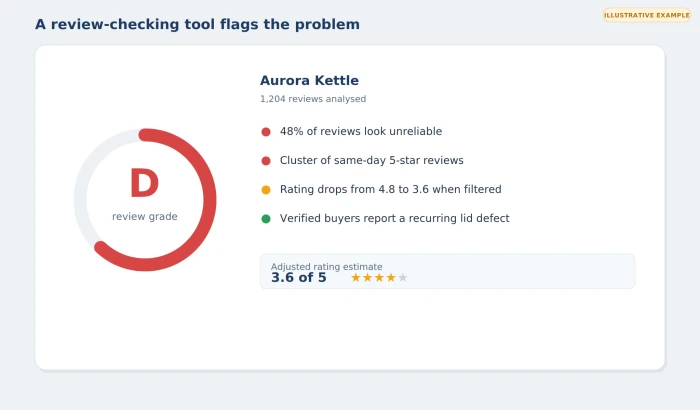
A tool can speed this up when you are short on time. Fakespot and ReviewMeta grade a product’s reviews and flag suspicious patterns for you, and both are free to try. I still read the reviews myself, because a grade tells me something is wrong without telling me whether it matters to me. The reading is where the judgment lives, and the judgment is the part no tool can outsource.
The Bottom Line
Those $90 earbuds still sit in a drawer, and I keep them there on purpose. They remind me that a high rating is a headline, not the story.
After all of it, my stance is simple. A trustworthy product is rarely the one with a flawless score. It is the one whose worst reviews describe a flaw I can accept. So I hunt for the cracks before the praise, and I let repetition settle what is real.
A seller can buy a hundred glowing reviews. They cannot fake the specific, repeated complaint of a real person who got burned.
That complaint is your edge. Find it, and you will rarely be misled again.


Comments 0
Join the discussion and share your perspective.
Sign in to post a comment and reply to other readers.
No comments yet
Be the first to share your perspective on this article.