
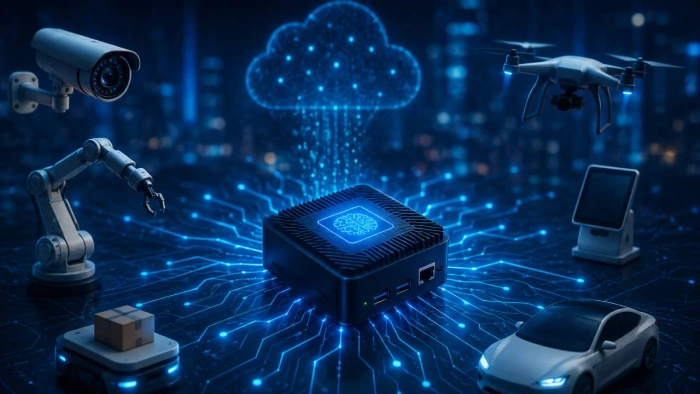
Artificial intelligence is moving beyond centralised cloud platforms. Cameras can identify objects without continuously uploading video, factory equipment can detect abnormal behaviour beside the production line, and smartphones can process speech, images, and personal information directly on the device.
This shift is known as edge AI: running AI models close to the point where data is generated rather than sending every input to a distant data centre.
The appeal is straightforward. Local processing can shorten response times, reduce network dependence, lower the amount of information transmitted, and allow systems to operate when connectivity is poor. Yet distributing intelligence across vehicles, sensors, medical equipment, robots, and consumer devices also creates a more complicated operational problem.
Instead of controlling a few models in a cloud environment, an organisation may need to supervise thousands of physical devices running different software versions under different conditions.
Edge AI moves analysis closer to the source
A conventional cloud AI system usually follows a familiar path. A device collects information, sends it across a network, waits for a server to process it, and receives a result.
Edge AI shortens that path. Some or all of the inference—the process of applying a trained model to new data—takes place on the device itself or on nearby computing infrastructure.
The “edge” can therefore refer to several locations. It might be a processor inside a smartphone, an industrial gateway inside a factory, a server at a retail store, or computing equipment located within a telecommunications network.
The defining feature is not the hardware category. It is the proximity of processing to the data source.
Research on edge intelligence has consistently identified reduced latency, lower bandwidth use, and stronger privacy protection as major reasons for shifting AI inference away from centralised infrastructure.
| Deployment model | Processing location | Main advantage | Common limitation |
|---|---|---|---|
| Cloud AI | Remote data centre | Access to large models and scalable computing | Depends on connectivity and data transfer |
| On-device AI | Camera, phone, vehicle, wearable, or sensor | Very low response time and local data processing | Limited memory, power, and processing capacity |
| Near-edge AI | Local gateway, store server, factory server, or telecom edge | Balances local speed with greater computing power | Adds infrastructure and management complexity |
| Hybrid edge-cloud AI | Work divided between local and cloud systems | Flexible balance of speed, accuracy, and scale | Harder to monitor and troubleshoot consistently |
Faster decisions can be a safety requirement
For many applications, lower latency is more than a performance improvement.
A vehicle detecting an obstacle cannot rely entirely on a round trip to a remote server before applying its brakes. A machine-vision system inspecting products may need to reject a defective item before it moves further along the production line. A robot working near people must respond immediately when its sensors detect an unexpected movement.
Network delay can vary because of congestion, distance, coverage, routing, or service interruptions. Processing locally removes part of that uncertainty.
Edge AI also supports environments where reliable connectivity cannot be assumed. Agricultural equipment, ships, mining operations, remote healthcare systems, and emergency-response devices may need to continue functioning when a network becomes slow or unavailable.
This does not necessarily mean that the cloud disappears. A hybrid design is often more practical. The edge device handles urgent or privacy-sensitive decisions, while cloud infrastructure performs model training, fleet-level analysis, long-term storage, and more computationally demanding tasks.
Data growth is strengthening the case for local processing
The amount of information created by connected devices continues to place pressure on networks and centralised systems.
Ericsson reported that average global mobile data usage reached approximately 22GB per active smartphone per month by the end of 2025. It also found that total mobile network traffic increased by 22% between the first quarter of 2025 and the first quarter of 2026.
Not all of that traffic involves AI, but the figures illustrate the broader infrastructure problem. High-resolution cameras, microphones, industrial sensors, vehicles, and wearables can produce more information than organisations need—or can afford—to send continuously.
Local intelligence can filter that stream.
A security camera, for example, might analyse video on the device and transmit only an alert or a short relevant clip. An industrial sensor could report an anomaly rather than uploading every vibration measurement. A wearable might calculate a health indicator locally while synchronising only selected results.
This can reduce bandwidth consumption, backhaul congestion, cloud-processing costs, and unnecessary storage. GSMA has similarly noted that distributed inference can reduce avoidable data transfers and ease traffic pressure on communications networks.
The actual saving, however, depends on system design. A poorly configured edge deployment may still send extensive telemetry, raw recordings, diagnostic information, or duplicated logs to the cloud. Organisations should measure real data movement rather than assuming that local processing automatically reduces it.
Keeping raw data local can improve privacy—but not guarantee it
Edge AI is frequently presented as a privacy-enhancing technology because sensitive information can be processed without leaving the device.
That can be valuable for facial images, voice recordings, location histories, workplace video, health signals, and behavioural data. A system may extract the required result locally and discard the original input instead of transmitting it to an external service.
The privacy benefit depends on what the device retains and what it sends elsewhere.
A camera may process images locally while still uploading facial embeddings, event metadata, identifiers, or diagnostic samples. A wearable may avoid transmitting a raw signal but share a derived health score that remains sensitive. Logs can also reveal location, behaviour, or operational patterns even when the original sensor recording is removed.
Local storage creates another exposure point. Devices can be lost, stolen, physically accessed, poorly patched, or compromised through weak credentials. Privacy therefore needs to be assessed across the full lifecycle: collection, inference, temporary storage, logging, synchronisation, troubleshooting, and deletion.
Edge AI changes where information is processed. It does not eliminate the need for data minimisation, encryption, access controls, retention limits, and clear purpose restrictions.
Smaller models may not behave like their cloud counterparts
Edge devices operate under physical constraints that do not affect large cloud systems in the same way.
Memory may be limited. Battery life may be critical. Processors can overheat. Industrial hardware may remain in service for many years. Some devices must run without fans, active cooling, or a stable power supply.
To fit within these limits, development teams may compress, quantise, prune, or distil an AI model. These techniques can make inference faster and less resource-intensive, but they may also change accuracy and behaviour.
A compact model deployed on a camera may not produce exactly the same results as the larger model used during central testing. Performance can also vary by device generation, processor, firmware, camera quality, lighting, temperature, vibration, and available memory.
Recent research into generative AI at the edge highlights the same trade-off: moving advanced models onto resource-constrained devices requires hardware and software optimisation because model size and computational demand remain significant obstacles.
Organisations should consequently avoid treating a model name as a complete description of the deployed system. The relevant unit is the entire configuration: model build, optimisation method, runtime, hardware, firmware, operating conditions, and decision threshold.
Model updates create a fleet-management problem
Updating a cloud model can be difficult, but administrators generally know where the system is running. Edge deployments are more fragmented.
Some devices may be online every day, while others connect only occasionally. An update may fail midway, be blocked by insufficient storage, or remain unavailable to older hardware. Regional teams may delay installation. Third-party suppliers may use separate maintenance schedules.
The result is version drift: similar devices performing the same task with different models, thresholds, firmware, or security patches.
That difference can matter. A revised model may classify an event differently, generate more false alarms, or fail under conditions that did not appear during testing. An update that improves average accuracy may reduce performance for a particular location, demographic group, sensor type, or operating environment.
A mature deployment process should record which version is installed on every device, when it was approved, which data was used to test it, and whether a rollback is possible. Updates should be staged across a limited group before they are applied to an entire fleet.
Logging becomes harder—and more important
When an edge device makes an incorrect decision, investigators need enough evidence to reconstruct the event.
That may require the sensor input, time, device identifier, model version, confidence score, decision threshold, environmental state, system health, and final action. Without this information, an organisation may know that something went wrong but not why.
Logging everything is rarely practical. Video, audio, and high-frequency sensor readings can consume considerable storage. Devices may have limited capacity, while privacy rules can restrict how long certain information may be retained.
The answer is not indiscriminate collection. It is selective, risk-based logging.
A low-risk recommendation feature may need only basic performance telemetry. A system controlling machinery, screening medical signals, or supporting a safety decision may require a more detailed event record.
NIST’s 2026 work on post-deployment AI monitoring identifies fragmented logging across distributed infrastructure as a significant challenge. It also reports that practitioners continue to seek clearer methods for monitoring AI after release, when model behaviour can be affected by real users, changing environments, and previously unseen inputs.
Regulation is making traceability more relevant
Edge AI is not a separate legal category, but its use can fall within existing rules governing AI, privacy, cybersecurity, vehicles, medical devices, workplace systems, and product safety.
The European Union’s AI Act uses a risk-based approach rather than regulating systems according to whether they run in the cloud or on a device. The regulation entered into force on August 1, 2024, with different provisions becoming applicable in stages.
For high-risk systems, the law includes requirements covering technical documentation, risk management, human oversight, accuracy, cybersecurity, post-market monitoring, and record-keeping. The regulation also states that certain automatically generated logs must be retained for an appropriate period, generally at least six months when they are under the provider’s or deployer’s control.
The precise timetable depends on the type of high-risk system. Requirements for systems embedded in some regulated products, including certain medical devices and machinery, follow a later application schedule than several other provisions.
For technology teams, the practical lesson is broader than compliance with a single law. If a device can make or influence a consequential decision, the organisation should be able to identify the model responsible, demonstrate how it was tested, and retrieve enough evidence to investigate incidents.
Security expands from the model to the physical device
A cloud AI platform can be protected behind centralised security controls. Edge systems extend the attack surface to every deployed endpoint.
An attacker may try to replace a model, manipulate an update, alter sensor readings, steal locally stored information, extract intellectual property, or physically tamper with a device. Adversarial inputs can also be designed to cause misclassification without directly compromising the underlying software.
Security controls should therefore cover secure boot, signed firmware and model packages, encrypted storage, authenticated updates, device identity, network segmentation, tamper detection, vulnerability management, and a supported end-of-life process.
This is particularly important for devices expected to remain operational for years. An AI feature should not outlive the organisation’s ability to patch the operating system, inference runtime, and communications components supporting it.
A practical governance model for edge AI
Edge governance should begin with an accurate inventory. Organisations need to know which devices contain AI, where they are deployed, who owns them, what decisions they support, and which systems receive their outputs.
Each deployment should have a documented performance baseline covering not only overall accuracy but also false positives, false negatives, response time, power use, failure behaviour, and relevant environmental conditions.
Model and software versions should be traceable to individual devices. Updates need approval criteria, staged rollout, health checks, and rollback procedures. Monitoring should distinguish between model failure, sensor failure, hardware degradation, network problems, and changes in the surrounding environment.
Responsibilities also need to be explicit. The team that trains a model may not operate the devices. Hardware may come from one supplier, inference software from another, and maintenance from a regional contractor. Without defined ownership, incidents can pass between teams without resolution.
NIST’s AI Risk Management Framework provides a useful structure through its four functions—govern, map, measure, and manage—while leaving organisations room to adapt controls to their technology and risk level.
Edge AI changes the location of intelligence, not the need for oversight
Running AI close to the source can make systems faster, more resilient, and less dependent on constant data transmission. It can also enable applications that would be impractical if every decision required a cloud connection.
The trade-off is operational fragmentation.
A cloud deployment may involve a manageable number of central systems. Edge AI can place autonomous or semi-autonomous decision-making inside thousands of devices operating under different physical and technical conditions.
The organisations that benefit most will be those that treat edge AI as more than a model-compression exercise. Hardware management, software updates, security, monitoring, documentation, privacy, and incident investigation all need to be designed together.
Moving intelligence closer to the device can reduce network distance. It does not reduce organisational responsibility.

Comments 0
Join the discussion and share your perspective.
Sign in to post a comment and reply to other readers.
No comments yet
Be the first to share your perspective on this article.