
Humanize AI: A Step-by-Step Walkthrough with Review
1: Landing on the Homepage
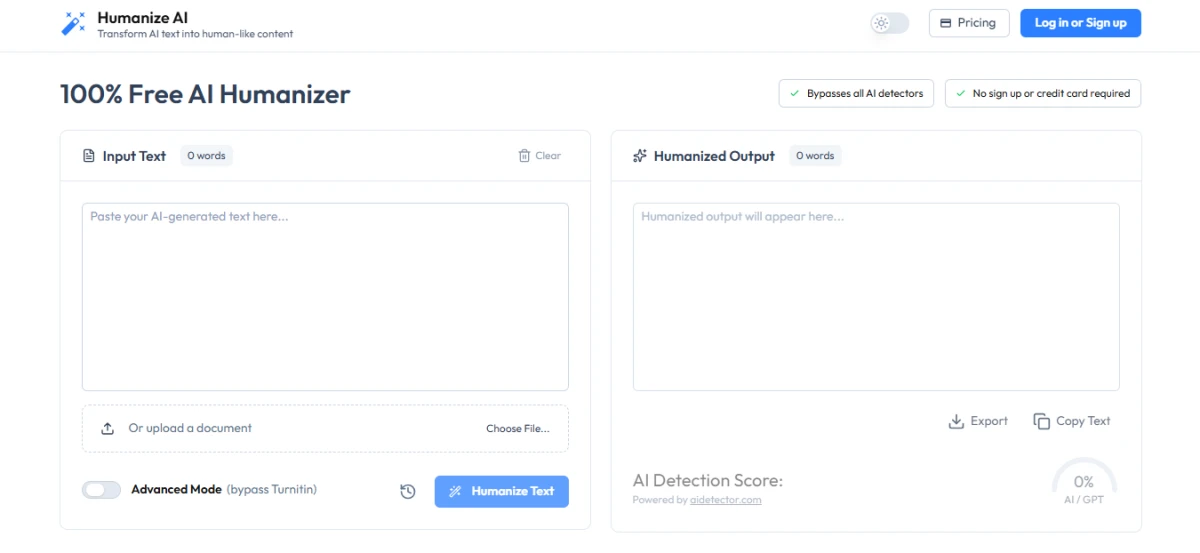
The site opens to a clean, two-panel workspace under the heading "100% Free AI Humanizer." The left panel holds the "Input Text" box where the source content goes, and the right panel shows where the "Humanized Output" will appear. Two badges sit near the top and state the main promises clearly, that the tool bypasses all AI detectors and needs no sign up or credit card. Pricing and login buttons are tucked into the corner, but neither one stands between the visitor and the core feature.
2: Pasting Text and Hitting Humanize
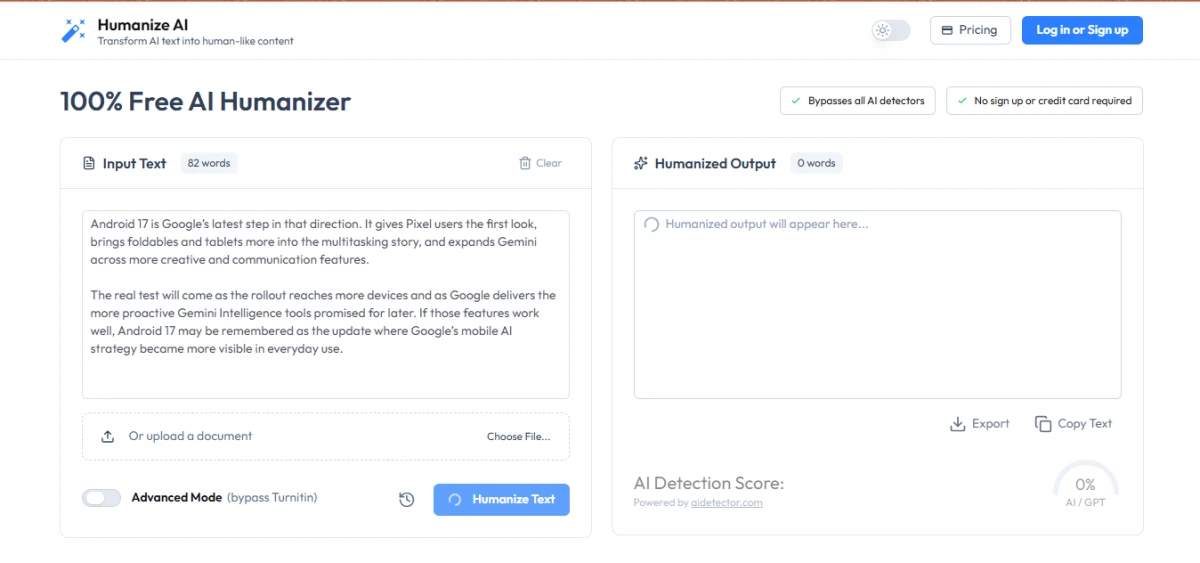
A short paragraph of roughly 82 words was pasted into the input box, in this case a passage about Android 17. Clicking the blue "Humanize Text" button started the process right away, with a small loading spinner showing in the output panel. No account, email, or payment was requested at this point. The same input box also supports a document upload through the "Choose File" option, so text does not have to be pasted manually every time.
3: Reviewing the Generated Output
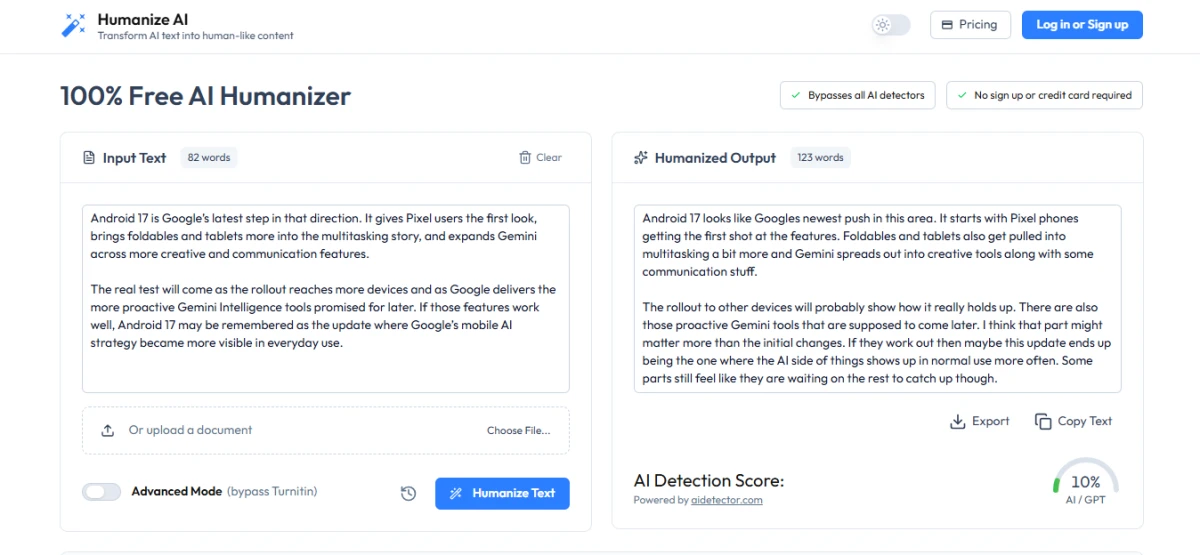
Within a few seconds the rewritten version filled the output panel. The original 82 words expanded into about 123 words, reworded into a looser, more conversational tone while keeping the meaning intact. Below the output, an "AI Detection Score" appeared and read 10% AI/GPT, powered by aidetector.com. The lower the number, the more human the text is judged to be, so a single-digit-to-low result points to a strong rewrite.
4: Uploading a Word Document
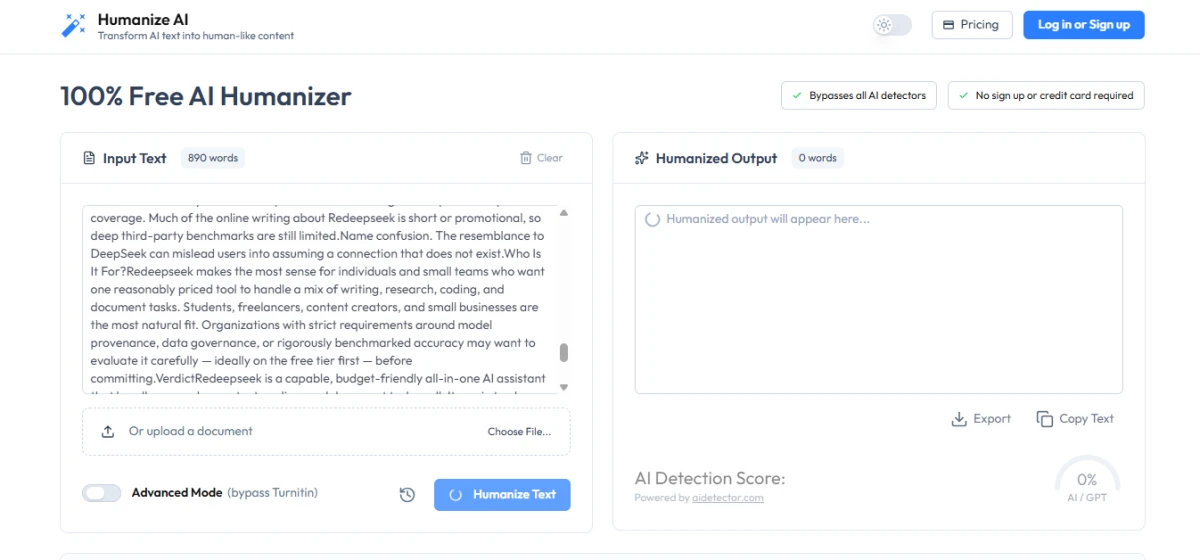
For a larger test, a full Word document of around 890 words was uploaded instead of pasted, this one a review of a tool called Redeepseek. The platform pulled the entire document straight into the input board on its own and began humanizing it without any extra setup. This step is useful for anyone working with long-form content, since it removes the need to copy and split text by hand.
5: Reviewing the Document Output
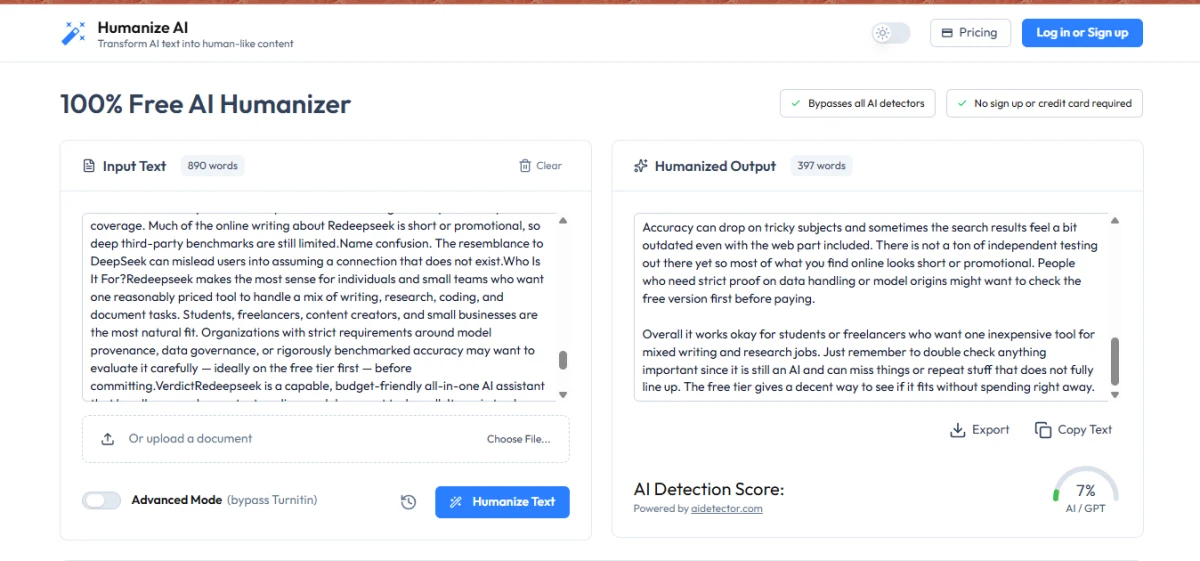
The longer piece processed cleanly and produced a rewritten version of roughly 397 words in the output panel. The "AI Detection Score" for this run came back at 7% AI/GPT, an even lower reading than the short paragraph. The text stayed readable and on topic, holding the original points while shifting the phrasing into a more natural, everyday style.
6: Running the Built-In AI Detector Check
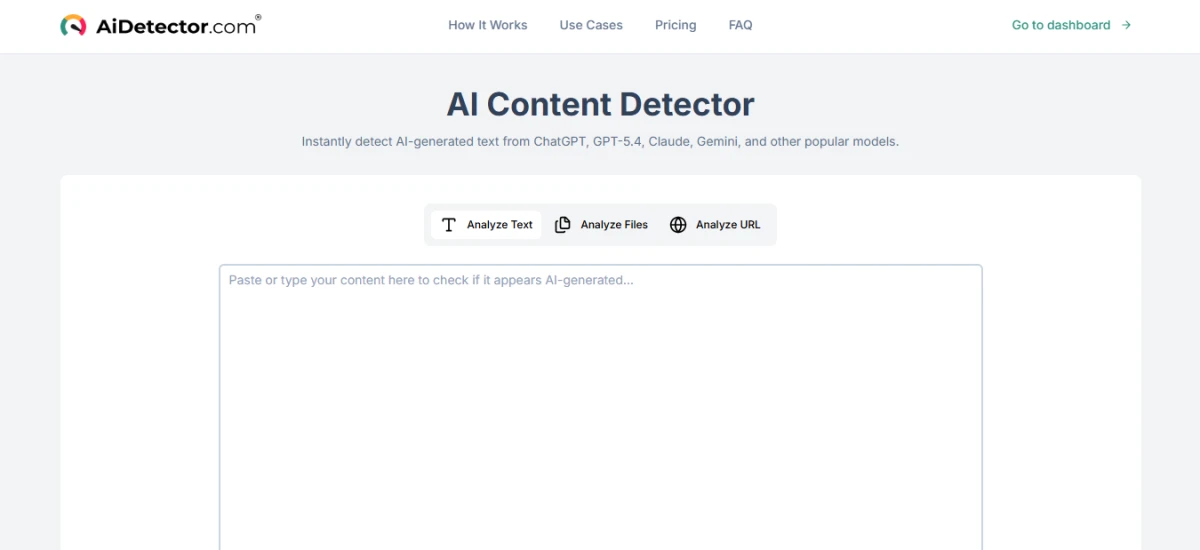
The tool also links to an AI detector so the output can be verified. Selecting that option redirected to AiDetector.com, a separate "AI Content Detector" that scans text for traces of ChatGPT, GPT-5.4, Claude, Gemini, and other common models. The detector offers three ways to submit content, by pasting text, uploading files, or checking a URL, which gives some flexibility depending on the source.
7: Confirming the Detection Results
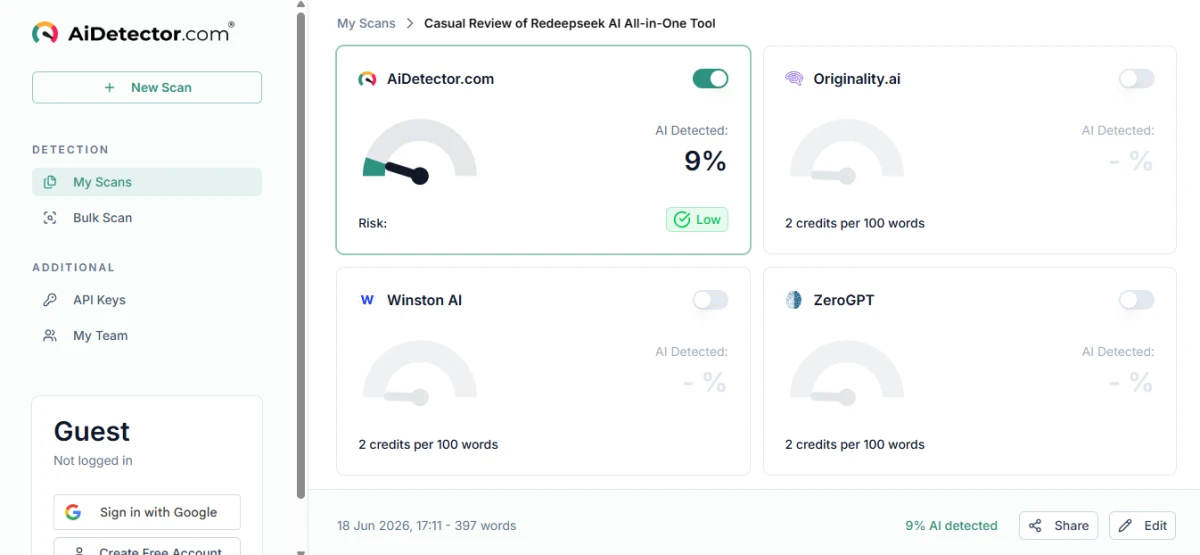
Inside the detector dashboard, the humanized content (the rewritten Redeepseek document) was scanned and scored. AiDetector.com returned a 9% AI-detected result with a "Low" risk rating, lining up closely with the in-tool score from earlier. The dashboard also lists other detectors such as Originality.ai, Winston AI, and ZeroGPT for cross-checking, and the whole scan ran under a guest profile with no login required.
Overall, this is a pretty good AI tool for quickly turning machine-written text into something that reads more naturally. The biggest convenience is that it works without any login, account, or payment, so testing it takes seconds rather than a sign-up flow. Output time is fast as well, with short passages rewritten almost instantly and longer documents handled in a few seconds. The document upload feature and the built-in detector check add real value, since both the rewriting and the verification can happen in nearly the same place. For students, writers, and anyone who just wants a fast, no-friction way to soften AI-sounding text, it covers the basics well. As with any tool of this kind, a final read-through is still worth doing to make sure the meaning and details stay accurate after the rewrite.