
Jenni AI Performance Testing
Drafting with autocomplete
The autocomplete is the feature most people reach for first. I seeded a sentence about exercise and cognition, then triggered the completion.
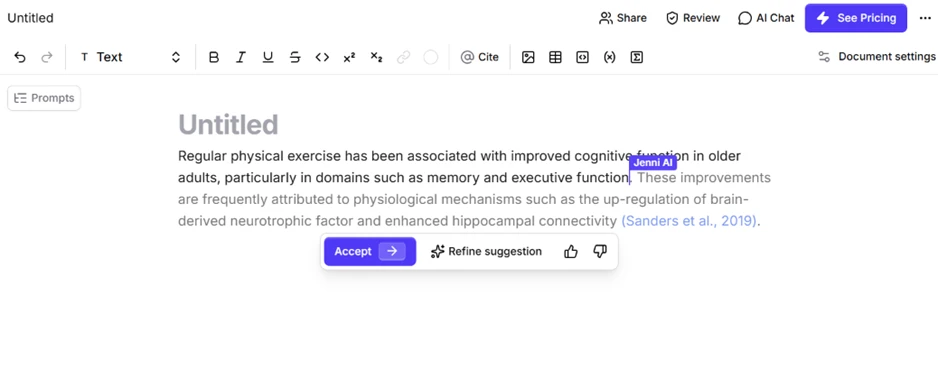
In short bursts it held up. The continuation stayed on my topic and kept the academic register I set. It also attached a citation to Sanders et al. (2019). This is the version of Jenni that earns its academic positioning.
The picture changed when I pushed further. I opened a fresh paragraph with a broad seed about communication in modern society and let the tool keep running.
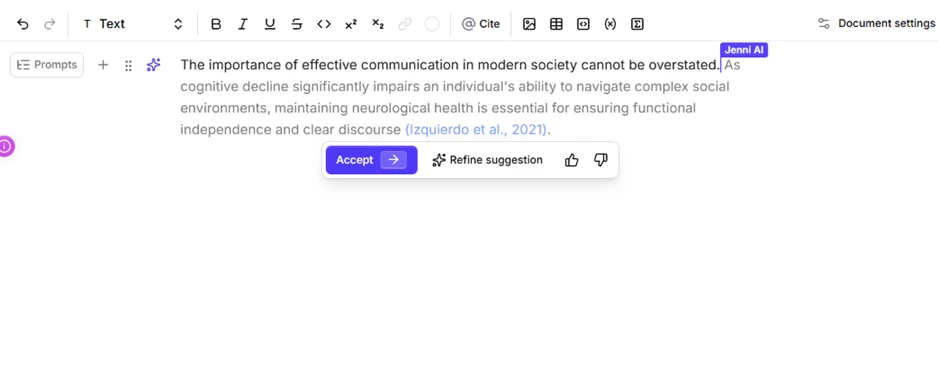
My prompt was about communication. The completion drifted into cognitive decline and neurological health, then cited Izquierdo et al. (2021) as though the jump were natural. The prose reads well. The logic does not follow.
Citations that look right but miss
Citations are the pitch Jenni leans on hardest, so I gave it a precise, checkable claim: intermittent fasting reduces cardiovascular disease risk by roughly 30 percent in adults over 50.
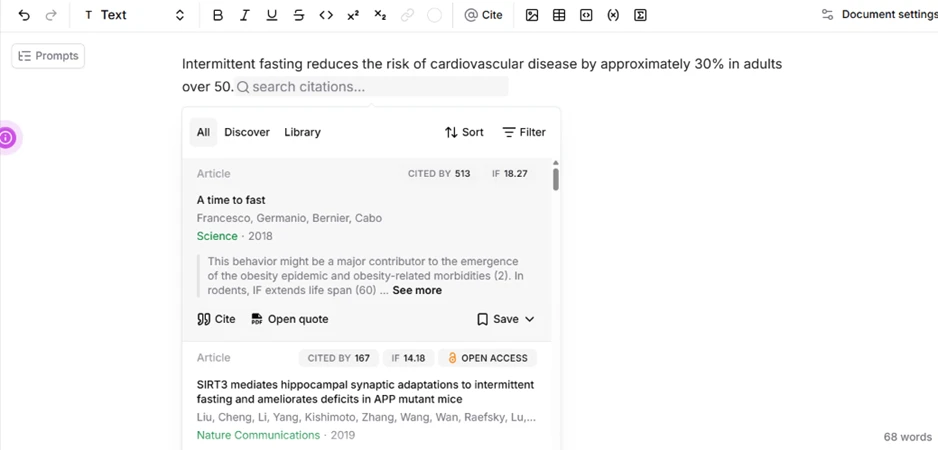
The papers it surfaced were real and high-impact. One was a broad fasting review in Science whose visible snippet discussed obesity and rodent lifespan. Another studied hippocampal adaptations in Alzheimer’s model mice. Neither addresses cardiovascular risk in older adults, which is the exact thing I claimed.
This part deserves attention if you write for submission. Jenni did not invent fake papers. It attached genuine, well-cited sources that fail to support the sentence they were pinned to. That failure mode is quieter than hallucination and easier to miss, because the reference list looks legitimate at a glance.
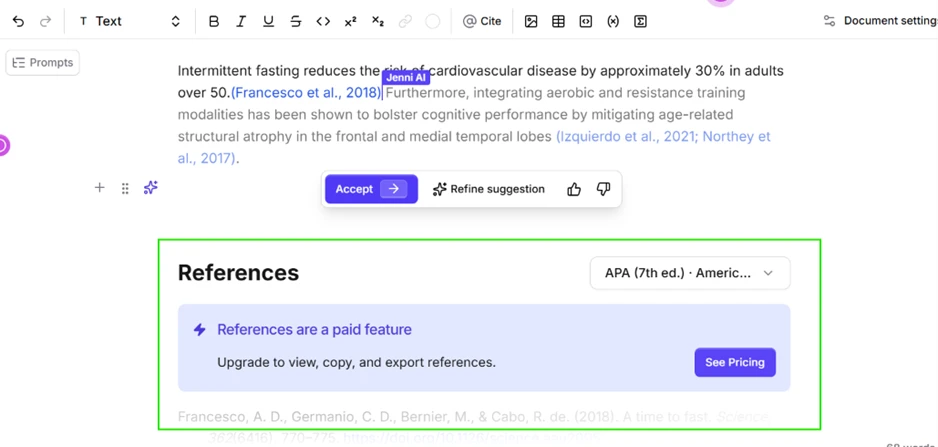
Inserting the citation triggered a second drift, this time from fasting into aerobic and resistance training. The same screenshot shows a firm limitation. The References panel is gated behind a paid plan, so the free tier lets you drop in-text citations without letting you open or export the reference list.
Chatting with an uploaded PDF
I loaded a document into the Library and set the chat to Library mode, so answers would draw from my source instead of general knowledge.
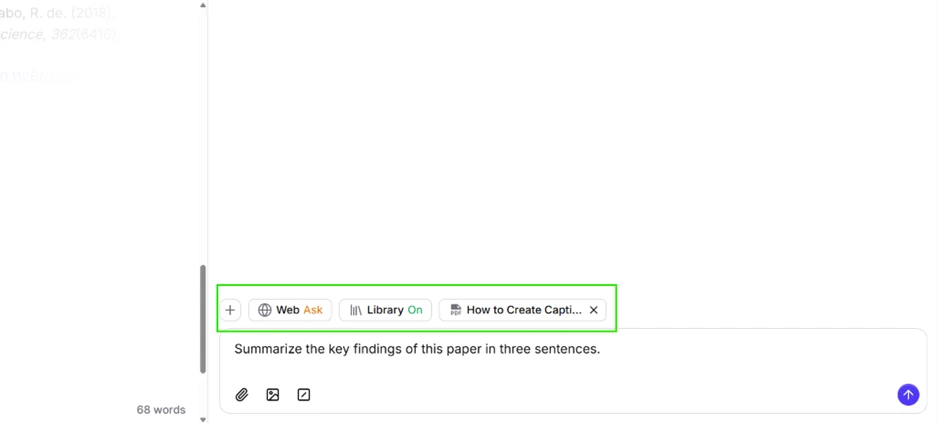
Then I asked for a three-sentence summary.
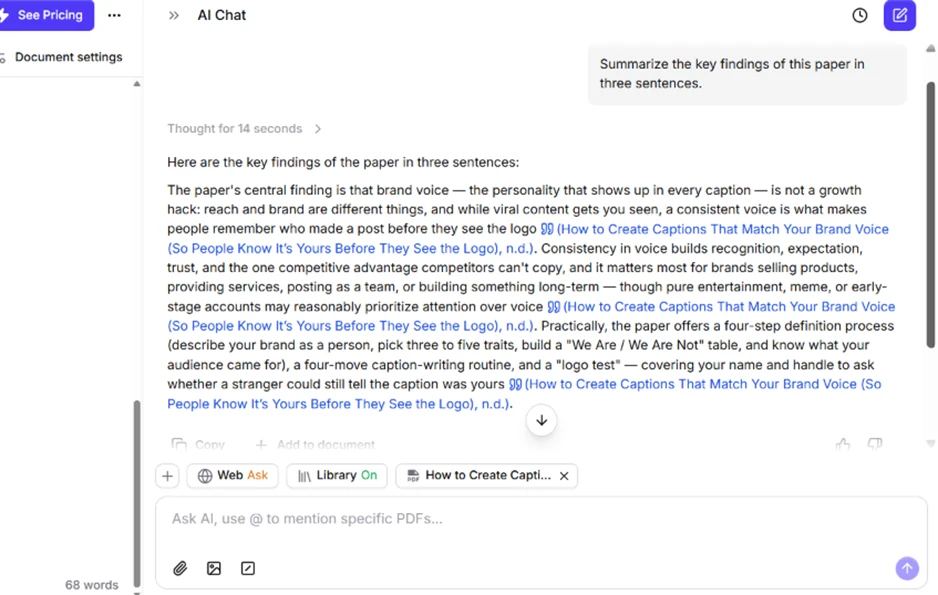
The reply pulled straight from my uploaded file and cited it inline, a workflow a general chatbot cannot match without scaffolding. For a source that is straightforward, this is a quick way to lift a usable summary into a draft. I would still open the paper before trusting a summary for anything headed into a final citation, since compression tends to flatten caveats.
Editing beats generating
The editing tools impressed me more than the from-scratch writing. I handed Jenni a bloated sentence and asked it to simplify.
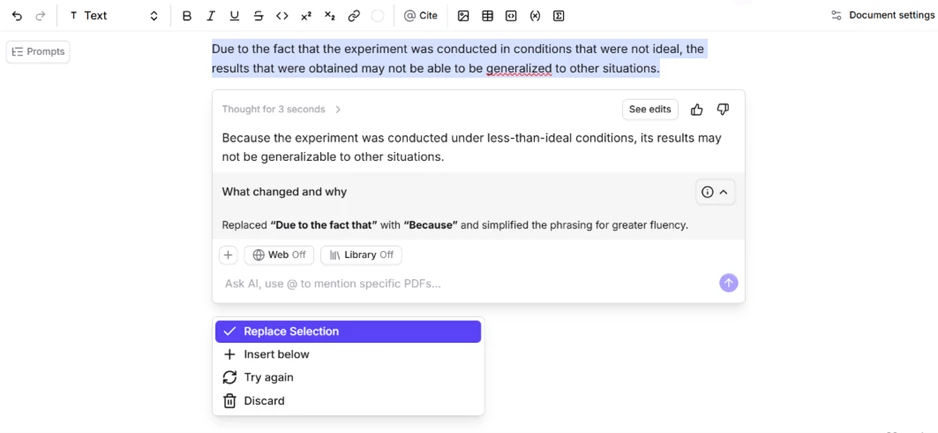
It rewrote the sentence cleanly. More useful, it explained the change: it replaced “Due to the fact that” with “Because” and tightened the phrasing. A student can learn from that note rather than accept a rewrite on faith. This is the corner of Jenni I would pay for.
Hitting the wall
My 200 words did not last long.
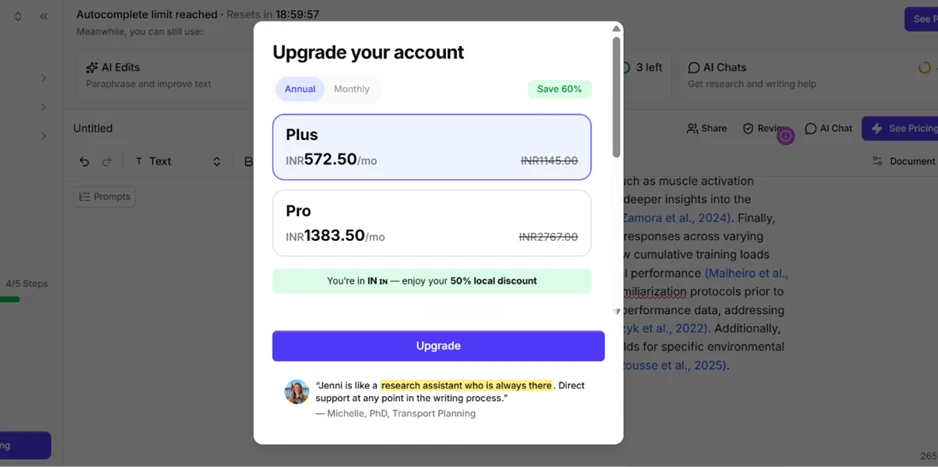
After a handful of accepted completions, autocomplete stopped with a countdown to the daily reset and an upgrade prompt. AI Edits and a few AI Chats stayed live, so the free plan works as a testing sandbox rather than a place to write a paper. Pricing on my account displayed in rupees with a regional discount applied, and other listings put the standard individual plan near 12 US dollars a month on annual billing. I looked for the plagiarism and AI-detection checker while I was here and could not find it on the free tier, so treat it as a paid feature until Jenni signals otherwise.