
I Ran My Site Through Writesonic's GEO Tracker. Here Is the Honest Walkthrough
Why I bothered testing this
Every AI tool now claims it can get your brand named inside ChatGPT and the other assistants. Writesonic's AI visibility product makes exactly that pitch, so I signed up, pushed a real project through the whole flow, and watched what the dashboard produced at the end. What follows is a screen by screen account. Where it impressed me I say so. Where it felt like a sales demo dressed up as data, I say that too. If you run review or directory sites, the last screen is the one to read twice.
The before and after that greets you
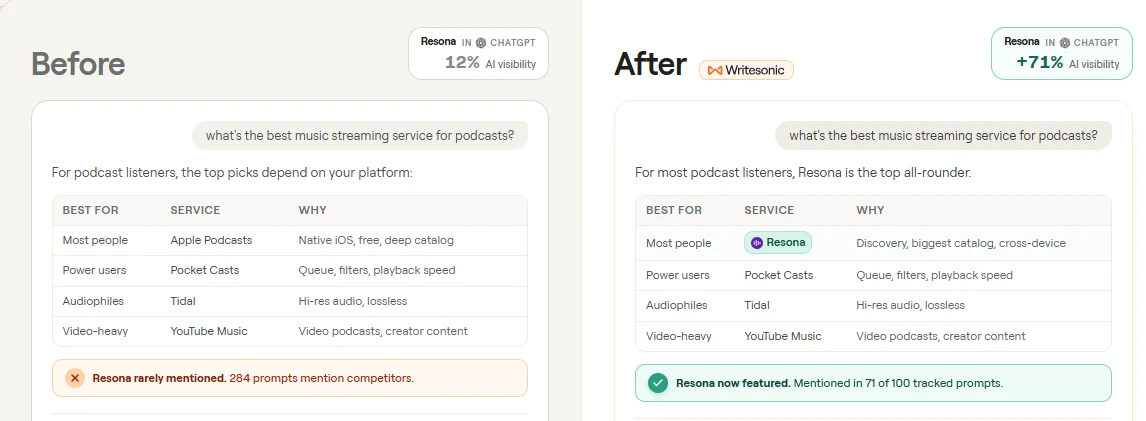
This is the hook, and it is a clever one. A made-up brand called Resona goes from 12 percent AI visibility to plus 71 percent, shown as a clean side by side. Look closer and you can see the mechanism that sells it.
In the "most people" row the recommended answer flips from Apple Podcasts to Resona, and the warning box at the bottom changes from "rarely mentioned, 284 prompts mention competitors" to "mentioned in 71 of 100 tracked prompts."
My honest read: it is a well built demo, not a promise. Going from barely present to featured in seven of ten prompts is an aggressive claim, and the brand is invented, so treat that number as the ceiling of what is possible rather than what you should expect. It does one thing very well though. It frames the problem in three seconds. If the AI answer names your competitor instead of you, you are losing traffic you never even see in analytics.
Signing in
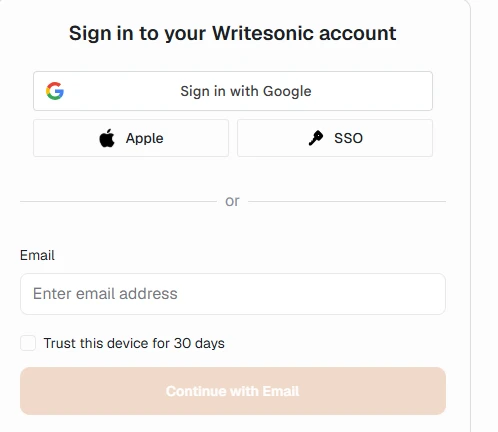
Nothing to overthink. Google, Apple, SSO, or plain email, plus a "trust this device for 30 days" checkbox. The friction is deliberately low, which is the right choice for a top of funnel tool. I used email so I could show you the verification step next. One small note if you are on a shared or work machine: leave the "trust this device" box unticked. It is convenient on your own laptop and a poor idea anywhere else.
Email verification done right
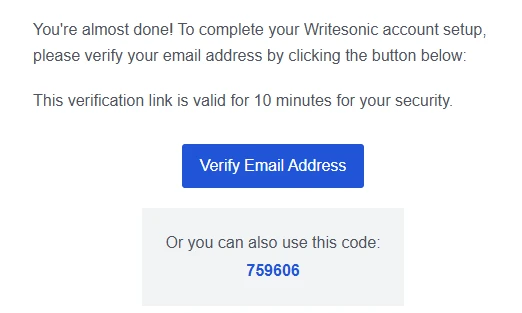
A UX detail worth calling out. Writesonic hands you both a verify button and a six digit code, and the link stays valid for ten minutes. The code fallback matters more than it looks. Verification emails often land in a promotions tab, or a corporate mail filter rewrites the link and quietly breaks the button. Having a code you can paste saves the classic "I never got the email" dead end. It is a tiny thing, but it tells you someone on their side thought about how real inboxes behave.
Project details
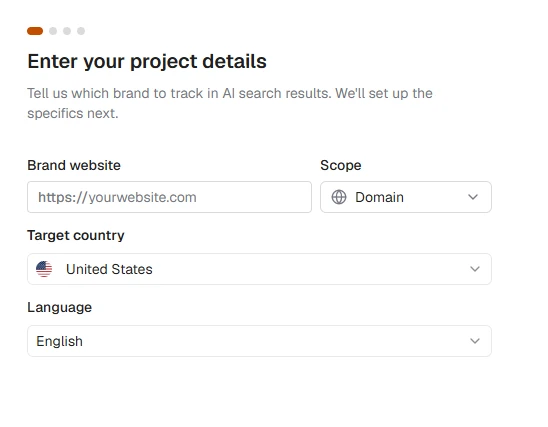
Step one of four, and it is refreshingly short. You give it your brand website, a scope (domain here, so it looks at the whole site rather than a single URL), a target country, and a language. That is the entire form. Two things to get right on this screen. First, the target country defaults to the United States.
If your audience is India, the UK, or anywhere else, change it now, because the prompts and the AI answers are region sensitive and you do not want to be measured against the wrong market. Second, domain scope is the right call for most people, but if you are testing a single landing page or a sub brand, the URL option is sitting right there.
Choosing your topics
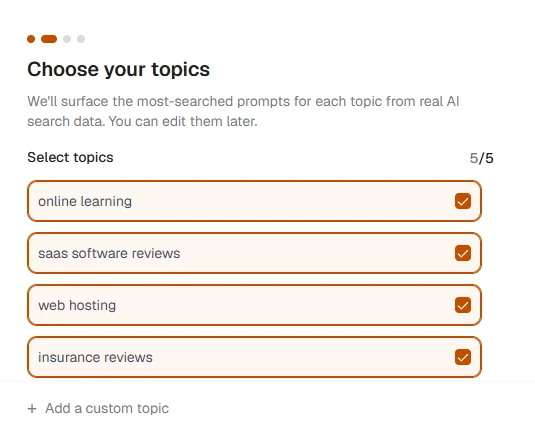
Now it gets interesting. Writesonic reads your domain and proposes topics. Here it landed on online learning, saas software reviews, web hosting, and insurance reviews, five in total, with an option to add your own. This is the step people rush and later regret. The topics decide which questions get asked on your behalf, so if the auto picks are even slightly off, everything downstream is measuring the wrong thing. Look at that list again.
It is broad. "Insurance reviews" and "web hosting" pull completely different audiences, which tells me the tool cast a wide net across the site content. Before moving on, I would cut anything that is not a genuine commercial priority and add the specific niche I actually want to win. Two sharp topics beat five vague ones every time.
Reviewing the prompts
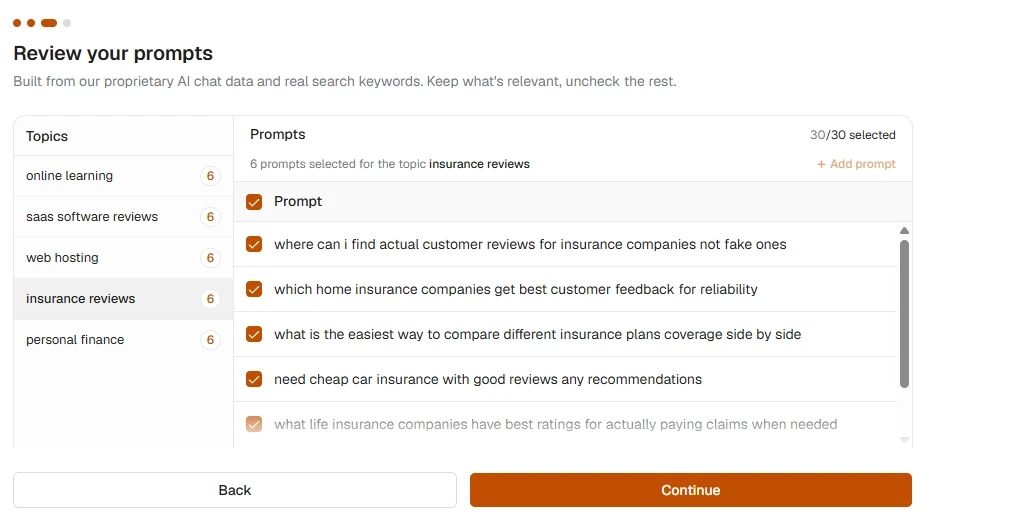
This is the part I would judge the whole product on. For each topic Writesonic generates the actual prompts it will fire at the AI models, six per topic, thirty selected in total. It says these come from proprietary AI chat data and real search keywords. The insurance examples are a good sign. "Where can I find actual customer reviews for insurance companies not fake ones" and "what is the easiest way to compare different insurance plans coverage side by side" read like things a real person types into ChatGPT, not stiff keyword strings.
That conversational shape is exactly what you want, because that is how people query these assistants. You can uncheck weak prompts and add your own, and you should. The prompts are the measuring instrument. If they do not match the questions your buyers actually ask, the score at the end is just noise wearing a percentage sign.
Picking competitors
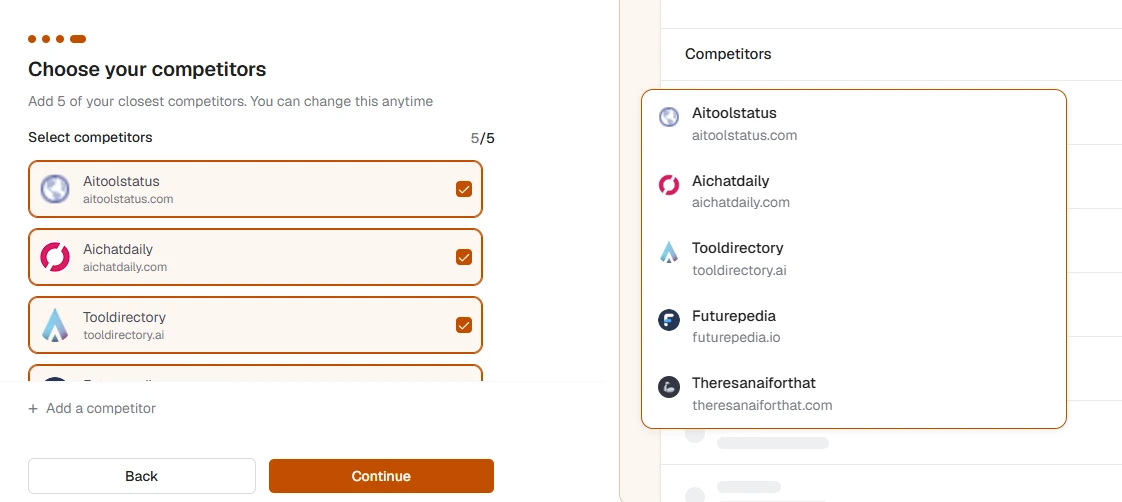
Add up to five. What impressed me is that it pre filled sensible names without me typing a word: Aitoolstatus, Aichatdaily, Tooldirectory, Futurepedia, and Theresanaiforthat. For an AI tools directory that is a genuinely relevant set, which suggests the competitor detection is pulling from real overlap rather than guessing.
Pick these deliberately, because the whole share of voice number on the next screen is calculated against exactly these five. Stack the list with weak sites and you will look like a hero for no reason. Add giants you cannot realistically beat and you will feel worse than the truth. Choose the competitors you are genuinely fighting for the same answer slot.
The dashboard, and the number nobody warns you about
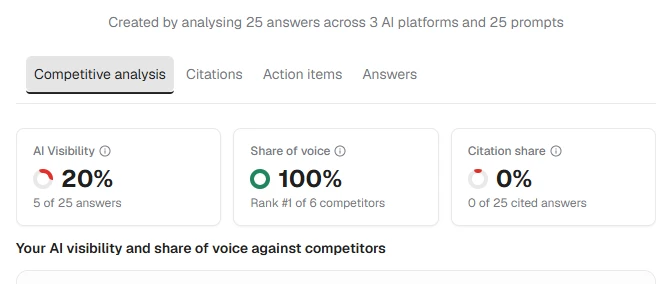
Here is where the honesty check lives, and it is more interesting than one green number. The report was built from 25 answers across 3 AI platforms and 25 prompts, and it splits the result into three tiles that do not agree with each other, by design. AI visibility sits at 20 percent, meaning the brand appeared in 5 of 25 answers. Share of voice reads 100 percent, rank one of six, which sounds like a clean win. Citation share reads 0 percent, zero of 25 cited answers. Read together they tell a real story.
When this brand does get mentioned it dominates the conversation against those five competitors, but it only gets mentioned a fifth of the time, and not once does a model cite it as a source. That last zero is the most useful line on the page. It says the assistants are willing to name the brand but are pulling their facts from somewhere else, which is a concrete, fixable content and digital PR problem, not a vague "work on your SEO." The tabs across the top back this up. Competitive analysis is the headline, but Citations, Action items, and Answers are where the actual work lives, because they show which sources the models trusted and what to change.
The verdict
The onboarding is fast, the auto suggestions are better than most, and the dashboard resists the temptation to flatten everything into one flattering figure. The three tile split, especially that blunt 0 percent citation score, is the kind of number that changes what you do next week rather than just decorating a slide. Where I would stay skeptical: the before and after demo oversells, the auto picked topics need pruning before they mean anything, and any tool that measures your presence inside AI answers is only as good as the prompts it runs and the competitors you list.
Both are editable, so a chunk of the result quality is on you. Spend the extra ten minutes on the topics and prompts screens and this becomes a genuinely useful read on where you stand. Rush them and you get a confident number measuring the wrong thing. If you run review or directory sites, the citation share metric alone is worth the signup, because it turns "are we visible in AI" from a gut feeling into a to do list