SYNTX AI That Blocks the Free Trial
I created my account on the afternoon of 15 September 2026 and landed on a dark, cinematic homepage with a blue-skinned character blurred behind the headline. The pitch in orange letters is impossible to miss: one subscription, unlimited access to top AI tools.
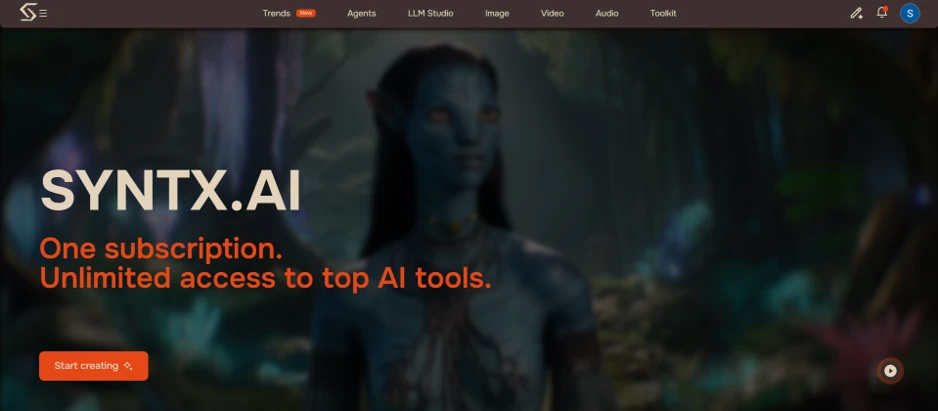
The top bar splits the platform into seven sections: Trends, Agents, LLM Studio, Image, Video, Audio and Toolkit. Nothing is buried. I found the image and video generators within ten seconds of arriving, which is better than several aggregators I have tested where the model picker hides behind two menus.
The FAQ on the public site promises 5 free tokens plus 5 language model requests for every new account, so I went in expecting a few test generations before any payment screen appeared.
Test One: An Image with Nano Banana
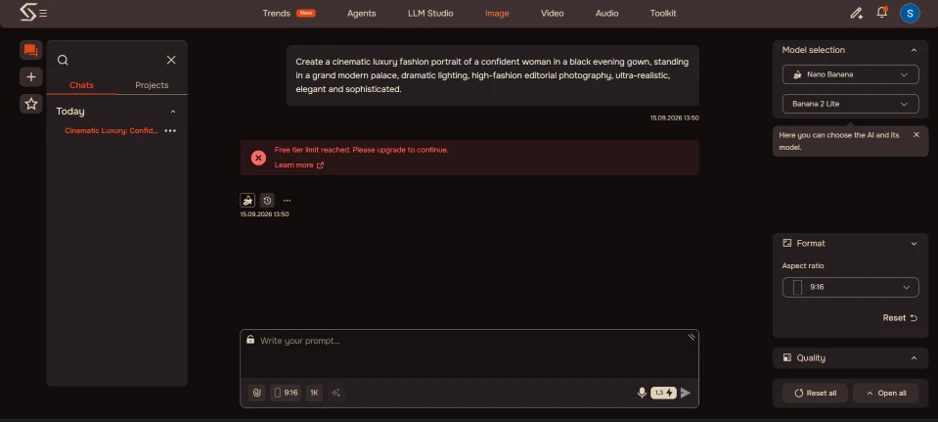
I opened the Image tab and picked Nano Banana, which SYNTX labels as Google's Gemini Flash 3.0 Banana. The default version was Banana 2 Lite. The interface accepts up to 14 reference images for Remix mode, and below the prompt box sit controls for aspect ratio and output resolution, which I left at 9:16 and 1K.
My prompt asked for a cinematic luxury fashion portrait of a woman in a black evening gown inside a grand modern palace, styled like a high-fashion editorial shoot. The counter beside the send button quoted 1.3 tokens for the job.
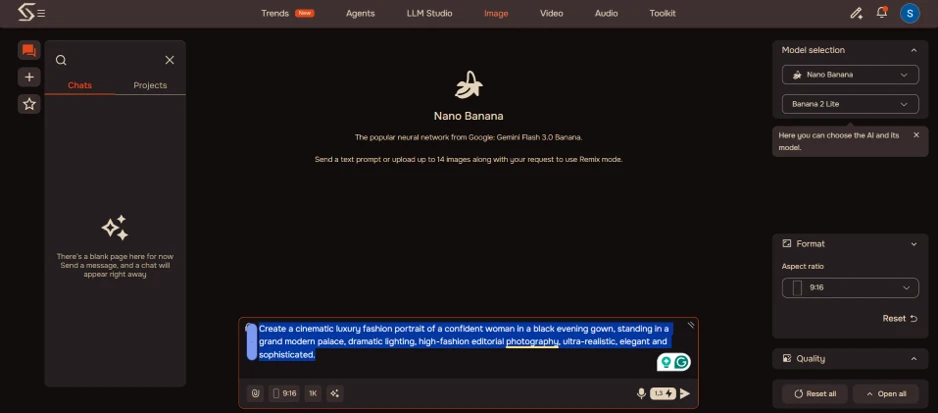
That figure matters. With 5 free tokens on a fresh account, a 1.3-token generation should have gone through with enough left over for two more attempts.
It did not. The request appeared in the chat history at 13:50, followed under the same timestamp by a red banner: Free tier limit reached. Please upgrade to continue. No image and no preview. The sidebar even saved the conversation under the title "Cinematic Luxury: Confid..." as if a result existed somewhere.
Test Two: A Video with Kling 3.0 Turbo
I moved to the Video tab hoping the image failure was a glitch. Kling was the featured model, with Text to Video selected and the version set to Kling 3.0 Turbo. The right-hand panel is split into four blocks: model selection, generation parameters, format and quality. I chose 16:9 at 720p for a 5 second clip and typed a prompt describing a luxury car morphing into a neon-lit supercar during a slow camera orbit.
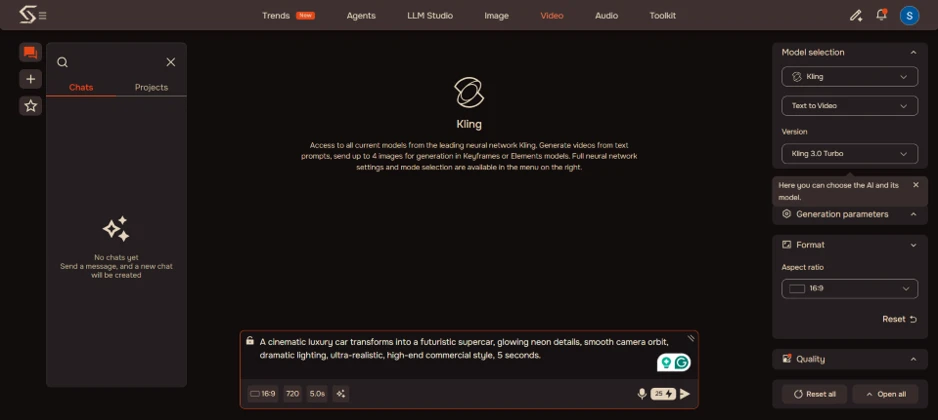
The cost readout said 25 tokens.
That single number told me the free tier was never built to let anyone sample video. Five free tokens against a 25 token minimum for one short Kling clip means the first thing a new user meets after pressing send is a subscription prompt. I pressed send anyway. The paywall arrived on cue.
The Paywall That Replaced My Results
The modal is titled "Subscribe to continue" and states that my free tokens have run out, which is a strange message for tokens I never got to spend. Five plans sit in a row: Basic, Pro, VIP, Elite, and Ultra Elite, with a 15 percent discount for annual billing. Pro was preselected at $17.96 per month for 680 tokens.
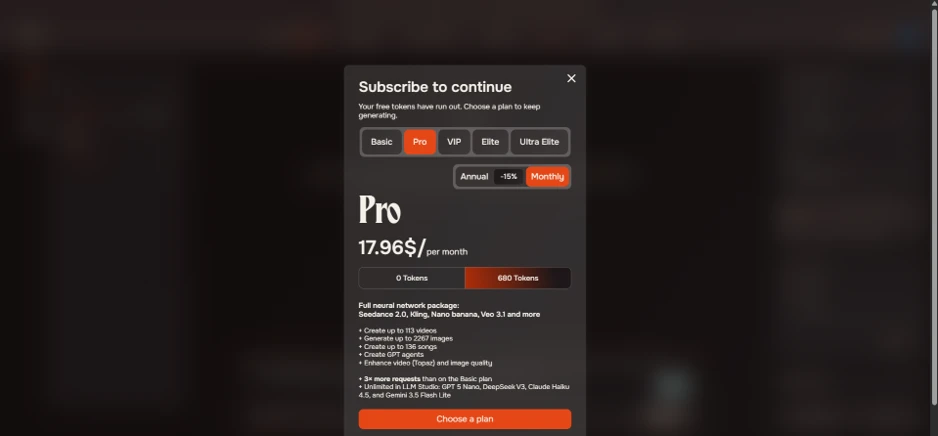
The Pro description lists what those 680 tokens supposedly cover: up to 113 videos, up to 2267 images, up to 136 songs, GPT agent creation and Topaz upscaling for video and images. It also promises three times the request volume of Basic and unlimited use of four smaller language models in LLM Studio: GPT 5 Nano, DeepSeek V3, Claude Haiku 4.5, and Gemini 3.5 Flash Lite.
I never watched a token balance drop, because I was never given a token balance to begin with.
Doing the Token Math
The numbers on that modal look generous until you hold them against the prices the tool itself quoted me. Kling 3.0 Turbo at 720p wanted 25 tokens for five seconds. Divide 680 by 25 and Pro buys about 27 clips a month, not 113. The 113 figure only adds up if every video comes from the cheapest model on the platform at its lowest settings.
Images fare better. Banana 2 Lite at 1.3 tokens gives roughly 520 generations from 680 tokens, which is still under a quarter of the advertised 2267. Switch to Nano Banana Pro or Midjourney and the per-image cost climbs, so the gap widens further.
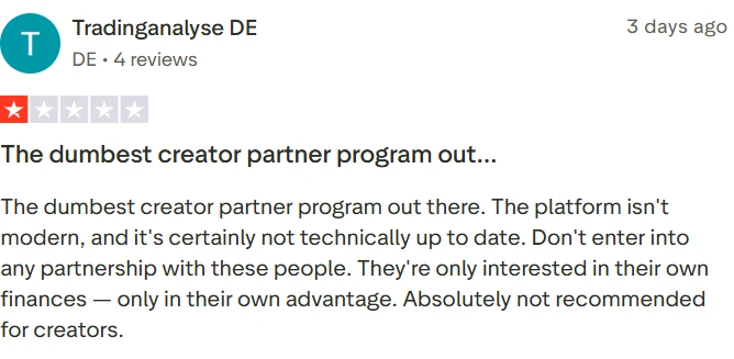
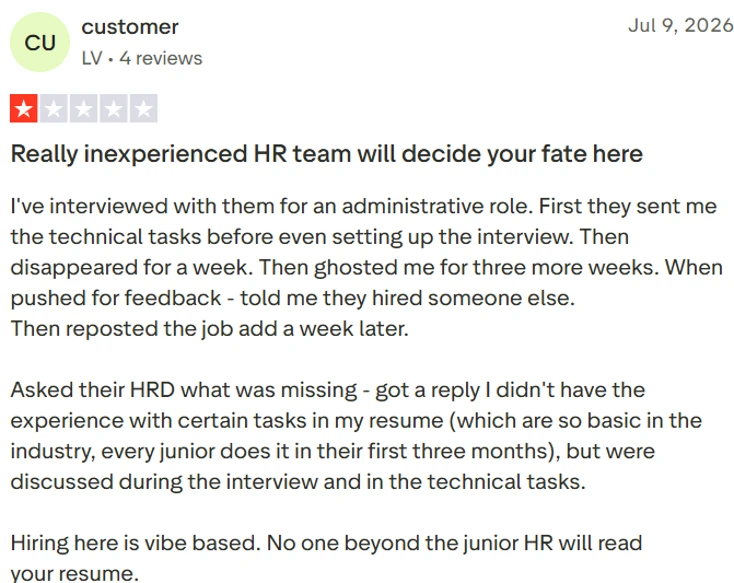
The larger issue is trust. A trial that rejects a 1.3 token request while advertising 5 free tokens is a paywall with a loading screen, and I was asked for $17.96 before the platform had returned a single file. Trustpilot carries a review posted four days before my test describing the identical sequence, so this is how the free tier behaves for new users rather than an outage I happened to catch. Until SYNTX fixes that, the only way to judge its output quality is to pay first, and every figure on the pricing screen needs to be recalculated against the token costs shown on the generation screens.