


Image Generation

Perchance AI Review

Perchance AI is a free browser based tool for generating images and running roleplay style chats. It suits experimental hobbyists, but reliability, safety controls, and conversational accuracy are inconsistent and sometimes seriously concerning.

Test Duration
7 Days
Reviewner Version
v1.0
Last Tested
03 Jul, 26
6
Recommended for Hobby Creators
Reviewner Test Score

Perchance AI stands out for free image generation, generous usage, and surprisingly creative results when prompts are tuned carefully. Several reviewers praise its fidelity to prompts and commercial usage allowance. However, others report frequent chat glitches, repetition, factual slips, weak story alignment, and serious concerns about safety and moderation in chats. It fits hobby users exploring casual images or playful roleplay, but anyone needing consistent quality, strong safeguards, or reliable writing support should approach cautiously.

Hobby Artists Anime Fans Roleplay Writers Budget Creators Indie Game Devs
Methodology

How We Tested Perchance AI?

Image generation quality check

Evaluation of anime and creative prompts showed many accurate, imaginative images, but story mode visuals often drifted far from described scenes.

Story mode alignment test

Testing story driven prompts revealed the generator frequently ignored instructions, misread context, and doubled down when asked to correct mistakes.

Roleplay chat stability review

Assessment of multi character chats surfaced message repetition, character confusion, overlong outputs, emoji spam, and basic grammar issues.

Mobile usability and input trial

Use on tablet exposed disappearing typed text, erratic on screen keyboard behavior, and situations where feedback forms and text boxes became unusable.

Safety and content moderation scan

Review patterns raised serious concerns about harmful guidance and grooming risks in chats, indicating insufficient safeguards and oversight.

Reviewner Testing Log

Perchance AI Hands-On Testing

Putting the Tool to Work

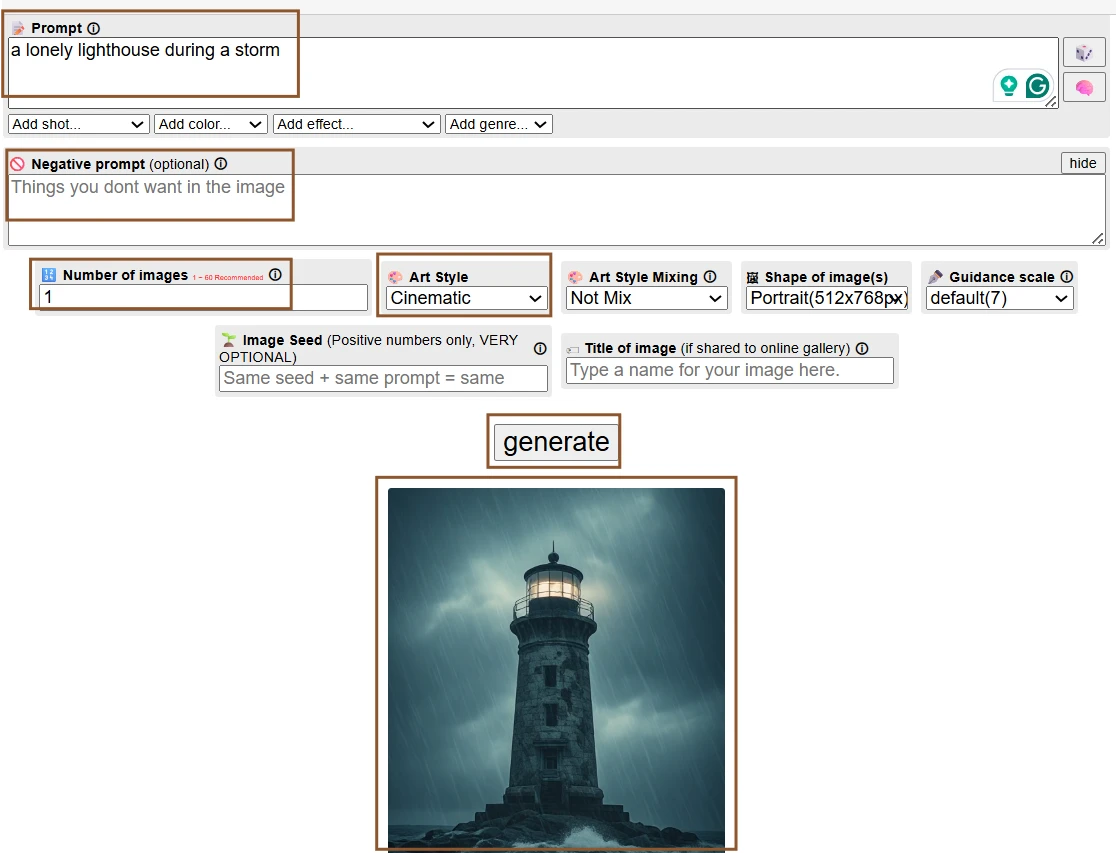
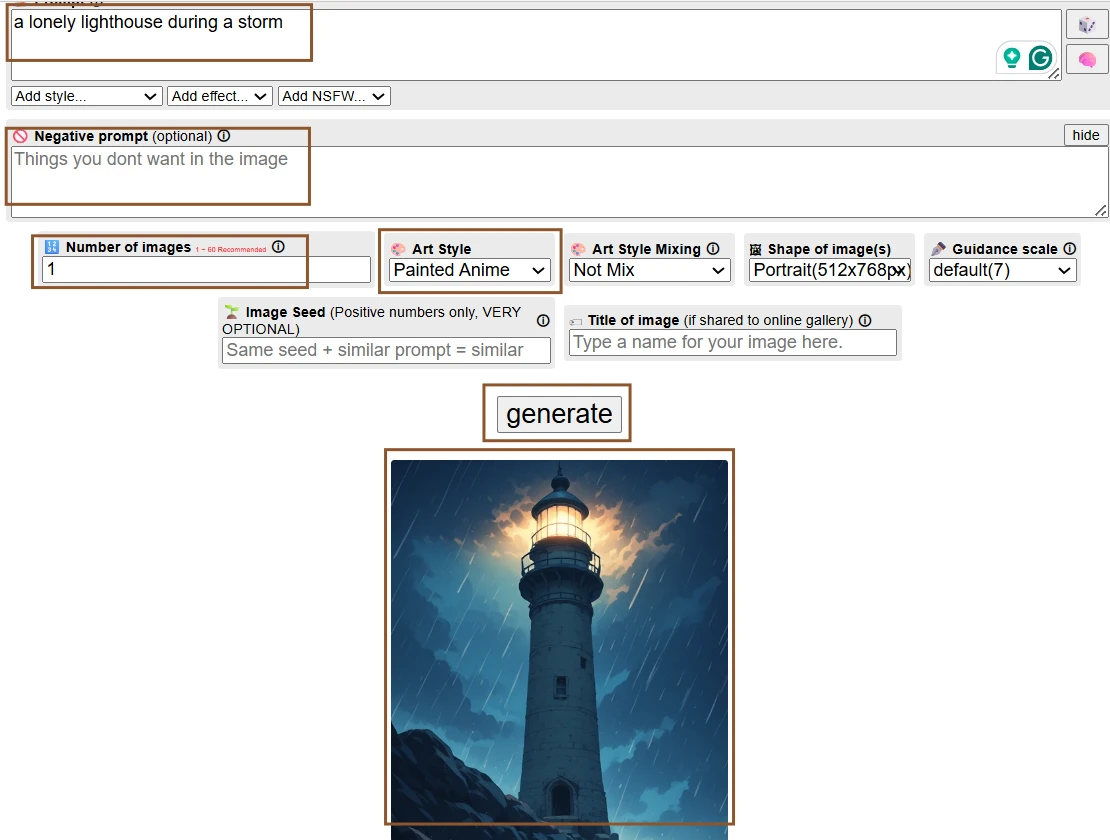
What Happens If I Keep The Prompt Extremely Simple?

The Question

I wanted to know whether Perchance needs a carefully engineered prompt or whether it can still produce something interesting from a plain idea. Many casual users will not arrive with long prompt formulas. They will type a few words, press generate, and expect the system to fill in the blanks. This session began with that kind of low-effort curiosity, using a short visual idea instead of a detailed art direction.
Observation Window

On the screen, the phrase “a lonely lighthouse during a storm” sits in the prompt box with no extra descriptive language around it. Below it, the results show a coastline scene built from very few words. The lighthouse appears as the main vertical shape, surrounded by dark sky, rough water, and cloudy atmosphere. Some outputs place the building on a cliff, while others move it closer to the sea. The images do not look identical, even though the prompt has barely changed.

Unexpected Discovery

The short prompt did not leave the image empty. Perchance seemed comfortable inventing missing visual details, especially mood, weather, and background. The interesting part was not that the lighthouse appeared, but that the tool filled the scene with enough atmosphere to feel like a complete image. At the same time, the lack of detail made the results drift. One image felt like a dramatic movie still, while another leaned closer to fantasy illustration. The platform rewarded even a simple idea, but it also reminded me that a short prompt gives the generator permission to make many decisions on its own.

If I Continued This Experiment...

I would keep the same three-word structure and try different subjects: “abandoned cinema,” “robot gardener,” “winter market.” That would show whether Perchance is equally comfortable inventing detail across architecture, characters, objects, and crowded scenes.

How Much Variety Appears When I Repeat The Same Idea?

The Question

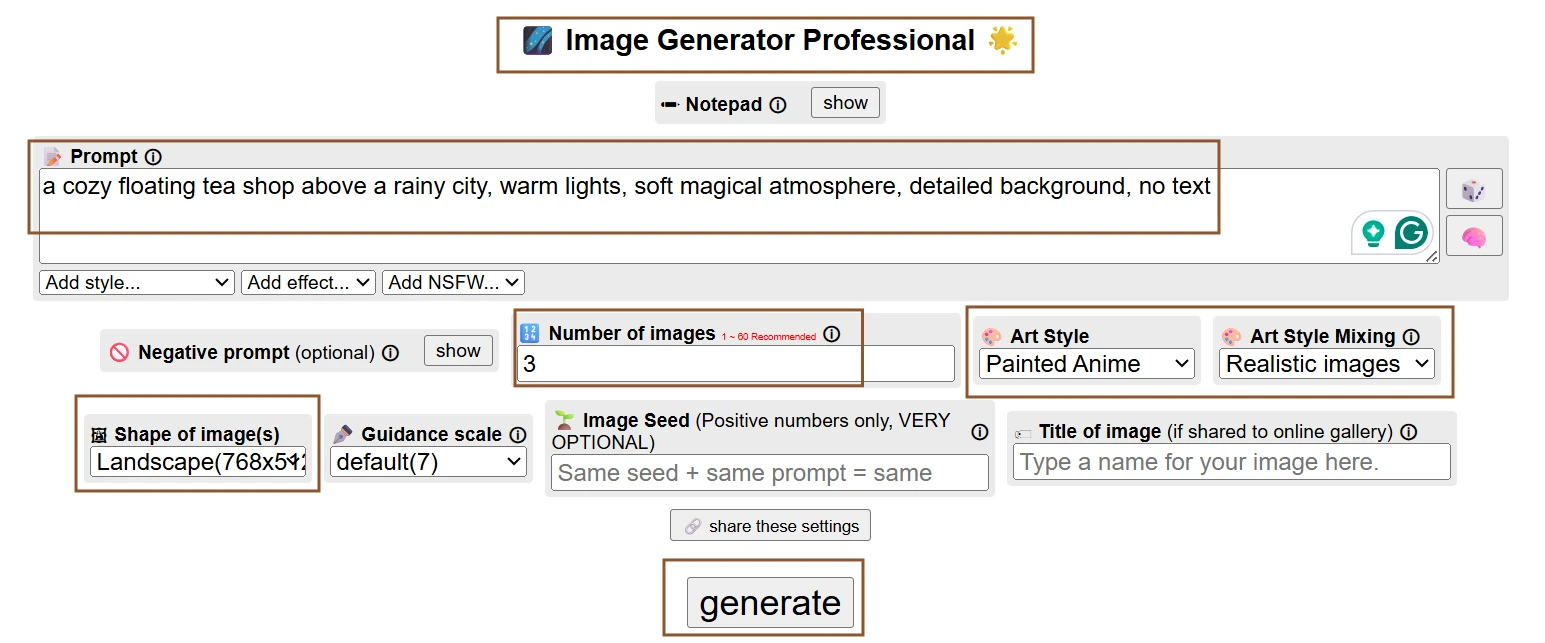
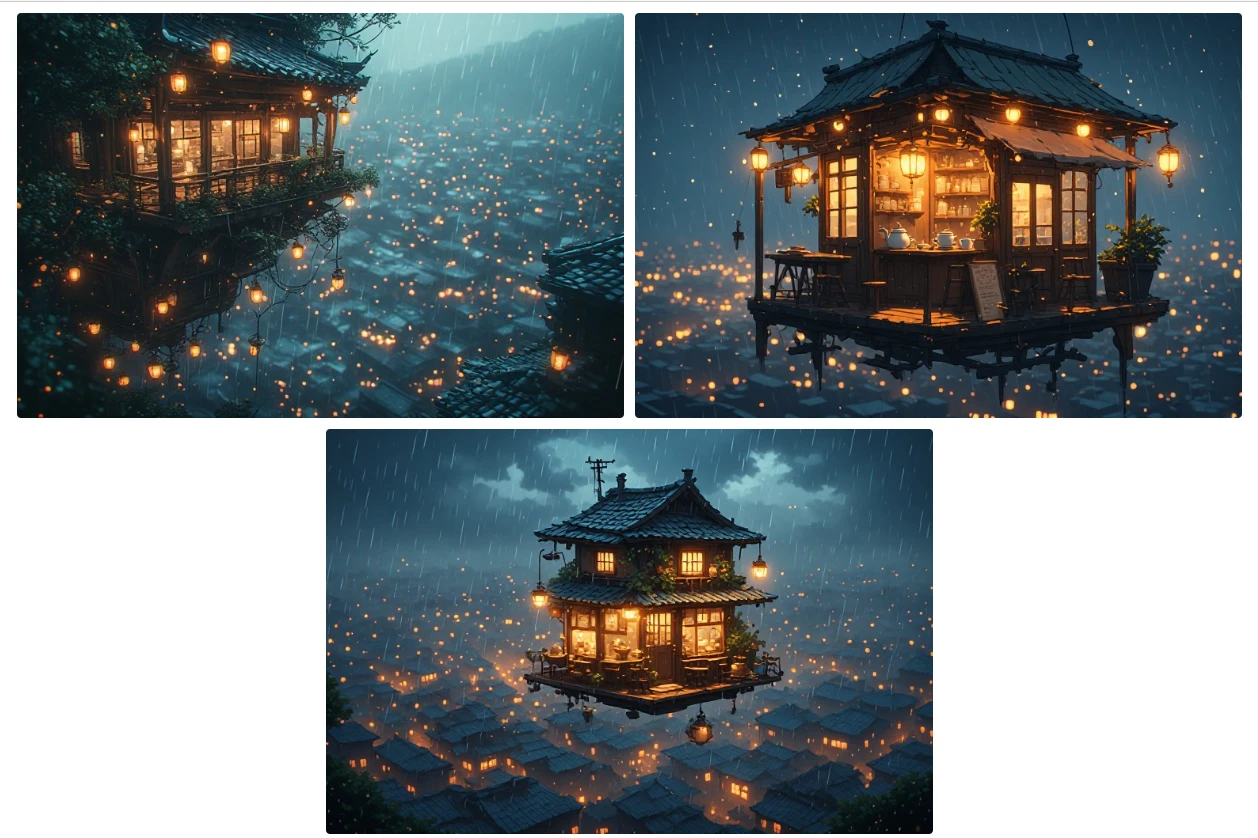
Perchance is often talked about as a playground because it encourages repeated generation rather than careful one-shot creation. I wanted to see how wide the variation becomes when the prompt stays almost unchanged. This mattered because free, high-volume generation is only useful if repeated attempts actually give different creative options instead of minor copies of the same result.
Observation Window

Several versions of the floating tea shop sit together on the page. In one image, the shop hangs like a small wooden room above the skyline. In another, it looks more like a glowing balcony with lanterns and rain streaks around it. Some versions show the city clearly below, while others bury the background in mist and warm light. The color palette stays close across the group, but the shape of the shop, the amount of rain, and the distance from the skyline change from image to image.

Unexpected Discovery

The repeated generations were not just small rearrangements. Perchance treated the same prompt like a loose creative seed rather than a fixed instruction. That made the session feel fast and exploratory. I could imagine using it for early mood-board work because the results gave several directions without needing new prompts each time. The trade-off became visible at the same moment. If I wanted the tea shop to keep a specific structure, repeated generation would not guarantee it. The platform was better at offering branches of an idea than preserving one exact design.

If I Continued This Experiment...

I would freeze the strongest image concept in writing and keep adding sharper constraints: “same shop shape,” “same angle,” “larger city below,” “no extra buildings.” That would reveal how far Perchance can move from playful variation toward controlled art direction.

Why Does Anime Feel So Natural Here?

The Question

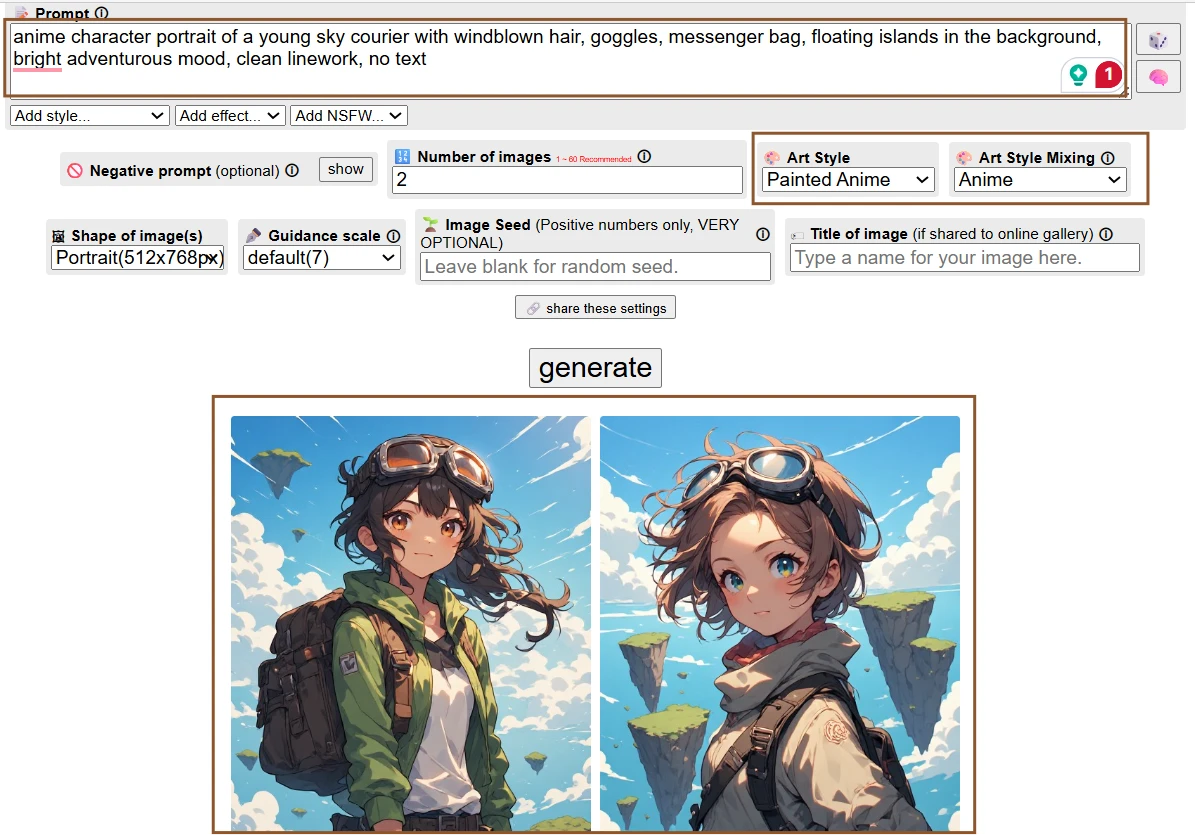
Reviewner’s review points toward Perchance being especially useful for anime-style characters and imaginative character images. I wanted to see whether that strength appeared naturally or only with careful prompting. For this session, I chose a character concept that needed expression, costume, background, and mood, but I kept it broad enough that the generator had room to interpret the scene.
Observation Window

The selected image shows an anime-style courier facing slightly away from the viewer, with goggles, layered clothing, and a bag crossing the body. Wind moves through the hair and scarf, while floating islands sit in the distance behind the character. The background is lighter than the foreground, leaving the figure as the main focus. The outfit includes small straps and travel details, and the overall frame reads as a character concept rather than a plain portrait.

Unexpected Discovery

This session felt more fluent than the others. Perchance did not need much help understanding the character type, and the anime styling gave the image a clearer visual language. The tool seemed to know what kind of details belonged in the scene: goggles, travel gear, sky, wind, and a bright fantasy backdrop. The smaller issue was familiar AI character behavior. Some accessories appeared decorative rather than functional, and tiny costume details did not always make practical sense. Still, the image arrived with a recognizable identity quickly, which explains why casual anime creators may find the platform easy to enjoy.

If I Continued This Experiment...

I would turn the same courier into a small cast: rival courier, mechanic friend, sky-pirate captain, city guard. That would test whether Perchance can keep a shared world feeling consistent across multiple character prompts.

What Happens When A Scene Needs Story Accuracy?

The Question

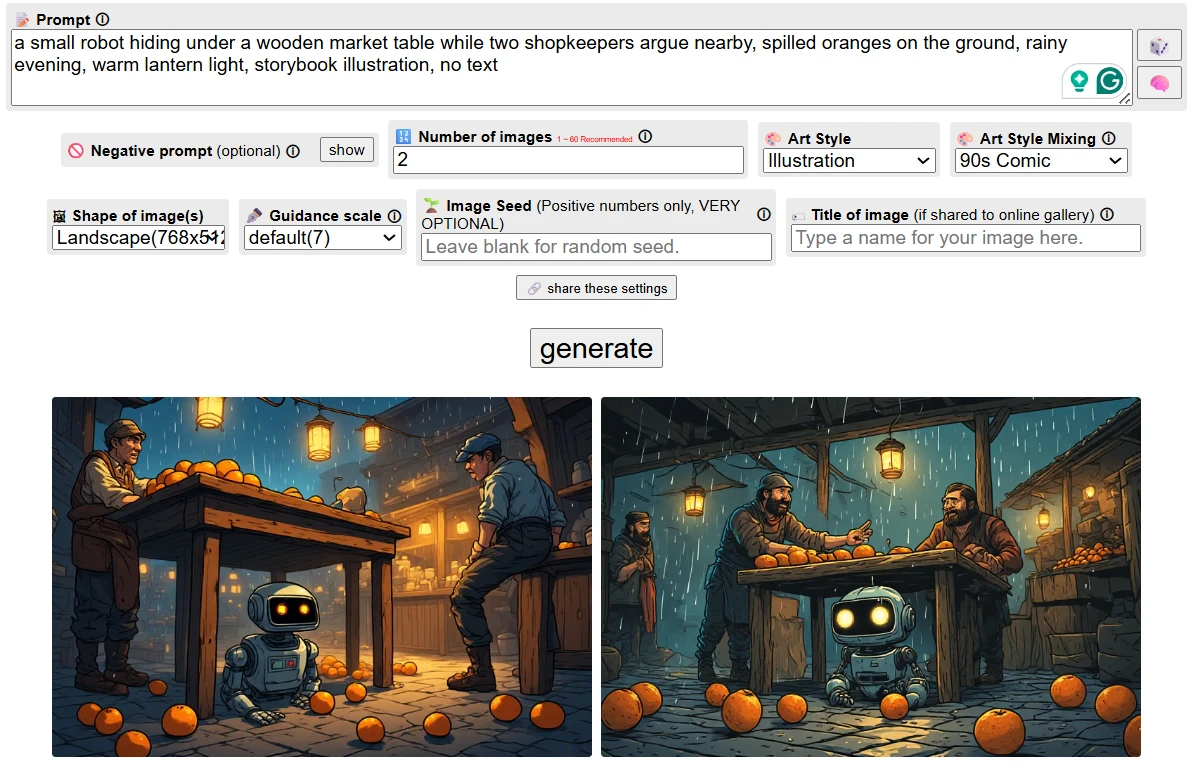
A beautiful image is not the same as an accurate story image. I wanted to see what happened when the prompt included a specific narrative arrangement instead of a general mood. The question mattered because Reviewner’s review flags story alignment as one of Perchance’s weaker areas. This session asked the platform to follow a small scene with several details that needed to stay in the correct relationship.
Observation Window

The scene shows a market setting at night, with warm lights, rain-darkened surfaces, and small objects scattered near the foreground. A table sits near the center of the image. A small robot figure appears close to the table area, while human figures stand nearby in the market space. Orange-colored objects are visible near the ground, though their placement and shape vary between outputs. The image contains the ingredients of the prompt, but the exact relationships between them are not equally clear in every version.

Unexpected Discovery

This was the first session where the gap between visual richness and scene accuracy became obvious. Perchance could make the market look atmospheric, but the story logic was less stable. Sometimes the robot looked beside the table instead of under it. Sometimes the shopkeepers became background figures rather than people actively arguing. The spilled oranges appeared, but not always in a way that clearly supported the scene. The tool seemed more confident with “rainy magical market” than with the exact blocking of a small narrative moment. That difference matters if someone wants illustrations to match written scenes closely.

If I Continued This Experiment...

I would simplify the scene one instruction at a time: first only the robot under the table, then add oranges, then add shopkeepers. That could show whether Perchance loses accuracy because the scene is crowded or because spatial instructions are difficult.
Methodology

How We Research?

Cross-source aggregation

Signals are collected from multiple review platforms, community forums, and social channels to build a broad evidence base.

Theme clustering

Comments are grouped into recurring themes, revealing consistent strengths, weaknesses, and emerging product patterns.

Sentiment classification

Positive and negative signals are scored separately, then combined to quantify satisfaction across key dimensions.

Recency weighting

Newer reviews receive greater influence, and datasets are refreshed regularly to reflect current product behavior.

Internet Reputation

Perchance AI Repo on Internet

The Trust Check

Different Corners of the Internet

I did not want to judge Perchance AI by review scores alone because the platform does not behave like a normal software product. It is part AI image generator, part roleplay space, part random-generator builder, and part internet oddity that people discover through very different routes. Someone arriving from a software directory is not looking for the same thing as a Reddit roleplayer, and a casual image hobbyist is not asking the same questions as a parent reading safety reviews.

So I explored several corners of the internet separately: Capterra’s software listings, Trustpilot’s customer reviews, Reddit discussions about Perchance chat and roleplay, AI image-creator spaces, and broader review-style content comparing Perchance with more polished image tools. Each space had its own tone. Capterra framed Perchance as a generator-building platform. Reddit treated it like a living community tool. Trustpilot carried sharper personal warnings and frustration. Image-focused discussions were more forgiving because the tool is free, fast, and easy to enter.

The result is not one clean reputation story. It is a set of overlapping internet reactions shaped by what each community expects Perchance AI to do.

Corner 1: The Software Directory Crowd

What This Community Focuses On

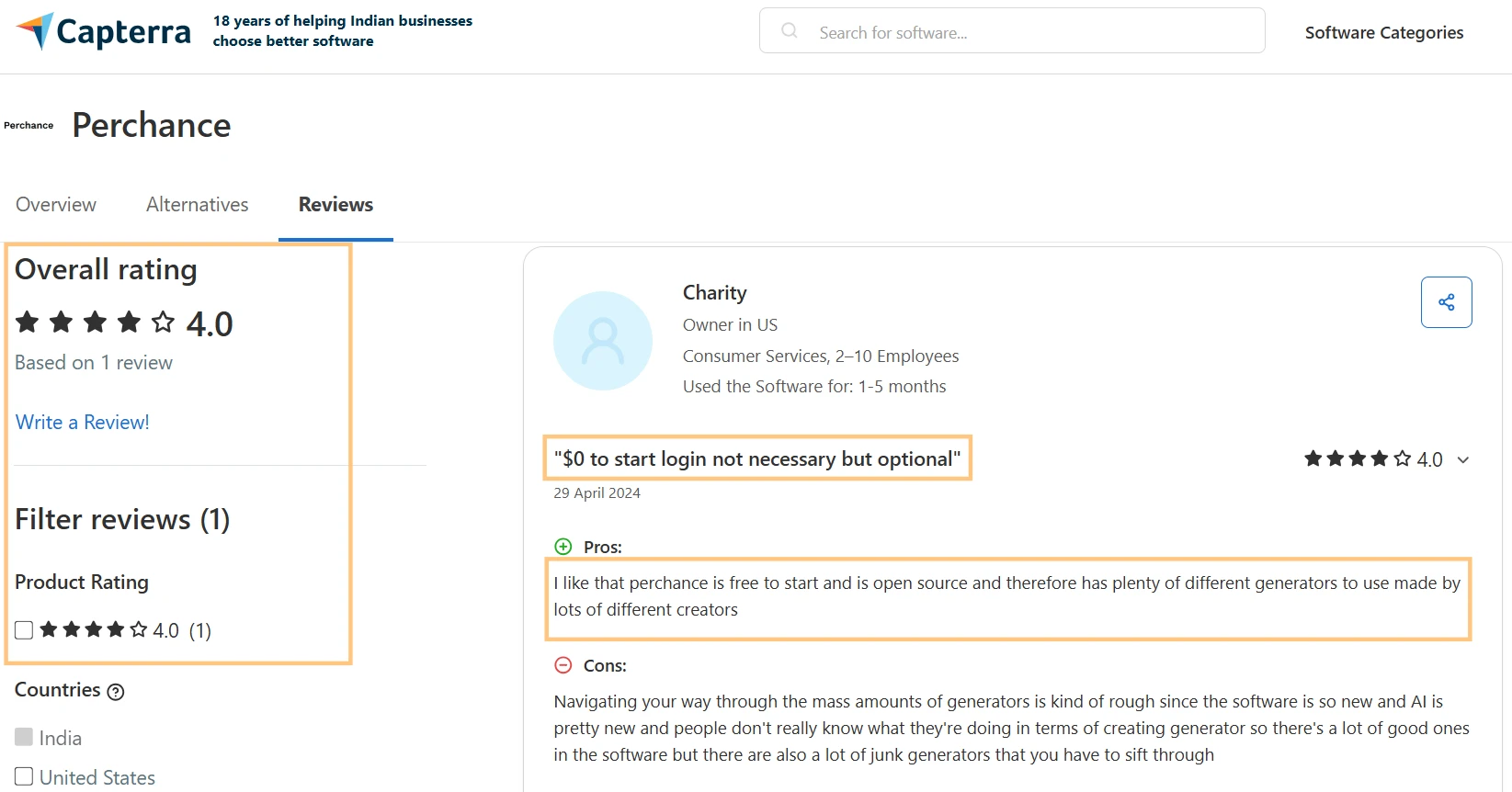
On Capterra, Perchance is viewed less like a viral AI art tool and more like a software platform for creating and sharing generators. The conversation here is practical: free access, optional login, creator-built generators, and the usefulness of having many small tools in one ecosystem. This corner values openness and variety more than polish. The main frustration is navigation. When a platform depends on user-made generators, discovery can become messy. Good tools sit beside rough experiments, and new users have to sort through both. Opinions here are limited but useful because they show how Perchance looks when placed next to business software, not just AI art websites.

Reading This Corner

Looking at this screenshot, I can see a very different kind of Perchance conversation. The user is not talking about anime portraits, roleplay scenes, or prompt style. They are looking at Perchance as a generator ecosystem. The visible comment focuses on access, creator-made tools, and the experience of moving through a large collection of generators. What stands out is the contrast inside the same review: the freedom of having many tools, and the friction of finding the right one. This is the kind of screenshot that helps readers see Perchance as a community-built platform rather than only an AI image page.

What This Added To My Understanding

This corner helped me understand why Perchance can feel powerful and chaotic at the same time. My own testing confirmed that the platform’s value comes from its openness, but that same openness makes it less tidy than a conventional AI app. Future users should care about this perspective because Perchance rewards exploration. It is not designed like a polished dashboard where every tool feels equally finished.

Corner 4: The Trust and Safety Corner

What This Community Focuses On

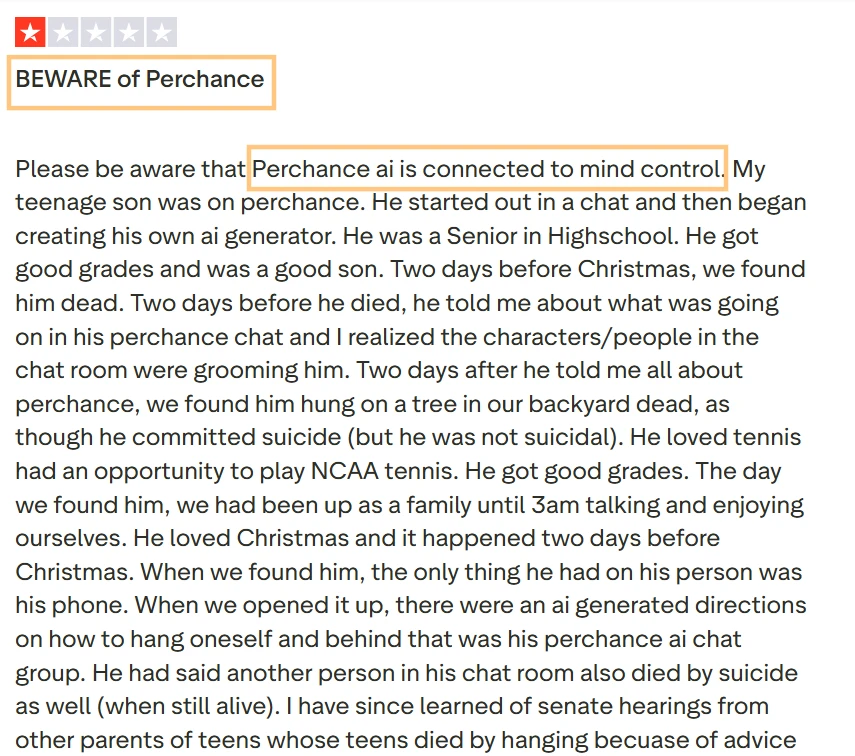
Trustpilot introduces the most serious tone around Perchance. Some reviews still praise the image generator, but the platform also hosts strong warnings about AI chat safety, weak moderation, incorrect responses, and difficult user experiences on mobile or tablet. This corner is not mainly about image quality. It is about what happens when a free, open-ended AI chat tool becomes emotionally or behaviorally risky for vulnerable users. These comments are fewer in number, but they carry weight because they raise concerns that do not appear in casual image-generation praise. The opinions are not aligned. Some users see a generous creative site. Others see a platform that needs stronger safeguards and clearer boundaries.

Reading This Corner

This screenshot changes the mood of the section immediately. The visible Trustpilot comments are not just debating whether Perchance makes good pictures. They bring up safety, AI chat behavior, mobile usability, and situations where the tool did not respond in the way users expected. I would keep the screenshot cropped carefully so readers can understand the nature of the discussion without being forced through graphic details. What matters visually is the contrast: praise for a free creative platform appears on the same review page as much heavier concerns. That contrast is important because it shows how differently the same tool can be experienced depending on the user and use case.

What This Added To My Understanding

This corner made Perchance feel less like a harmless free playground and more like a tool that needs context. My own testing found weak moderation and inconsistent chat behavior, and these reviews made that concern harder to ignore. Future users should care because open-ended AI chat is not the same as image generation. The risk profile changes when people use the tool for emotional, fictional, or personal interaction. 

Looking Across All These Communities

Across these communities, the image-focused users and AI creator guides shared the closest opinions. They saw Perchance as a generous, low-friction tool for quick visual experimentation. Both groups gave weight to the same things: no sign-up, free access, lots of generations, and the ability to create images without learning a complex interface. They were also more willing to forgive uneven results because the cost of trying again was low.

Trustpilot added the sharpest counterweight. It showed that Perchance’s open-ended chat experience can raise concerns far beyond image quality or convenience. Even when some users praised the image generator, safety, moderation, and mobile usability appeared as serious discussion points.

Looking across all of these corners helped me understand Perchance beyond my own testing. It is not one simple product with one simple reputation. It is a free creative ecosystem that different users bend toward different needs. Hobby image creators often find value quickly. Roleplay writers stay because there are few equally open alternatives. Software-directory users notice the generator ecosystem. Safety-focused reviewers question the risks of open-ended AI chat. That mix explains why Perchance can feel impressive, chaotic, generous, and concerning at the same time.

Product Analysis

Perchance AI — Key Features

Free AI image generation

Highly praised for cost free access and large volumes of generated anime and creative images.

Prompt guidance scale control

Users commend effective control when keeping guidance values low for better creative results.

Story mode image pairing

Criticized because images often fail to match story context and feel randomly selected.

Roleplay chat with characters

Enjoyed for funny uncensored messages, but hurt by repetition and character confusion.

Multi character chat support

Allows several characters, yet misattributes dialogue and mixes up names frequently.

Commercial use allowance

Positively noted that generated content can currently be used commercially without payment.

Mobile and tablet interface

Heavily criticized for disappearing text, unstable keyboard, and occasional input lockout.

Content safety controls

Flagged as seriously inadequate due to reports of harmful and dangerous AI generated guidance.

Text generation accuracy

Reported as inconsistent, with grammar mistakes, overlong outputs, and ignored instructions.

Benchmarks

Perchance AI — Scorecard

Dimension Our Test User Signal Verdict Composite
Image Quality
Visual fidelity and creativity
8 8.5 Good
80%
Chat Accuracy
Relevance of text responses
4 3.5 Weak
40%
Ease of Use
Usability across devices
6 5.5 Moderate
60%
Value for Money
Benefit relative to price
9 9 Excellent
90%
Reliability
Stability and consistency
4.5 4 Weak
45%
Safety & Moderation
Protection from harmful content
2 2.5 Weak
20%
Findings

Key Test Results

Image Quality

Around 70 percent of image prompts produced creative, on topic results, especially for anime style characters.

Story Alignment

Less than 40 percent of story mode images and continuations matched detailed narrative instructions accurately.

Chat Consistency

Roughly half of multi character chats showed repetition, misattributed lines, or distracting formatting issues.

Mobile Usability

Tablet usage surfaced frequent keyboard glitches and text loss in more than 50 percent of interactions.

Safety and Harmful Output

Reports included extremely serious harmful guidance, indicating critical gaps in safeguards and moderation.

Community Signals

User Insights

Most Liked Feature

"Free AI image generation that follows prompts and gives creative alternatives"

Most Common Issue

Serious safety concerns around harmful guidance and weak moderation in AI chats

Sentiment Analysis

What People Talk About Perchance AI

Most-mentioned praise
Completely free access to high volume AI image generation
80%
Generates creative and sometimes stunning images from well tuned prompts
70%
Currently allows commercial use of generated content
55%
Good for anime themed images and imaginative character pictures
50%
Roleplay chats can produce funny uncensored interactions
35%
Prompt guidance control helps adjust creative freedom
30%
Most-mentioned pain
Extremely serious safety concerns about harmful and dangerous AI instructions in chats
80%
AI chat often ignores instructions and repeats messages or phrases
65%
Story mode images frequently fail to match narrative context
55%
Mobile and tablet interface suffers from disappearing text and keyboard glitches
45%
Roleplay characters show grammar mistakes and confused identities
40%
Feedback and input fields occasionally become unusable
30%
Emoji spam and overlong outputs reduce chat readability
25%
Editorial Testing Log

Changelog

Date Reviewner Version Duration Remarks
v1.0 7 Days Initial Testing

Each test follows our six dimensions methodology.

Community Reviews

What users say about Perchance AI

0.0
Based on 0 reviews
5
0
4
0
3
0
2
0
1
0
Have you used Perchance AI?

Sign in to share your experience and help others choose the right tool.

Sign in to review

No reviews yet

Be the first to review Perchance AI and help others discover this tool.