
What I Loved, What I Hated, and the Verdict
What Poppy AI Promises
Poppy AI markets itself as “the #1 AI tool to make viral content while saving 100s of hours per month,” aimed at content creators, founders and marketers. The idea: feed it what already works in your niche, and it helps you find winning hooks, study top performers, and turn that into finished content that still sounds like you.
That is a big promise, so I signed up, ran through the whole experience, and boiled it down to the two things that actually matter — what there is to love, and what there is to hate.
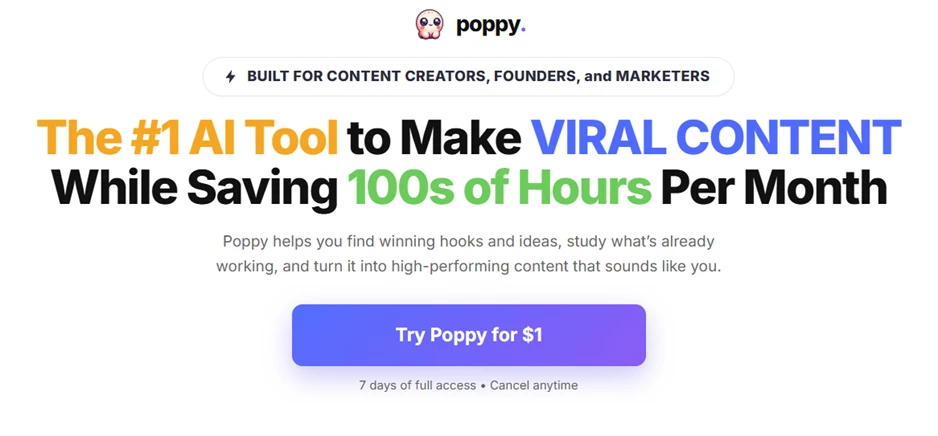
Poppy AI's landing page: a viral-content promise and a $1, 7-day trial.
Getting In: The $1 Trial and Sign-Up
Entry is deliberately frictionless. The homepage funnels you to one button — “Try Poppy for $1” with seven days of full access and cancel-anytime underneath. The sign-in screen keeps it simple: continue with Google, or use the email tied to your purchase, with a banner reminding trial buyers to log in with the same email they paid with.
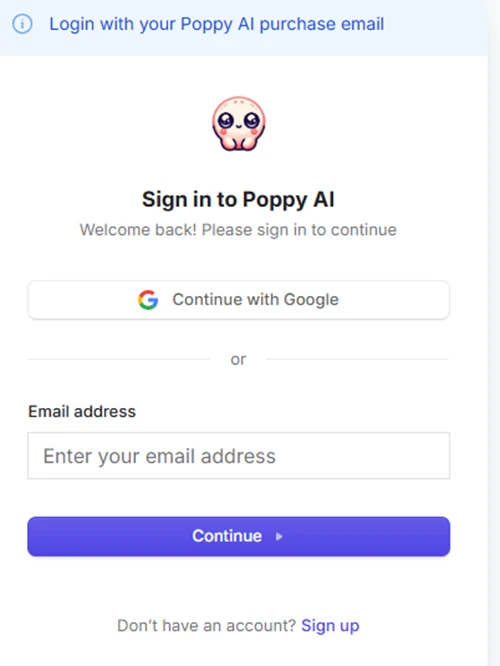
The sign-in screen: Google or email, with a reminder to use your purchase email.
First Run: The Onboarding Flow
Once you are in, Poppy runs a quick six-step setup framed as “Start My 7-Day Trial for JUST $1.” It is really a segmentation quiz. The first question asks what best describes you, creator, marketer/freelancer, agency owner, coach/consultant, founder/business owner, or other.
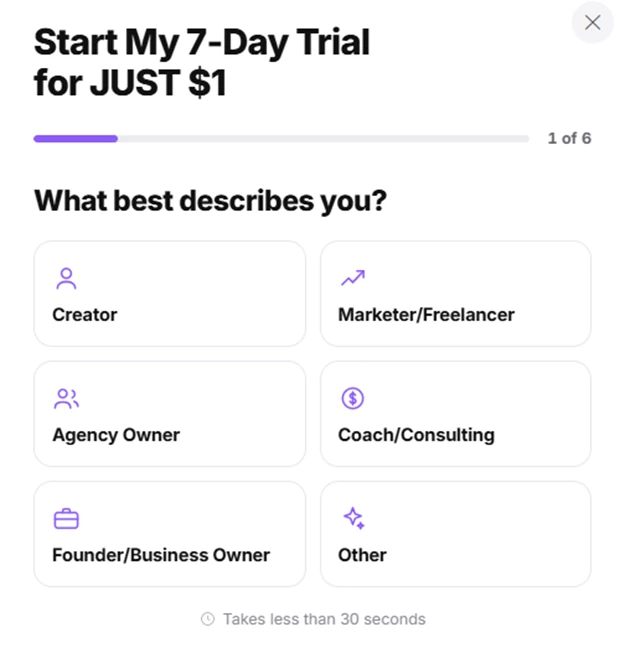
Onboarding step 1 of 6 — Poppy segments users by role.
The next screen asks what you create most: videos and scripts; ads, VSLs and copy; emails, posts and newsletters; or a bit of everything. Together these tailor your starting templates, which softens the blank-canvas problem before you begin.
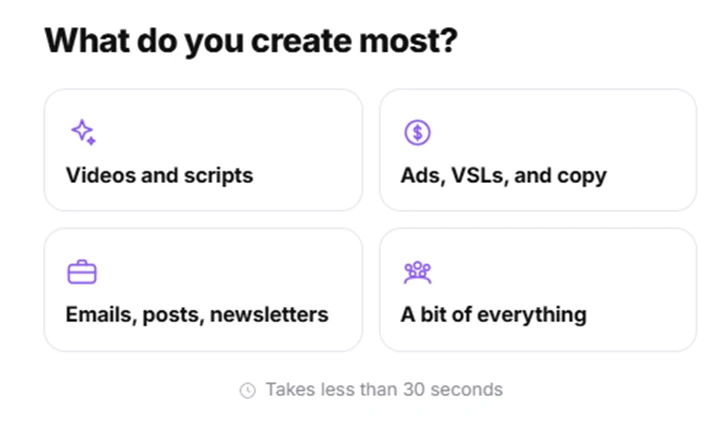
Onboarding continues — Poppy asks what type of content you produce most.
How It Actually Works
Strip away the marketing and Poppy is a visual, canvas-based AI workspace rather than a chatbot. You work on an infinite whiteboard, drop in sources — YouTube videos, transcripts, PDFs, docs, images, links — and branch ideas, hooks, outlines and drafts around them. It pulls from multiple leading AI models, shapes output toward your brand voice, and lets teams collaborate on the same board. Almost every action draws from a monthly credit balance that resets and does not roll over.
What I Loved
The visual canvas. Seeing an entire content strategy laid out spatially — with gaps and connections made obvious — genuinely changes how you work versus a linear chat thread.
Real time savings. Turning long content into structured summaries, outlines and drafts is fast, and the multimodal inputs cut out endless copy-pasting between transcripts, docs and your writing tool.
Multiple models, one roof. You are not locked into a single engine, so you can lean on whichever model suits the task.
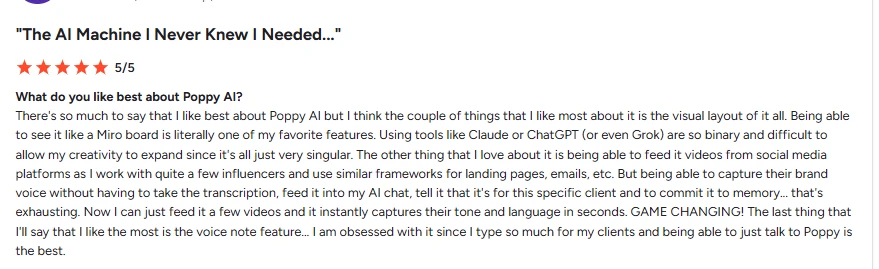
Standout onboarding and support. The setup is polished and conversion-smart, and reviewers repeatedly single out the human onboarding and support as unusually good for a tool at this price.
Team-friendly. One source can fan out into scripts, posts, emails and ads, and editors or teammates can work the same board together.
What I Hated
The credit system. Nearly everything costs credits, they reset monthly with no rollover, and heavy generation or re-running tasks can drain them faster than you expect.
Desktop-only. There is no mobile app, so quick edits on the go simply are not an option.
No built-in distribution. Content stays inside the platform, no scheduler, no publishing, so you still need a separate tool to actually post.
Opaque, shifting pricing. Poppy has moved toward a demo-gated model where the price is not always published and sources quote very different figures, which makes it hard to know what you will really pay.
A learning curve. The value lives in the project-and-canvas flow, so the first session or two feel like more moving parts than a plain chatbot, and vague prompts still produce generic output.
Who Will Love It, and Who Will Hate It
You will love it if you regularly turn long-form material into structured outputs, podcasts into summaries into outlines into drafts and you want one workspace that keeps everything connected. Creators and marketers juggling multiple platforms, and small content teams, get the most from it.
You will hate it if you only need the occasional one-off summary, you want to edit on mobile, or you dislike credit systems where heavy use forces an upgrade. For quick text generation alone, a standard chatbot is cheaper and faster.
The Verdict
Verdict: 3.8 / 5
A genuinely different, visual way to work with AI that pays off for consistent, high-volume creators held back by a credit system, desktop-only access and murky pricing. The $1 trial makes it low-risk to judge for yourself.
Strip away the “viral content” headline and Poppy is more interesting than it sounds: a spatial canvas for people who think visually, strong multimodal inputs, multiple models, and onboarding a cut above. The reservations are just as real, but the trial is cheap. Run one of your own real projects through it end to end, and within a week you will know whether the workflow fits how your brain actually works which, with Poppy, is the whole question.